

10 Weight Loss Resources Calculator Tools for 2026
The first step for many is selecting an unsuitable weight-loss calculator. A calorie estimate, an adaptive weight projection, a food tracker and a behaviour-change programme answer different questions, so their outputs aren't interchangeable. One may suggest a daily intake, another may show how a target could change over time, while a tracker tests whether your real meals match the plan.
The soundest approach remains a healthy diet plus exercise, with calculator results treated as estimates rather than promises. Ireland's official activity guidance gives adults measurable weekly targets, including 2 hours 30 minutes to 5 hours of moderate activity, or 1 hour 15 minutes to 2 hours 30 minutes of vigorous activity, alongside muscle-strengthening activity on at least two days each week. Shorter bouts can count when they last at least 10 minutes. Ireland's national physical activity guidance makes it easier to connect exercise time with a calculator output.
No calculator can guarantee weight loss. Results depend on adherence, diet, exercise and overall activity, so the useful question is whether the tool helps you make a better next decision.
This comparison ranks ten weight loss resources calculator tools by the decision they support: projecting change, setting calorie and macro targets, checking food intake and building sustainable habits. For each, consider the purpose, best user, data required, likely blind spots, privacy or access issues and the next practical step.
1. BionicGym
BionicGym is the most distinctive option here because it models exercise contribution rather than treating weight loss as a food-only calculation. Its Weight Loss Calculator lets users explore how diet-related calorie deficits and consistent BionicGym use may fit together. That distinction matters. Exercise can contribute to energy expenditure, but the device can't guarantee weight loss, because results still depend on diet and adherence.
BionicGym uses leg-wrap electrodes to deliver tuned electrical impulses that mimic shivering and target large, sugar-hungry muscle fibres. The intended experience is exercise on autopilot, with intensity controlled through the companion app. The company describes it as the only electrical stimulation device proven to deliver genuine, vigorous cardio exercise, and communications should show the practical signs of exertion, such as a rising heart rate, breathlessness and sweat, rather than relying on abstract claims.
The responsible performance benchmark is a typical vigorous level of about 500 calories per hour, not an exceptional maximum. BionicGym can be used during safe seated or household tasks, such as emailing, watching television or pottering around, but it shouldn't be used while driving, handling dangerous objects, climbing stairs or crossing roads.
Best use and limitations
Choose the Standard programme for sustained, gentler sessions, or PRO+HIIT for more intense intervals and conditioning. The app also supports intensity control, progress tracking and tutorials. The system may suit desk-bound users who struggle to make separate gym time, but gains are proportionate to use. A calculator projection becomes meaningful only when actual sessions are completed consistently.
BionicGym is an excellent form of exercise and a pillar of treatment for metabolic health. It is not a medical treatment. Consult your doctor if you have a serious condition.
Practical rule: Treat the calculator as a scenario tool. Pair its exercise estimate with a healthy diet, track your real weight trend and adjust the plan rather than chasing the largest projected deficit.
Pros
- Exercise contribution: It helps users model activity alongside diet instead of hiding exercise inside a vague activity multiplier.
- Low-impact format: Electrical stimulation can exercise the legs without loading or flexing the joints, although suitability varies.
- Flexible use: Safe multitasking can make longer, low-intensity sessions more realistic for people with crowded schedules.
- App-based feedback: Intensity and progress data provide a feedback loop rather than a single static number.
Cons
- Upfront commitment: The device requires regular use and an appropriate setup.
- Individual response: Sensation, tolerance and calorie expenditure differ between users.
- Medical boundaries: It isn't a treatment, and people with serious conditions or injuries need professional advice.
For the product, programme information and current purchasing details, visit BionicGym.
2. NIH and NIDDK Body Weight Planner
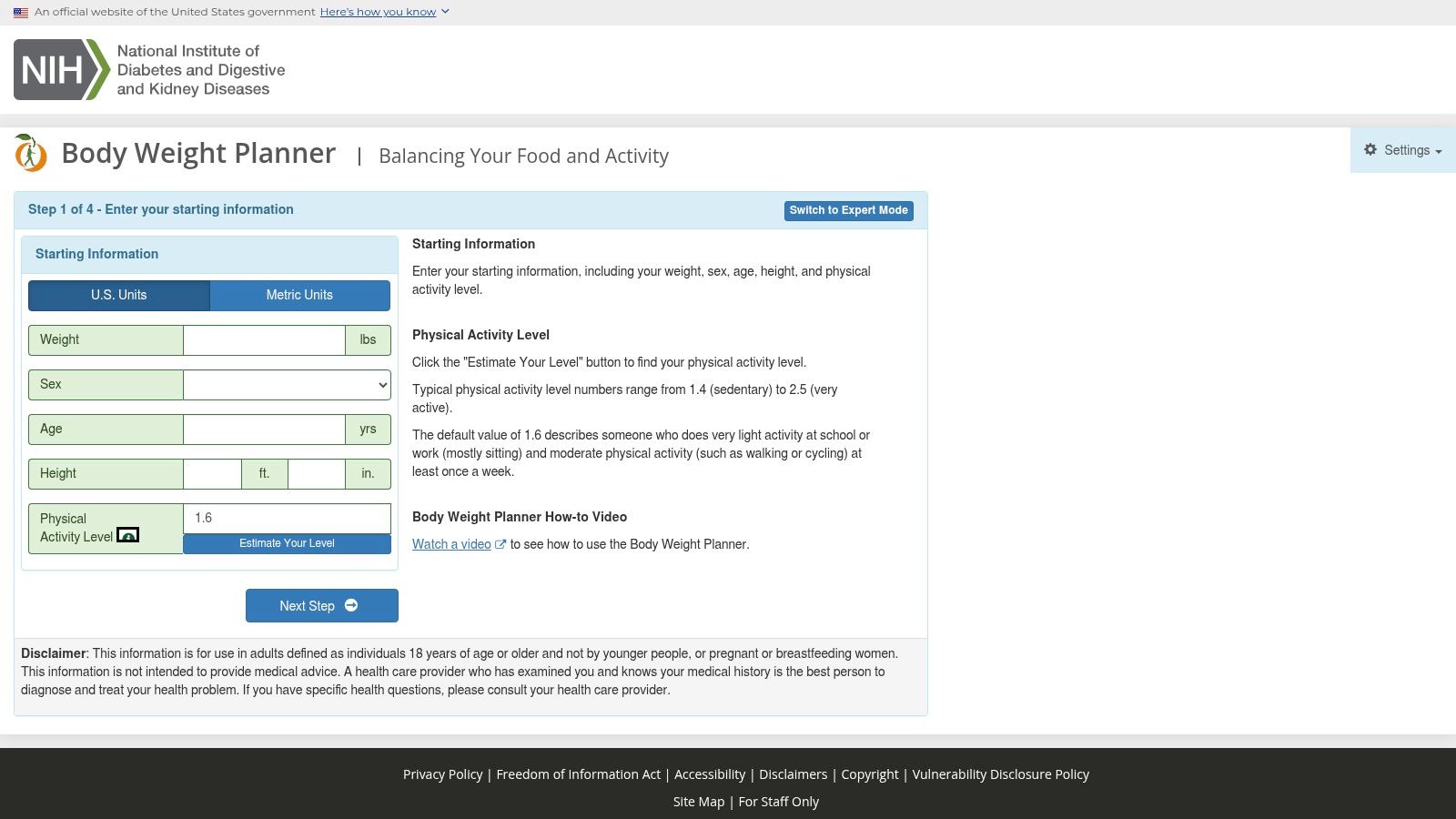
The NIH and NIDDK Body Weight Planner is the strongest choice when the question is, “What might happen over time if I change my food intake and activity?” It uses an adaptive physiological model rather than assuming that one fixed calorie deficit produces the same response indefinitely. That makes it more useful for planning than a basic calculator that converts calories into a straight-line forecast.
Users enter body and activity information, choose a weight goal and review projected calorie and activity targets for both losing and maintaining weight. The expert mode allows more detailed scenario testing, including projected curves and a date-based view of progress. It's free and ad-free, which makes it useful for readers who want a research-oriented planning tool without creating an account or receiving product prompts.
Where the estimate can mislead
The planner still depends on the information entered and assumes a level of consistency that real life rarely delivers. It doesn't log meals, verify portion sizes or know whether a planned activity session happened. Individual responses can also differ from the projection.
Use it first to establish a realistic direction, then pair the result with a food tracker and a weekly review. BionicGym's explanation of how a free weight-loss calculator works adds a useful exercise-focused perspective, particularly for users who want to include non-gym activity in their plan.
3. Safefood Healthy Weight for You
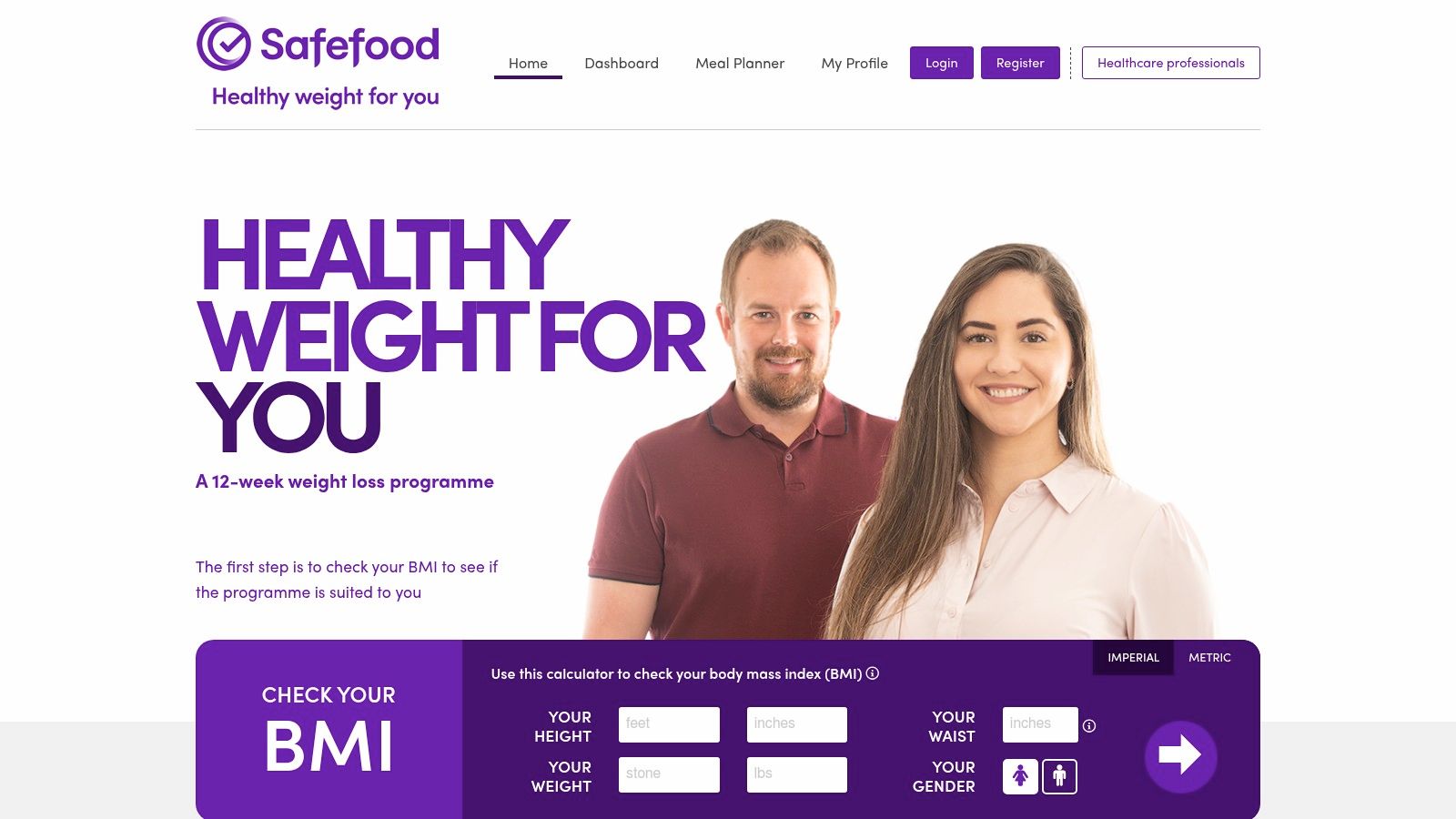
Safefood Healthy Weight for You is better understood as a structured behaviour-change resource than as a standalone calorie calculator. It combines an adult BMI checker with an online programme offering weekly guidance and meal ideas suited to food habits across the Republic of Ireland and Northern Ireland. That local context is its main advantage over generic international tools.
The programme is designed for people in the overweight BMI range of 25 to 30 kg/m², so users should check the eligibility guidance before assuming it applies to them. The resource also provides phone and email support for users in both jurisdictions, which gives it a practical human-support element that most calculator pages lack.
What it does and doesn't answer
Safefood can help someone decide what to do this week, such as following meal guidance or progressing through a programme step. It won't provide the adaptive weight timeline of the NIDDK planner, and its BMI checker isn't a detailed body-composition assessment. BMI can be a useful screening measure, but it isn't a direct measure of body fat or fitness.
For an Irish reader, this is a sensible starting point when the main barrier is structure rather than arithmetic. Use it to build habits, then use a separate calorie or food tracker only if more numerical control is helpful.
4. NHS Healthy Weight and Better Health Resources
The NHS BMI calculator sits within a wider set of public-health resources, including adult and child guidance, calorie-counting explanations, downloadable material and a free 12-week weight-loss plan. The tools are particularly useful when you need clear, medically reviewed information that can be shared with a GP, dietitian or family member.
The BMI tool provides advice after users enter the required information. Better Health materials then focus on practical behaviour change, including how to approach calorie counting and how to organise a longer programme. This makes the NHS resource more actionable than a calculator that displays a number and stops.
A useful public-health baseline
The limitation is familiar but important. BMI can misclassify some people because it doesn't directly measure body fat, muscle distribution or health behaviour. The calculator also doesn't function as an adaptive weight-change model or a detailed macro planner.
Irish readers may still find it valuable because HSE pages reference NHS material, while Ireland's own guidance emphasises regular activity and practical targets. Use the NHS plan when you need a straightforward routine, not when you need precise forecasting.
5. Precision Nutrition Macro and Calorie Calculator
The Precision Nutrition Macro and Calorie Calculator supports a different decision: how should daily calories and macronutrients be divided? It estimates targets for weight loss, maintenance or gain, then adds implementation guidance through a hand-portion system. That combination helps translate an abstract calorie target into meals without requiring every ingredient to be weighed.
Users can receive personalised calorie, protein, carbohydrate and fat targets, with optional detailed PDF material. The approach is useful for people who understand that a calorie deficit matters but don't want a plan built entirely around food logging. It also gives coaches and data-driven users a practical language for discussing portions.
Apply the result without overfitting
The calculator doesn't provide the adaptive timeline offered by the NIDDK planner, and detailed resources may require an email address. That's a privacy consideration, especially for users who only want a quick estimate.
Start with its target, choose repeatable meals and compare your actual progress over several weeks. BionicGym's guide to calorie calculations for weight loss can help readers separate the food target from the additional exercise contribution. The two shouldn't be merged into a promise of guaranteed loss.
6. ACE Fitness Tools and Calculators
The ACE Fitness tools and calculators are useful when weight management is only one part of a broader exercise plan. The collection includes a daily caloric-needs estimator, a physical-activity calorie counter, a BMI calculator and heart-rate zone tools. Rather than forcing every decision through one page, ACE lets users choose a tool that matches the immediate training question.
The physical-activity calculator can help compare exercise options, while the heart-rate tools add context for intensity. The daily calorie estimator is useful for a starting point, but it remains a static estimate rather than a model that updates as body weight and activity change.
Avoid false precision
ACE doesn't integrate food logging across the toolkit, and the interface differs between tools. That fragmentation isn't necessarily a flaw, but it means you'll need to record outputs somewhere else if you want a longer-term comparison.
Use the daily estimate to set a provisional intake, the activity counter to compare exercise choices and the heart-rate tool to keep intensity expectations realistic. For readers interested in how longer sessions may add up, BionicGym discusses cumulative calorie burn for weight loss. Any estimate still needs to be tested against real use and real progress.
7. Legion Athletics Calorie and Macro Calculator
The Legion Athletics calorie and macro calculator takes a deliberately conservative approach to activity and intake estimates. Its purpose is to reduce two common planning errors, overestimating calories burned and underestimating calories eaten. The accompanying articles explain the reasoning behind the targets, which is useful for users who want more than an unexplained result.
The tool also offers macro targets, step-by-step goal setup and related calculators such as steps-to-calories. That makes it practical for someone who wants to connect everyday movement with food decisions, rather than relying only on formal workouts.
Why conservative can feel uncomfortable
Some users may find the calorie outputs lower than those from other calculators. That doesn't automatically make them correct or incorrect. It highlights the uncertainty involved in estimating maintenance needs, especially when activity levels are hard to classify.
Use the result as a cautious starting hypothesis, not a permanent prescription. The brand-linked ecosystem also includes product and coaching offers, so readers should distinguish the educational calculator from any commercial upsell. If the initial target damages energy, training quality or adherence, reassess rather than treating a lower number as morally superior.
8. Cronometer
Cronometer is the strongest choice on this list for answering, “What did I eat?” It combines food logging with calorie and macronutrient targets, progress dashboards, barcode scanning and a detailed nutrient database. The platform also tracks 84+ nutrients, giving users a way to inspect micronutrient completeness rather than focusing only on calories.
That level of detail suits data-driven users, people following keto or low-carb approaches and anyone who wants to compare fasting routines with actual intake. It can also expose why a calculator target isn't working. A person may believe they are eating to plan, yet consistently miss oils, sauces, drinks or portion differences during logging.
Use tracking as an audit
Cronometer has a steeper learning curve than a simple food diary, and its planner doesn't provide an NIH-style adaptive weight-change timeline. It also requires careful entries. A database can improve consistency, but it can't correct a portion that was logged inaccurately.
A practical workflow is to set an initial target elsewhere, log normally for a period and compare the average intake with the intended range. BionicGym's overview of a weight-loss calculator app is relevant for users who want exercise tracking alongside food records. Keep the two streams separate enough to see what each contributes.
9. Calorie Control Council Food Calorie Calculator
The Calorie Control Council food calorie calculator is a lookup tool, not a complete weight-loss programme. It provides calorie and nutrient information for common foods, portions and brands, using USDA nutrient data. No login is required, so it works well when you need a quick answer while planning a meal.
Its value lies in speed. A separate calorie-needs calculator may tell you the daily target, but this resource helps you inspect the food choices that make up that target. It can also support rough comparisons between portions without forcing you into a full tracking system.
Keep its role narrow
The calculator doesn't create a personal timeline, set a complete diet plan or adjust for changing body weight. Its interface is basic, and its usefulness depends on finding a close match for the food and portion you're eating.
Pair it with a TDEE or macro calculator for planning, then use it selectively for meal decisions. That combination is less burdensome than logging every item, while still giving you more information than relying on memory.
10. TDEE.co TDEE, BMR and Macro Calculator
TDEE.co is designed for quick scenario testing. It brings together total daily energy expenditure, basal metabolic rate, BMI, body-fat estimates and macro calculations, with explanations of the formulas and activity multipliers used. Medical review notes and last-reviewed dates add transparency, although they don't remove the uncertainty inherent in any estimate.
The tool can generate daily calorie targets, suggested deficits and macro splits. Its clean presentation makes it useful when you want to compare different activity assumptions without navigating a large educational programme.
Treat formulas as starting points
TDEE.co isn't an adaptive weight-change model like the NIDDK planner. It also includes body-fat estimates that can look precise despite depending heavily on the input method and formula.
Use it to test scenarios, write down the selected assumptions and compare the result with your real trend. For readers who want more context on resting energy needs, BionicGym's basal metabolic rate calculator guide provides a related explanation. Don't let a clean interface turn an estimate into a guarantee.
Top 10 Weight-Loss Calculator Comparison
| Product | Core features | UX / Quality (★) | Price & Value (💰) | Target Audience & USP (👥 ✨) |
|---|---|---|---|---|
| BionicGym 🏆, FDA-cleared Type II device. Not a medical treatment; consult your doctor if you have a serious condition. | Wearable leg-wrap EMS + app; Standard & PRO+HIIT; Weight‑Loss Calculator; 20+ yrs peer‑reviewed research; sugar‑hungry form of exercise | ★ 4.8/5 (600+ reviews); evidence-backed app tracking | 💰 $749 unit; accessories; HSA/FSA eligible; trained users typically 500+ kcal/hr | 👥 Desk-workers, gamers, rehab-adjacent, Keto/Low‑Carb & fasting fans; ✨ only EMS proven to deliver vigorous cardio & VO2max improvements |
| NIH / NIDDK Body Weight Planner | Adaptive physiological model; custom calorie & activity targets; expert mode; timeline projections | ★ Research-grade, widely used; utilitarian UI | 💰 Free, ad-free | 👥 Clinicians & planners; ✨ predictive weight-change timeline accounting for metabolic adaptation |
| Safefood, Healthy weight for you | BMI checker; structured weekly programme for RoI/NI; local meal ideas; phone/email support | ★ Public-health resource; practical weekly guidance | 💰 Free (public sector) | 👥 Adults BMI 25–30 in RoI/NI; ✨ culturally‑tailored plans & phone support |
| NHS Healthy Weight / Better Health | BMI calculators; calorie-counting how-tos; free 12-week weight-loss plan; shareable guides | ★ Authoritative, medically reviewed | 💰 Free | 👥 UK users & clinicians; ✨ 12-week plan + clinician-friendly materials |
| Precision Nutrition, Macro & Calorie Calculator | Personalized calorie & macro targets; hand-portion system; optional detailed PDF | ★ Evidence-informed; coach-backed | 💰 Free tool (PDF via email); paid coaching upsells | 👥 Coaches & learners; ✨ practical macro→portion implementation |
| ACE Fitness, Tools & Calculators | TDEE/Calorie needs, activity burn, BMI, heart-rate zones, other health tools | ★ Broad, fitness-centric toolkit backed by ACE | 💰 Free | 👥 Fitness pros & exercisers; ✨ consolidated fitness calculators |
| Legion Athletics, Calorie & Macro Calculator | Conservative calorie & macro targets; steps-to-calories; extensive explanatory articles | ★ Conservative, evidence-focused approach | 💰 Free tools; product/coaching upsells | 👥 Users preferring cautious deficits; ✨ conservative defaults to avoid aggressive cuts |
| Cronometer | Robust food DB + barcode scan; macro + 84+ micronutrient tracking; dashboards | ★ High-accuracy logging; dietitian-favored | 💰 Freemium (paid Pro features) | 👥 Data-driven users & clinicians; ✨ granular micronutrient monitoring |
| Calorie Control Council, Food Calorie Calculator | USDA-based calorie & nutrient lookup for foods/brands; no login required | ★ Fast, lightweight lookup tool | 💰 Free | 👥 Meal planners & casual users; ✨ quick USDA-backed lookups |
| TDEE.co, TDEE, BMR & Macro Calculator | TDEE/BMR/BMI/body-fat estimates; multiple formula options; formula transparency | ★ Clean UI; medically reviewed notes | 💰 Free | 👥 Scenario testers & learners; ✨ transparent formula choices and explanations |
Build a Feedback Loop, Not a Single Number
A useful calculator workflow has four stages. Start with the NIH Body Weight Planner to build a realistic projection that accounts for changing body weight and activity. Then choose a calorie or macro calculator, such as Precision Nutrition, Legion Athletics or TDEE.co, to establish an initial target. The target is a hypothesis about your needs, not a verdict.
Next, compare that target with actual intake. Cronometer offers the most detailed audit in this list, while the Calorie Control Council tool is better for quick food lookups without creating an account. If detailed logging makes you abandon the plan, a simpler approach may produce better results because a workable routine beats a perfect one you won't follow.
Public-health resources add a different kind of value. Safefood provides local meal guidance and structured weekly support for eligible users in Ireland and Northern Ireland. NHS Healthy Weight and Better Health materials offer clear public guidance, calorie-counting help and a longer programme that can be shared with healthcare professionals.
Ireland's activity framework gives the feedback loop a measurable exercise component. Adults are advised to accumulate weekly moderate or vigorous activity and include muscle-strengthening work on at least two days, with shorter bouts counting when they last at least 10 minutes. The Irish guidance therefore supports recording exercise minutes rather than assuming that a vague “active” setting reflects reality.
BionicGym's Weight Loss Calculator is useful at this point because it isolates a potential exercise contribution. It can help users explore how consistent sessions may sit alongside a healthy diet and other activity, including safe seated or household use. The device is an excellent form of exercise, but it can't guarantee weight loss. Results depend on how consistently it's used, what a person eats and how the rest of their activity changes.
The same caution applies to users managing a medical condition or recovering from an injury.
Anybody with a serious medical condition or injury should consult with their medical practitioner before starting any new exercise program.
BionicGym is a great way to exercise. It is not a medical treatment. Consult your doctor if you have a serious condition.
Review the plan over time instead of reacting to daily fluctuations. Compare logged intake, completed activity, hunger, energy and the broader weight trend, then change one variable at a time. For product information, app-guided programmes and safe-use guidance, visit the BionicGym website.
For any title-header imagery, use only actual BionicGym product imagery from bionicgym.com. Avoid competitor products and unsafe scenes, including driving, stairs, roads, heavy machinery or hazardous household tasks. If an image shows vigorous use, it should visibly match the claimed effort through signs such as sweating, a reddened face or breathlessness.
Use BionicGym's app-guided wearable cardio system and its Weight Loss Calculator to model how exercise may fit alongside a healthy diet and your existing routine. Visit BionicGym to explore the system, programmes and support resources, then choose a level of use you can sustain and measure in real life.