

Weight Loss Calculator Calories: What the Numbers Actually
You've entered your age, height, weight and activity level into a weight loss calculator, then watched a daily calorie target appear. It looks precise enough to organise your entire week around, yet the number doesn't explain what to do when hunger rises, activity changes or your weight refuses to follow the forecast.
That's the problem with treating weight loss calculator calories as a verdict. The output is better understood as a working estimate, one you compare with real intake, movement and weight trends. Irish guidance supports a modest deficit and sustainable progress, not an increasingly severe food restriction, so the useful question isn't “What's the lowest number I can tolerate?” It's “What does this estimate tell me, and how should I refine it?”
Staring at a Calculator Number and Wondering What It Means
At the kitchen table, you type in your details and see a figure such as 1,940 kcal. You scroll down, looking for the smallest target because smaller appears faster. A few days later, hunger is distracting, meals feel awkward to plan and the scales haven't delivered the result you expected.
That sequence is common because calculators present an estimate with the visual confidence of a measurement. The number combines a population-based equation with your reported body details and an activity category. It can't directly observe your sleep, stress, muscle mass, digestion, spontaneous movement or whether cooking oil and weekend portions made it into your food log.
Treat the output as a hypothesis
A calculator can suggest a starting maintenance level, then apply a deficit. It can't know whether “moderately active” means structured training, a physical job, or mostly sitting with occasional walks. Two people with matching height, weight and age can still respond differently because their body composition, routines and actual expenditure aren't identical.
Irish adults are already familiar with the basic message. Thirty-eight per cent reported trying to lose weight in Healthy Ireland 2024, compared with 34% in 2022, while 63% said eating fewer calories was their main strategy, according to the Healthy Ireland Survey 2024 summary report. A static number alone doesn't answer the harder questions: why progress stalls, how activity changes the target, or how to distinguish a poor estimate from inconsistent adherence.
Practical rule: Use the first result as a figure to test for two to four weeks, not a permanent prescription.
Your job is to compare the estimate with an average intake and an average weight trend. If the pattern doesn't match the projection, adjust the model or the behaviour. The number should move when your circumstances change.
How Calculators Estimate Your Maintenance Calories
Most calorie calculators work in two stages. First, they estimate basal metabolic rate, or BMR, the energy your body uses at rest for essential functions. Then they multiply that estimate by an activity factor to approximate total daily energy expenditure, or TDEE.
Step one, estimate resting energy
The Mifflin-St Jeor equation uses details such as weight, height, age and sex to estimate BMR. For a worked illustration, consider a 35-year-old person weighing 80 kg whose BMR is estimated at about 1,700 kcal per day. That figure doesn't represent a normal day of eating. It represents estimated resting needs before ordinary movement and exercise are added.
Step two, account for movement
The calculator then applies an activity multiplier. A sedentary classification may use 1.2, while a very active classification may reach 1.9. If the example person uses a light-active multiplier of 1.5, the calculation is approximately:
1,700 × 1.5 = 2,550 kcal per day
That 2,550 kcal is an estimated maintenance level, not a guaranteed allowance. The activity multiplier is usually the least reliable input because people tend to overestimate exercise and underestimate sitting, commuting and recovery time.
| Activity label | Multiplier | Lifestyle cue |
|---|---|---|
| Sedentary | 1.2 | Mostly seated, little planned exercise |
| Lightly active | 1.375 | Some regular walking or exercise |
| Light active example | 1.5 | Regular movement with additional activity |
| Moderately active | 1.55 | Purposeful exercise on several days |
| Very active | 1.725 | Frequent hard exercise or a physical routine |
| Extremely active | 1.9 | Very demanding exercise and lifestyle |
For a plain-language explanation of the same calculation, see BionicGym's guide to total daily energy expenditure. The useful takeaway is simple: the calculator estimates what you burn, then subtracts a planned amount. If your activity category is wrong, every later number is shifted.
What a 500 kcal Deficit Looks Like in Real Life
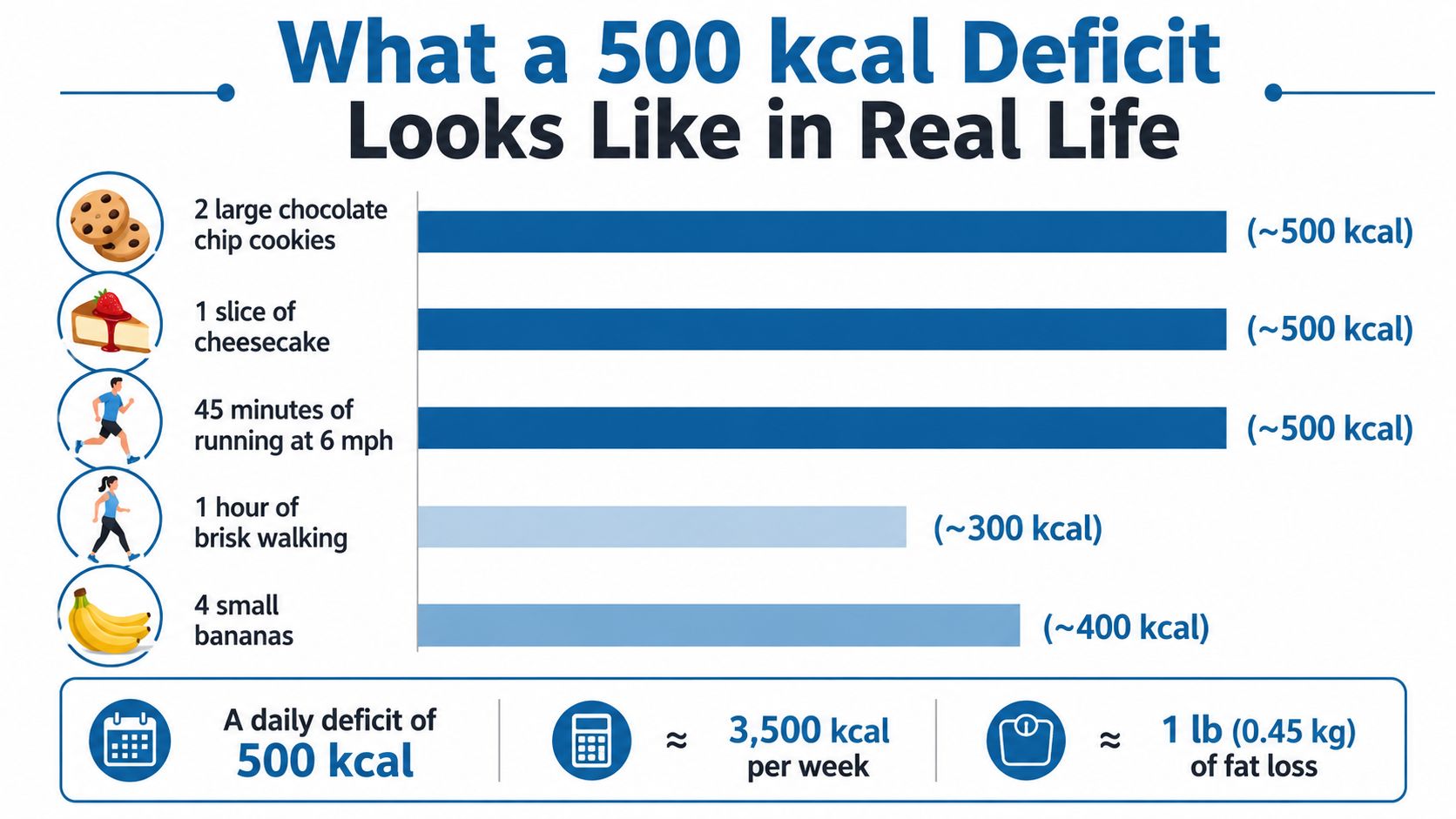
You follow the calculator's target, yet the scale barely changes. The first question is whether the target represents a real, sustained gap between energy consumed and energy used. A planned deficit of roughly 500 kcal per day equals about 3,500 kcal across a week, commonly treated as approximately 0.45 kg, or 1 lb, of fat loss. Actual results vary because adherence, water balance and changing energy needs disrupt the arithmetic.
That gap could come from a large latte and two slices of bread, a takeaway doughnut or a generous glass of wine. You do not need to ban one food. Smaller portions, fewer energy-dense extras, more movement, or a combination can produce the same mathematical difference.
The calculator's result is a starting estimate, more like a weather forecast than a fixed contract. Over a year, the simple arithmetic suggests about 22 kg of theoretical loss, but appetite, missed targets and lower energy expenditure as body weight falls can reduce the outcome. Irish HSE guidance recommends first preventing further gain, then aiming for a 5–10% reduction in original body weight, with a maximum weekly loss of 0.5–1 kg, as described in the HSE weight-management guidance.
A calorie deficit guide for sustainable weight loss with Trim can help turn the maths into food and activity choices. BionicGym's calorie deficit explanation for weight loss is relevant if an exercise device used while sitting could contribute to the movement side of the calculation. Recheck the estimate against several weeks of consistent intake and weight trends, then adjust carefully rather than treating the first number as permanent.
How Exercise Intensity Changes the Daily Target
Intensity changes how much energy an activity uses in a given period. Irish activity guidance places moderate activity around 3–6 METs and vigorous activity at 6 METs or more, where one MET represents the energy cost of resting, according to the Irish national physical-activity guidelines.
Consider someone with a BMR of 1,600 kcal:
- At a sedentary multiplier of 1.2, estimated TDEE is 1,920 kcal.
- At a moderately active multiplier of 1.55, estimated TDEE is 2,480 kcal.
- The difference is 560 kcal per day.
That difference can change the recommended food target dramatically. A person who performs vigorous exercise may create more of the deficit through movement, while someone whose day is mostly seated may need to rely more heavily on food changes.
| Intensity band | MET range | Activity multiplier | Example TDEE, BMR 1,600 |
|---|---|---|---|
| Resting or sedentary | Around 1–2 | 1.2 | 1,920 kcal |
| Moderate | 3–6 | 1.375 | 2,200 kcal |
| Vigorous | 6 or more | 1.55 | 2,480 kcal |
The HSE explanation of moderate and vigorous activity offers a practical test: vigorous work makes you sweat, breathe heavily and struggle to hold a conversation. The important distinction is not merely “longer is better”. A shorter, harder session can contribute more energy expenditure per minute than a casual walk, although the activity multiplier still depends on what you do across the whole week.
For a more detailed look at using heart rate as context rather than as an infallible calorie meter, read the guide to heart-rate training zones.
Long Sessions, Short Sessions, and Cumulative Burn
A 45-minute vigorous workout may have a clear beginning and end, but it can be easy to skip after a demanding day. A lower-intensity session spread across desk time or television time asks less of your schedule. The better model is the one you'll repeat consistently.
Suppose you use a seated exercise device during work, email or a household task. Short blocks can accumulate without requiring one formal gym visit. You might combine light movement, standing and a passive workout across a weekday, then review the total rather than judging each block in isolation.
That approach needs honest classification. Long, low-intensity use can add meaningful cumulative expenditure, but it shouldn't automatically move you from sedentary to extremely active in a calculator. Treat the activity category as the next reasonable rung, then compare the result with your actual weight trend.
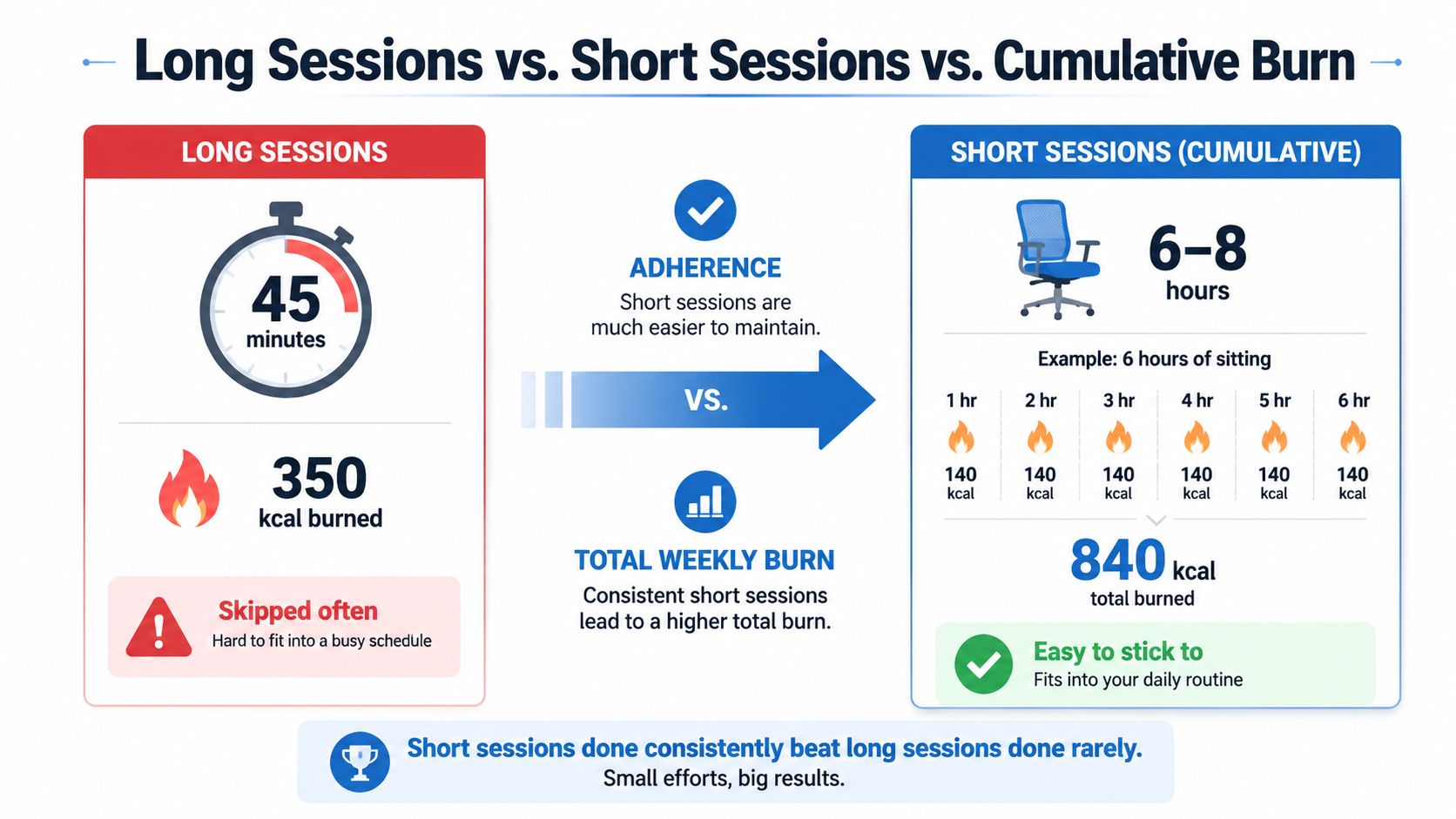
A seated electrical-stimulation exercise option can fit around work or leisure, but the experience still depends on intensity, session length and consistent use. The cumulative calorie burn guide explains why repeated manageable sessions may be more useful than an ambitious routine you regularly abandon.
Ireland's activity guidance recommends building gradually, starting with 5–10 minutes a few times a week before progressing towards the weekly target, as outlined by the HSE active-lifestyle guidance. That progression matters more than forcing a high multiplier on day one.
Why Your Number Stops Working After a Few Weeks
A calculator number can stop matching reality even when your intention hasn't changed. The first problem is often adherence drift. Portions become less exact, cooking oils disappear from the log, drinks go uncounted and a few hundred calories can enter the day without feeling like a major deviation.
The second problem is exercise estimation. Wearables and machines can overstate calories burned, especially when users add the displayed exercise number to a TDEE that already assumes regular activity. The third is compensation. When food intake falls, people may unconsciously fidget less, take fewer steps and rest more, reducing everyday expenditure outside planned exercise.
Re-check the hypothesis
A paper deficit can therefore become much smaller in practice. The scale may stall because intake rose, expenditure fell, water retention obscured fat loss, or the original activity category was too generous. None of those possibilities means the calculator has failed completely. It means the estimate needs calibration.
Re-run your calculation after 2–4 weeks, using your current weight and a more realistic activity description. At the same time, review average intake and logged movement rather than one unusually high or low day. The weight-loss plateau guide can support that review without turning a normal fluctuation into a reason for an extreme food cut.
A stalled trend is information, not a personal failure.
If your average weight is falling faster than intended, increase caution rather than celebrating an unlimited deficit. If it's moving more slowly, change one variable at a time so you can tell whether the adjustment helped.
Putting Diet and Exercise Together Using the Calculator
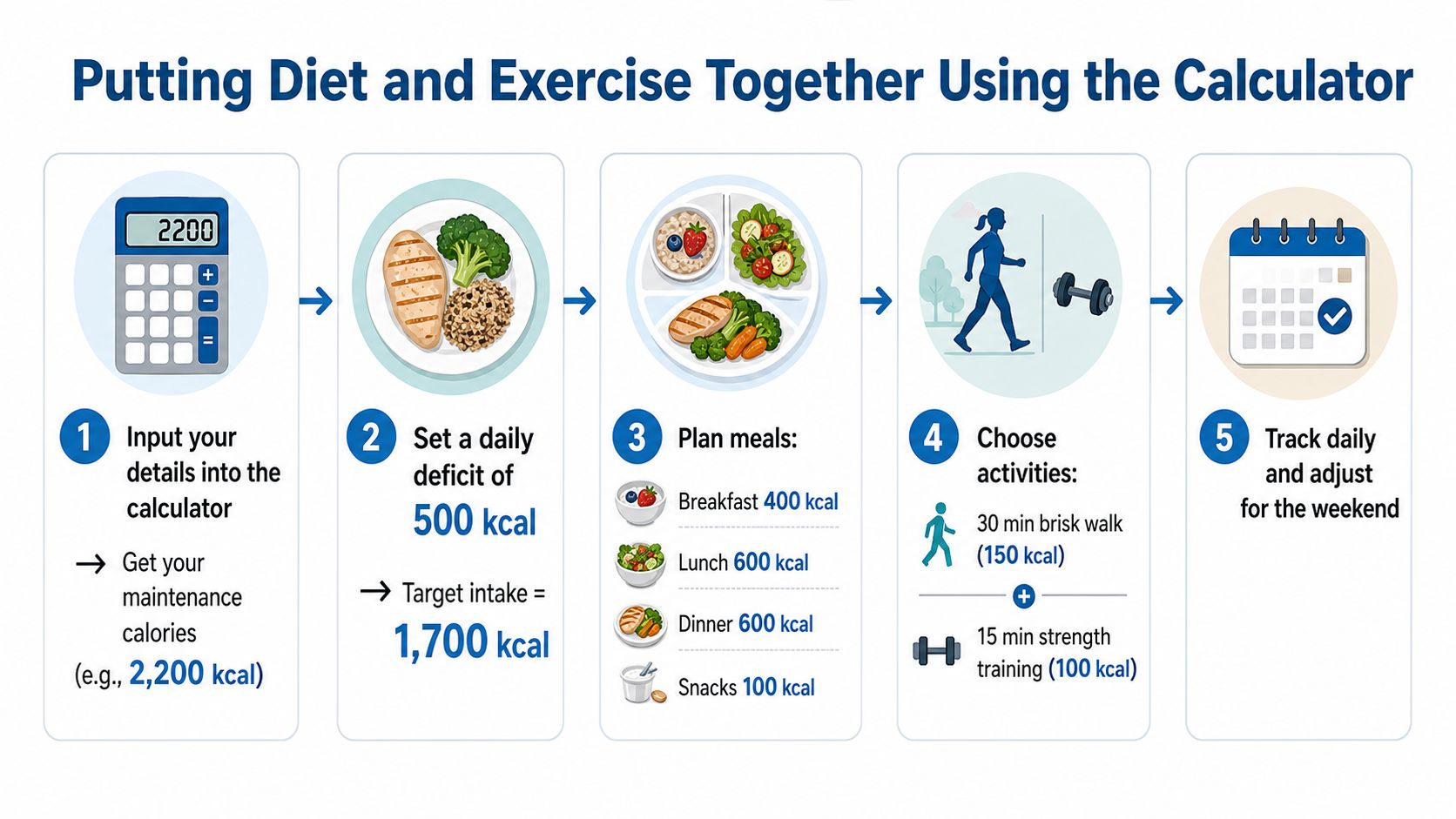
A useful plan gives food and movement separate jobs. Your maintenance estimate is the approximate total energy your body uses, while your eating target and activity routine are two ways to create a manageable gap beneath it. That structure prevents exercise calories from becoming permission to eat back every displayed estimate.
A sample week might include whole-food meals averaging 1,500 kcal on five days, two longer moderate-intensity sessions producing an estimated 300–400 kcal each, and two shorter vigorous sessions contributing an estimated 150–200 kcal each. Those figures are planning examples, not guarantees, and should be interpreted alongside your actual weight trend. Irish adults are advised to complete at least 150 minutes of moderate activity per week, with vigorous activity counting at roughly double the moderate dose, according to the Irish physical-activity guidance.
Build the week around repeatability
A sedentary week may require a larger food reduction to create the same theoretical deficit, but that can make hunger and social meals harder to manage. Combining a modest food deficit with activity can distribute the effort across the week, although it doesn't guarantee better results for every person.
A calculator becomes more useful when it helps you decide where effort belongs:
- Food structure: Plan filling meals and include drinks, sauces, snacks and cooking ingredients in the log.
- Activity structure: Choose sessions that fit your work, home and recovery demands.
- Feedback structure: Compare weekly average weight and adherence before changing the target.
For broader context on combining movement, eating habits and professional support, see Aspen Falls Wellness weight management. If you're considering BionicGym as a seated exercise option, remember that it's an FDA-cleared medical device, not a promise of weight loss. It uses leg wraps and app-guided electrical impulses to stimulate exercise while seated or multitasking, and outcomes depend on how consistently and intensely you use it.
Quick Answers to the Questions the Calculator Raises
How often should I enter my details again?
Re-check the calculator every 2–4 weeks, especially after a meaningful change in weight, activity or routine. Compare the revised estimate with average intake, adherence and weight trends. The calculator is a moving estimate, not a permanent prescription.
Could muscle gain or water retention explain a short stall?
Yes. Training, sodium, digestion and fluid shifts can hide changes in body fat. Review a longer weight average and, where useful, waist fit or exercise performance before changing calories.
What if weight loss is faster than projected?
Check whether the pace is consistent and whether your intake still supports a balanced diet and normal functioning. Irish HSE guidance gives a maximum weekly loss of 0.5–1 kg, so faster progress calls for caution rather than automatic encouragement, as stated in the HSE weight-management guidance.
What if progress is slower?
Audit portions, unlogged extras, weekend intake and the activity multiplier. Change one factor at a time, then allow enough time to see whether the average trend responds.
Should training-day and rest-day calories match?
They can, if one daily target makes adherence easier. You can also vary intake around activity. Judge either approach by the weekly average, rather than forcing every day to match.
Is a very low-calorie target automatically better?
No. Older Irish nutrition guidance strongly discourages intakes below 1,000 kcal per day because of malnutrition risk and functional decline, as noted in the Healthy Weight for Ireland report. A calculator should show a safety floor, not reward the smallest number.
Can I trust my wrist tracker's calorie estimate?
Use it as a rough activity signal, not as a precise food allowance. Wearable estimates can be wrong, and adding them directly to TDEE may count the same movement twice.
Why do two people with identical calculator details get different results?
Equations use averages. Muscle mass, daily movement, sleep, stress, appetite and the accuracy of each activity description can change actual energy balance.
BionicGym offers app-guided seated exercise through leg wraps that deliver tuned electrical impulses, allowing activity during work, television or household routines. Use the BionicGym calculator alongside a healthy diet and other exercise, then compare its estimate with real progress rather than treating it as a guarantee.