

Weight Loss Calculator Free
A free weight loss calculator can give you a useful starting point, but the popular advice to “just eat less and move more” leaves out the part that determines whether the plan survives a busy week. The arithmetic matters. So do your working hours, energy, appetite, exercise access, sleep, and ability to repeat the routine tomorrow.
In Ireland, excess weight has remained a persistent public-health concern. The 2015 Healthy Ireland Survey found that 60% of people aged 15 and over were overweight or obese, comprising 37% overweight and 23% obese, estimated at about 2.2 million people. Irish government reporting found the same split in the 2019 Healthy Ireland Survey, while the 2022 survey reported 35% overweight and 21% obese. The same 2022 data showed that 34% of respondents were trying to lose weight, and 71% of those people said they were doing more exercise or manual labour. These figures point to a large audience for practical, exercise-aware planning, not just calorie arithmetic. Healthy Ireland Survey reporting
Why Most Weight Loss Calculators Fail You
A calculator doesn't fail because maths is useless. It fails when people treat an estimate as a command.
Your body uses energy at rest, during movement, while digesting food, and through ordinary activity such as standing, walking around the home, or moving between tasks. A calculator compresses that changing reality into a daily target. If the target assumes regular activity but your day is mostly spent at a desk, the result may look precise while being difficult to maintain.
The familiar “calories in, calories out” model is still a useful foundation, but it isn't a complete behaviour strategy. The calorie balance explanation from BionicGym is helpful for understanding the basic relationship between energy intake and expenditure. It doesn't remove the practical questions: How hungry will you feel? Can you exercise without setting aside more time? What happens on a day filled with meetings, childcare, commuting, or gaming?
The gap between an estimate and a routine
A calculator usually asks for sex, age, height, weight, and activity level. It can't see whether “moderately active” means planned training, a physical job, or an optimistic guess based on intentions. It also can't know whether you can repeat the suggested activity often enough for the estimate to become relevant.
Sedentary routines reduce the amount of movement available outside formal exercise. Someone may understand their target perfectly and still struggle to create a consistent deficit because food restriction becomes the only lever. That can make the plan feel like a test of willpower rather than a system designed around real life.
Practical rule: Use the result as a baseline to test, not as proof that your body must follow a particular number.
Metabolic adaptation also complicates the picture. As body weight, food intake, activity, and routine change, energy needs can change too. A useful calculator therefore starts a feedback loop: choose a reasonable target, follow it consistently, observe your trend, and adjust carefully rather than reacting to a single weigh-in.
The strongest plan isn't the one with the most impressive projected result. It's the one that combines a manageable diet with movement you can perform regularly, including activity that fits around desk-bound work instead of competing with every other responsibility.
Understanding BMR and TDEE Calculations
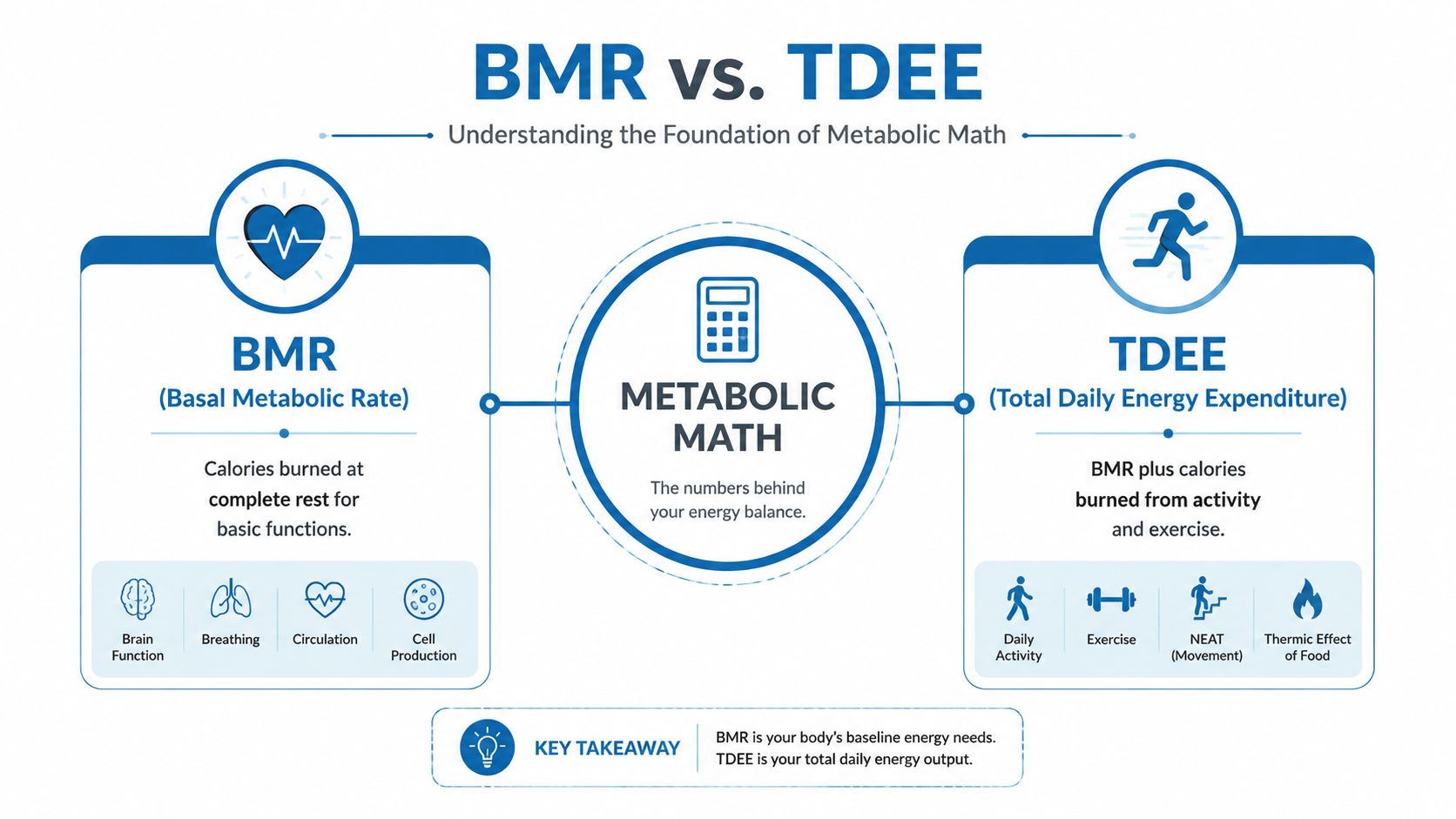
A reliable free weight loss calculator should distinguish between Basal Metabolic Rate, or BMR, and Total Daily Energy Expenditure, or TDEE. These terms describe different layers of the same energy picture.
BMR is the estimated energy your body uses at complete rest for essential functions. TDEE starts with that resting requirement and adds the energy associated with daily movement and exercise. Irish nutrition tools commonly use equations such as Mifflin-St Jeor or a BMR estimate multiplied by a Physical Activity Level, or PAL, factor. An Ireland-specific calorie calculator describes targets as beginning with an activity-adjusted energy estimate before applying a fat-loss deficit.
How the pipeline works
The process normally follows this sequence:
- Enter personal details. Sex, age, height, and weight influence the resting estimate. A weight-only calculator misses important context.
- Estimate BMR. An equation provides a starting estimate for energy used at rest.
- Apply activity. The calculator adjusts BMR with an activity factor to estimate TDEE.
- Choose a deficit. The tool subtracts an amount from estimated maintenance calories to create a fat-loss target.
- Monitor and refine. Your real-world response helps you judge whether the initial estimate fits your routine.
A calculator isn't measuring your metabolism directly. It is modelling it from inputs, which means your activity selection deserves particular care. A desk-based day with occasional walks should be described accurately rather than labelled “very active” because you plan to train later.
The BMR calculator guide from BionicGym can help you understand why resting needs and total daily needs aren't interchangeable. If you encounter the term “metabolic age”, Lola's metabolic age guide offers useful context. It explains why such labels are better treated as general comparisons than as clinical measurements.
The result is most useful when you treat it as a working hypothesis. Your maintenance level may shift with body composition, movement, diet, and adherence. Recalculate when your circumstances change, but don't chase daily fluctuations.
Key Features of a Reliable Free Calculator
A good tool should make its assumptions visible. The phrase weight loss calculator free shouldn't mean “a dramatic answer with no explanation”. It should mean an accessible estimate that shows how personal details, activity, and the selected deficit affect the outcome.
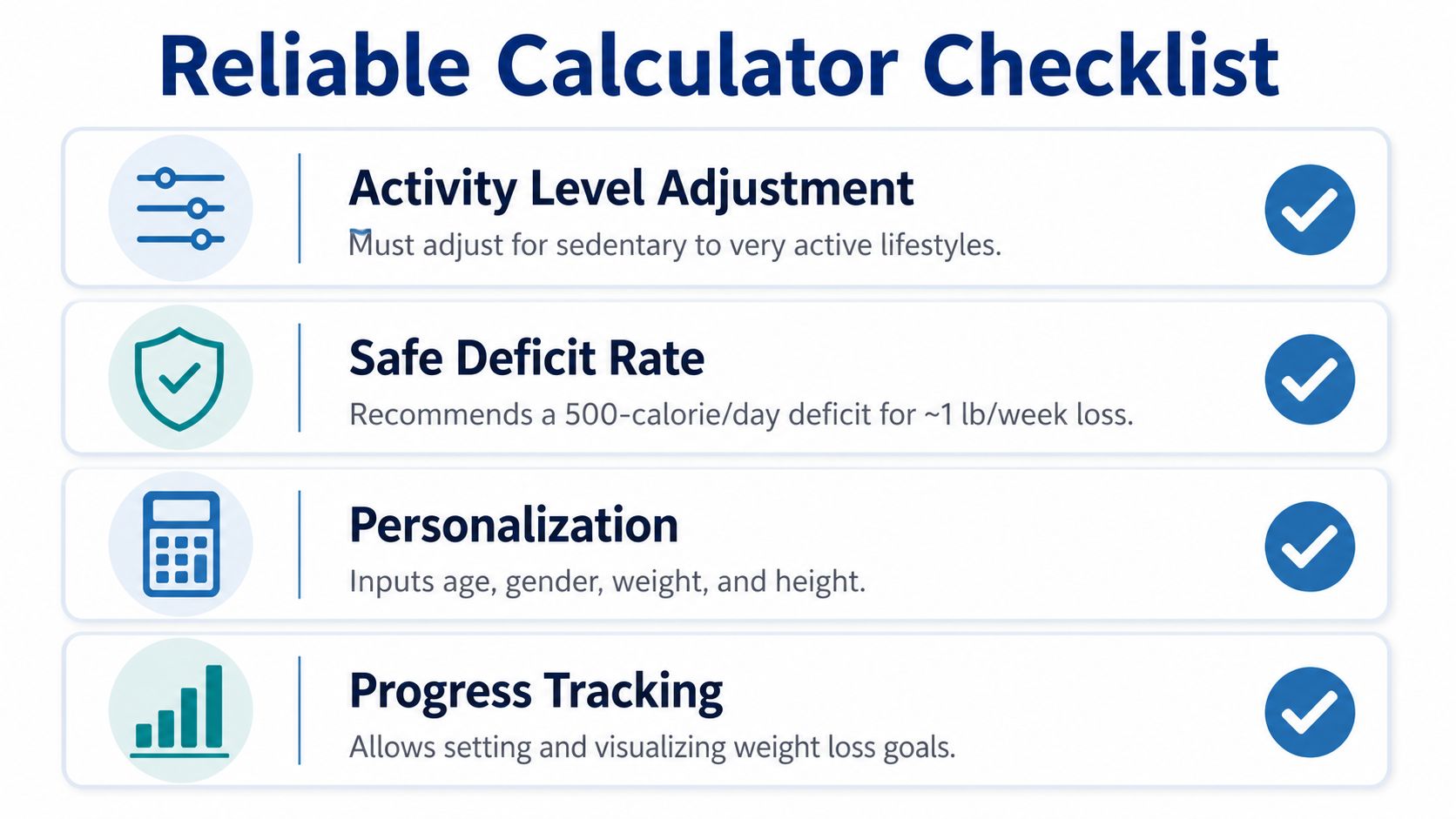
Irish calorie calculators commonly use sex, age, height, weight, and activity level. They then apply a deficit to estimate a rate of loss. Safefood guidance referenced by an Irish calorie calculator associates a reduction of about 500 kcal per day with roughly 1 lb per week, while Irish tools may express a projected rate of approximately 0.25 to 0.5 kg per week, depending on the chosen deficit.
What to look for
- Activity adjustment: The tool should distinguish between sedentary, lightly active, and more active routines. This is central to estimating TDEE.
- A moderate deficit: A credible tool should present a measured reduction rather than encouraging extreme restriction. One Ireland-specific nutrition tool discusses a 300 to 500 kcal daily deficit for fat loss. Apex Nutrition's calculator guidance also places this alongside the 2,000 kcal EU reference intake used on Irish food labels.
- Personalisation: Age, sex, height, weight, and activity should influence the output. If changing every input produces almost the same answer, the model isn't giving you much useful information.
- Progress tracking: The best tools let you compare the plan with your actual trend and revise assumptions when your routine changes.
- Clear limitations: A calculator should make clear that its projection is an estimate, not a diagnosis or a guarantee.
Watch for tools that imply faster is always better. A lower target may look attractive on screen, but the practical cost can appear through hunger, reduced training quality, low energy, or a plan that collapses after a short period. The useful question isn't “What is the lowest number I can tolerate?” It's “What level can I follow while eating a balanced diet and staying active?”
Bridging the Deficit Gap with Diet and Exercise
Your calculator gives you a target. It doesn't tell you how to create the gap between intake and expenditure during a day dominated by sitting.
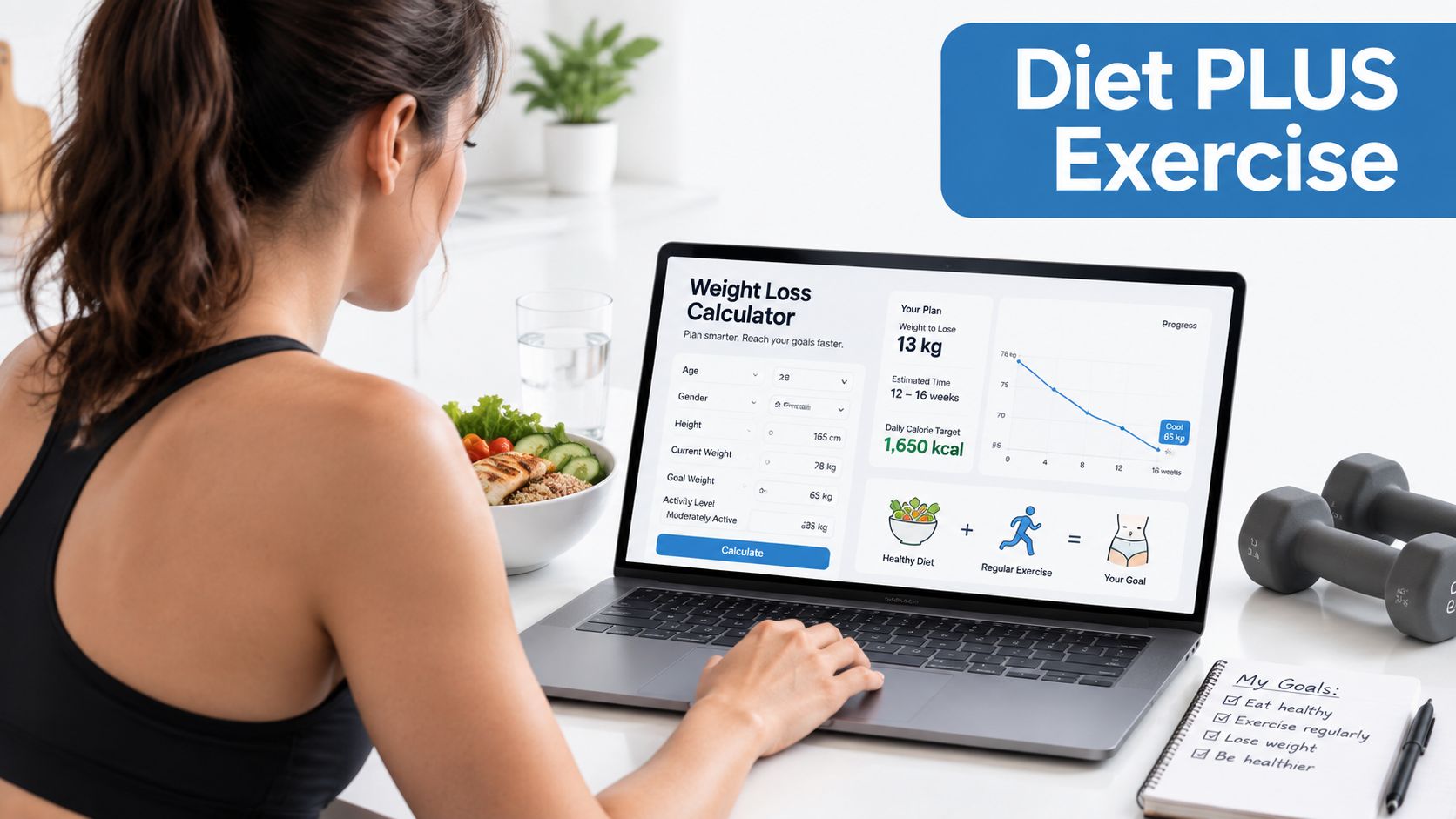
A diet PLUS exercise approach gives you more than one practical lever. You can make food choices that support a reasonable calorie deficit, then use movement to increase energy expenditure without relying entirely on further restriction. This doesn't guarantee weight loss, because results still depend on overall intake and consistent use, but it can make the plan less dependent on hunger management alone.
Making exercise fit the day
Traditional workouts work well for some people, but scheduled gym time isn't the only form of useful activity. A wearable system such as BionicGym uses leg wraps and app-guided electrical stimulation to exercise leg muscles while the user is seated or completing safe household tasks. That makes it relevant to people who want multitasking fitness during activities such as emailing, watching television, or doing chores.
BionicGym was invented and developed by a medical doctor, and the company describes it as an FDA-cleared medical device. Its communication should remain realistic: gains depend on use, intensity, recovery, and the wider diet. It isn't a weight loss guarantee, and it shouldn't replace sensible nutrition or other forms of movement.
Irish physical-activity guidance defines vigorous intensity as 6.0 METs or more and associates it with roughly 77 to 93% of maximum heart rate. The guidance recommends adults aim for 1 hour 15 minutes to 2 hours 30 minutes of vigorous aerobic activity per week. Ireland's national physical-activity guidance provides the standard against which vigorous cardio claims should be judged.
A genuine workout should be observable. Heart rate rises, breathing becomes faster, and you may sweat or feel warmer. HSE cholesterol guidance uses those cues to describe moderate activity, including breathing that is faster but still allows conversation. HSE exercise guidance gives readers a practical way to distinguish meaningful activity from barely moving.
For more detail on turning a target into a daily plan, use the BionicGym calorie deficit guide. Keep the food plan balanced, select an activity level you can sustain, and increase exercise gradually.
Pros and Cons of Free Weight Loss Tools
Free calculators have a legitimate role. They make energy-balance concepts accessible, provide immediate feedback, and help you see why activity changes the target. They can also prevent a common mistake, choosing a calorie target without considering age, height, weight, or routine.
Their limitations are equally important. A calculator doesn't provide personal coaching, assess your complete medical context, or understand the emotional and logistical reasons a plan might fail. It also can't determine whether a particular exercise option is safe for you.
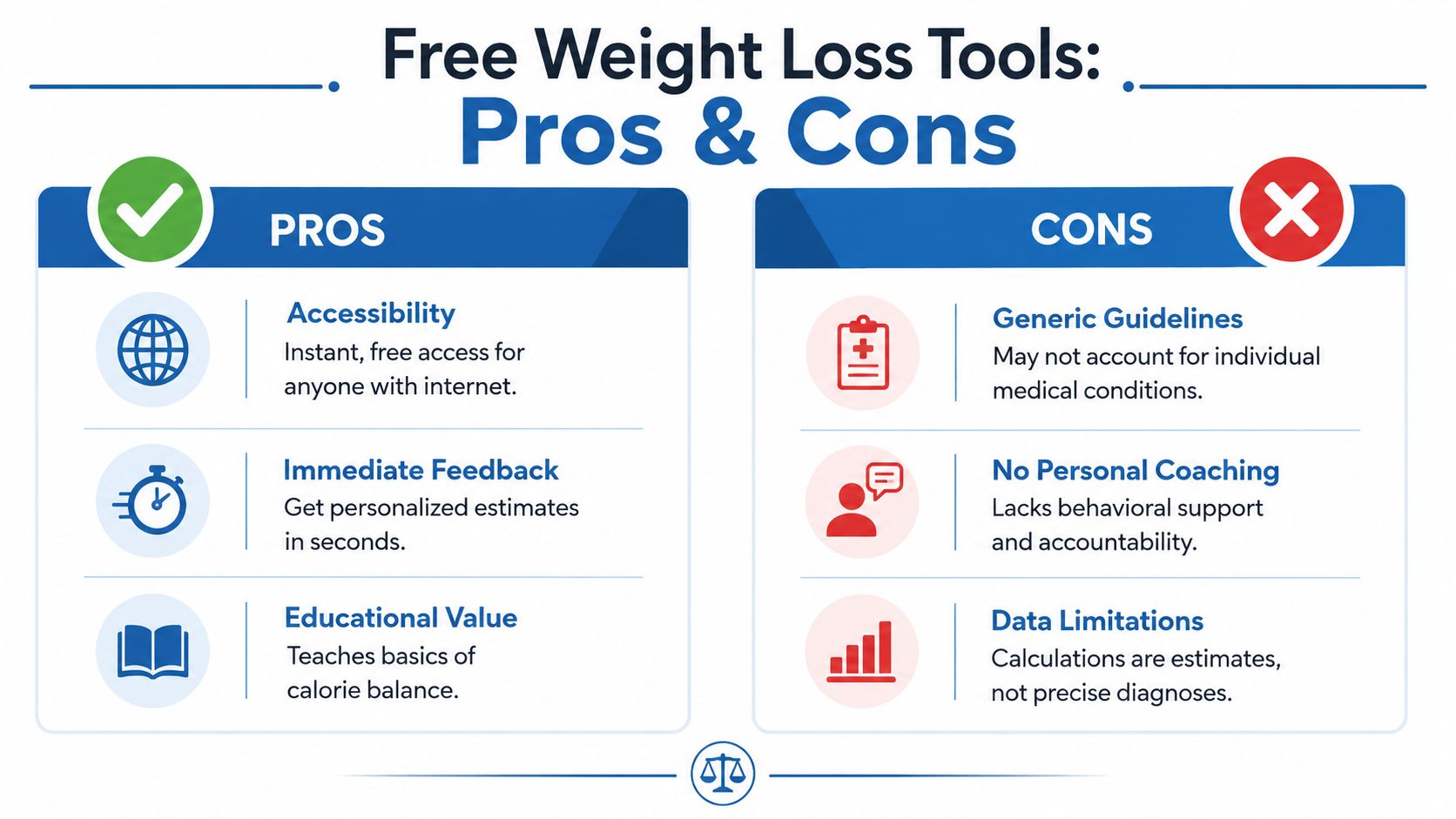
| Free tool advantage | Limitation to manage |
|---|---|
| Immediate access and feedback | The output remains an estimate |
| Educational calorie-balance context | It doesn't provide accountability |
| Activity-aware targets, when built well | It may miss personal health considerations |
| A starting point for goal setting | It can't create adherence for you |
Use the result, don't worship it
Calculator fatigue often begins when someone keeps changing inputs to find a more appealing target. That creates the illusion of progress without changing the routine. A better approach is to record the initial estimate, follow the plan consistently, and review the broader trend rather than reacting to isolated changes.
A free calculator is useful for asking better questions. It isn't a substitute for judgement.
Pairing the tool with structured exercise improves the practical value of the number. Choose movement that matches your ability, available time, and preferences. If you have a serious medical condition or injury, get individual advice before starting a new programme.
How to Use the BionicGym Weight Loss Calculator
Start with honest inputs. Enter your age, sex, height, weight, diet deficit, and expected BionicGym use without inflating the activity level. The calculator can then show how food intake and planned exercise interact, rather than presenting diet as the only source of the deficit.
The BionicGym weight loss calculator targets guide is useful for understanding that relationship. A long, low-intensity session can contribute to cumulative expenditure, especially when it takes place during activities you already do, such as answering emails, browsing, or watching television.
A practical desk-based approach
Suppose your normal day is mostly sedentary. Don't assume a single intense session is the only route forward. Instead, choose a sustainable food target, schedule exercise around safe seated tasks, and record how your body responds.
Long-duration use can create a substantial cumulative burn. The BionicGym communication guidance gives 1,000 to 2,000 calories in one day as an example of cumulative expenditure from 4 to 6 hours of low-intensity background use. That isn't a promise or a typical requirement. It illustrates why duration and consistency can matter alongside intensity.
For users who build towards vigorous exercise, the stated typical achievable level is about 500 calories per hour, but the visible effort should match the claim. A reddened face, sweat, breathlessness, and a raised heart rate are more meaningful than a large number on a screen. Start below your maximum, follow the app guidance, and allow your tolerance to develop.
Review the plan with your actual routine. If the calculator assumes exercise you rarely complete, lower the assumption. If your diet target leaves you unable to function well, reconsider the deficit and seek qualified advice rather than forcing compliance.
Building a Sustainable Plan for Long-Term Success
Long-term weight loss depends less on finding a perfect formula and more on repeating a reasonable process. Use the calculator to set a measured deficit, choose food that supports energy and satiety, and add joint-friendly movement you can fit into ordinary life.
BionicGym can provide a sugar-hungry form of exercise through electrically stimulated leg-muscle activity, including sessions performed while seated. It should be viewed as exercise that complements a healthy diet and other physical activity, not as a guarantee or a replacement for professional advice. For broader reading on emerging approaches, PepFlow's guide to the science of peptides for weight loss provides useful background, but medical decisions belong with a qualified clinician.
The BionicGym guide to sustainable weight loss captures the central principle: combine diet with exercise, select a routine you can maintain, and adjust based on real experience. Anyone with a serious medical condition or injury should consult their medical practitioner before starting any new exercise programme. BionicGym is a great way to exercise. It is not a medical treatment. Consult your doctor if you have a serious condition.
Use the Weight Loss Calculator page to test a realistic diet-plus-exercise plan for your routine. Then explore BionicGym to see how app-guided, seated exercise can fit around desk work, home tasks, and other daily activities.