

Weight Loss Calculator Percentage: How to Track Progress
What if the most useful number on your weight-loss plan isn't the kilograms you've lost, but the percentage of your starting weight that represents? A five-kilogram reduction can be a major personal milestone for one person and a relatively small change for another. A weight loss calculator percentage gives context that the scale alone can't provide.
That context matters in Ireland, where weight management is a widespread public-health concern. The 2022 Healthy Ireland Survey found that 41% of adults reported a normal weight, 35% reported being overweight and 21% reported being obese, while about 34% were currently trying to lose weight (Healthy Ireland Survey 2022). The HSE also states that 61% of adults aged 16–65 are currently overweight or obese (HSE weight-management guidance).
Percentage tracking doesn't judge your body or guarantee a particular result. It gives you a more proportionate way to understand progress, set a realistic target and decide whether your daily routine supports the number shown by a calculator.
Why Percentage Beats Raw Kilograms on the Scale
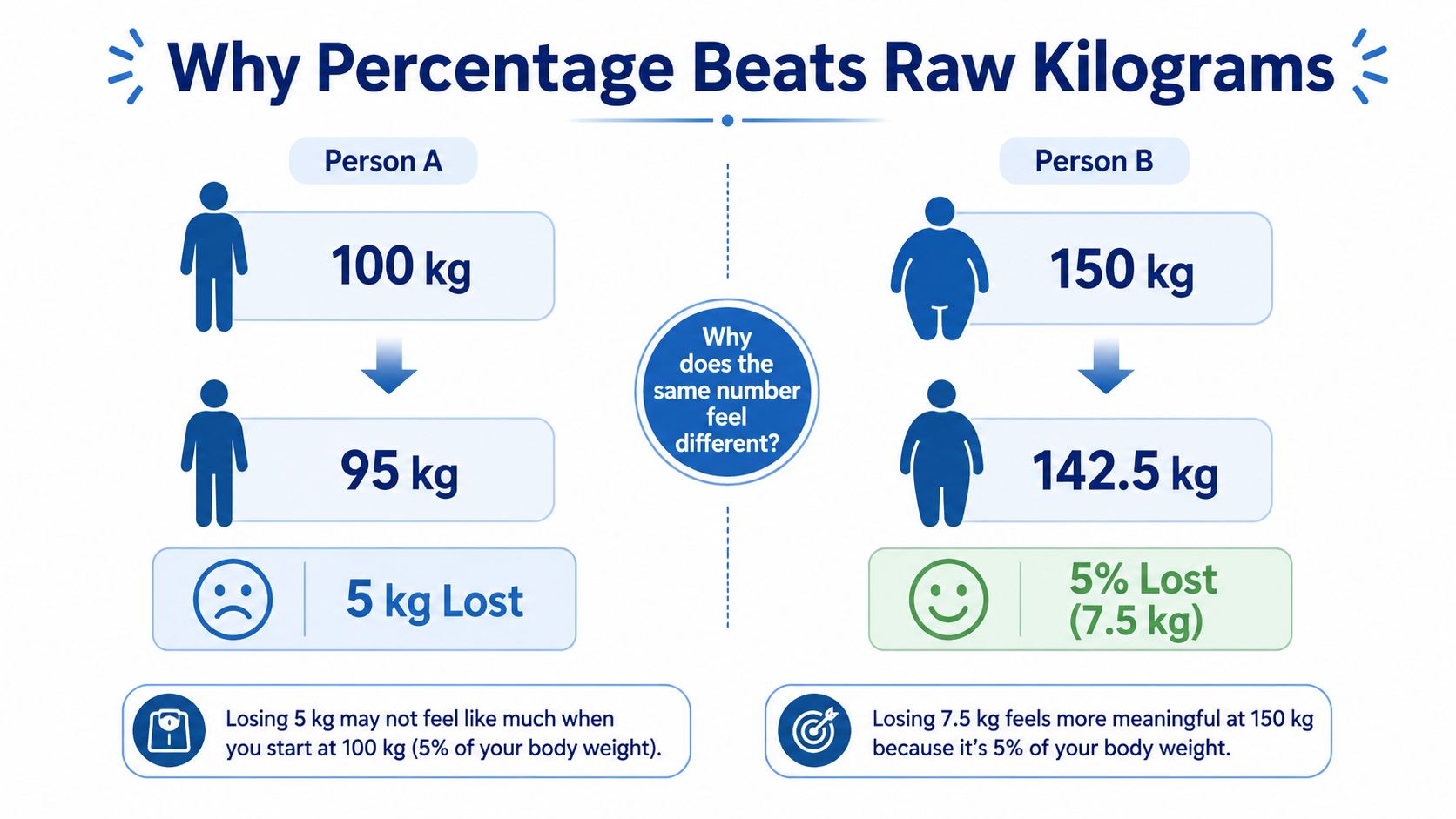
Why can the same kilogram loss represent very different progress? Losing 5 kg from 70 kg is a larger share of starting weight than losing 5 kg from 110 kg. The scale records the absolute change, but percentage adds the missing context.
A percentage asks, “How much of my original body weight have I lost?” That measure keeps the comparison personal. Starting weight, body composition, age and lifestyle all affect what a kilogram change means, so another person's total is a poor benchmark for your own progress.
Practical rule: Compare your current percentage with your own starting point, not another person's kilogram total.
Irish health guidance uses proportional targets because they apply across different body sizes. The HSE recommends first stopping further weight gain, then working towards 5–10% body-weight reduction, with a maximum weekly loss of 0.5–1 kg (HSE weight-management guidance). The Irish Nutrition and Health Alliance also highlights that losing 10% of body weight can have a positive effect on long-term health (INDI nutrition resource).
Irish population data gives this approach useful context. Government reporting recorded 37% of adults as overweight and 23% as obese in 2019, unchanged from 2015. Another analysis reported adult obesity rising from 11.5% in 1990 to 23.7% in 2011, before reaching 17.3% in 2024 among adults aged 18–64 (Irish obesity policy progress report). These are population trends, not predictions for one person. They do show why a consistent measure helps track change over time.
For unit conversions, use this guide to the weight-loss calculator from kilograms to pounds. Once the percentage is clear, a calculator result can connect with practical choices, such as adding low-impact, desk-friendly movement with BionicGym alongside eating and activity habits you can maintain.
How to Calculate Your Weight Loss Percentage
How can the same kilogram loss represent different levels of progress? The answer is the starting weight. Use this formula:
Weight-loss percentage = ((Starting weight − Current weight) ÷ Starting weight) × 100
Keep both measurements in the same unit. Kilograms and pounds both work, but they cannot be mixed in one calculation.
Work through the maths
Suppose your starting weight was 80 kg and your current weight is 75 kg:
- Subtract current weight from starting weight: 80 − 75 = 5 kg.
- Divide the loss by the starting weight: 5 ÷ 80 = 0.0625.
- Multiply by 100: 0.0625 × 100 = 6.25%.
You have lost 6.25% of your original body weight. The denominator is your starting weight, not your current weight.
The comparison below shows why raw kilograms can give an incomplete picture:
| Starting Weight (kg) | Weight Lost (kg) | Percentage Lost (%) |
|---|---|---|
| 80 | 5 | 6.25 |
| 100 | 5 | 5 |
| 130 | 5 | 3.85 |
Each person loses 5 kg, yet that loss represents a larger share of body weight for the person who began at 80 kg. Percentage tracking therefore creates a fairer reference point than comparing kilograms alone.
Keep two measures separate. Percentage lost records progress from your original weight. Percentage of goal achieved records the distance covered towards a chosen goal. Starting at 100 kg, aiming for 90 kg, and reaching 95 kg means losing 5% of starting weight and completing half of the 10 kg journey.
An online tool can handle the arithmetic, while the formula lets you check the result. BionicGym's free weight-loss calculator can organise the calculation alongside a target and expected pace, helping connect a numerical result with manageable daily movement.
Setting Realistic Percentage Targets Using Irish Health Data
What percentage target can you follow without turning weight loss into an extreme restriction? Irish obesity-management guidance places 5–10% body-weight reduction within practical weight management. HSE adult guidance also recommends keeping weekly loss within 0.5–1 kg, so a percentage goal works best when paired with a measured pace rather than a rushed deadline.
The maths changes with starting weight:
- At 90 kg, 5% equals 4.5 kg, 7.5% equals 6.75 kg and 10% equals 9 kg.
- At 110 kg, 5% equals 5.5 kg, 7.5% equals 8.25 kg and 10% equals 11 kg.
These figures show what the calculator means. They do not prescribe what you should lose. A suitable target depends on your health history, medication, age, current intake, activity and the need to protect muscle mass. A percentage keeps the target relative to your starting point, like choosing a route based on the distance you need to travel rather than giving everyone the same number of kilometres.
Irish public-health data also puts modest goals in context. The 2025 Irish Health Survey classified 21.5% of adults as obese, while 41% met activity guidelines (Central Statistics Office Irish Health Survey 2025). For someone beginning with little activity, a target that fits ordinary routines may last longer than an aggressive plan that becomes difficult to maintain.
Irish guidance discusses sustained deficits of about 200–300 kcal per day as potentially supporting weight reduction and longer-term maintenance. An Irish guideline also found similar short-term weight reduction from intermittent and continuous calorie restriction over 6–12 months (Irish obesity-management guideline). Set a percentage milestone, review the trend and adjust your plan instead of chasing rapid double-digit loss.
For dates and milestones, the weight-loss calculator goal-date guide can turn a percentage into a calendar plan, while keeping the estimate flexible rather than treating it as a promise.
Turning Calculator Results Into Daily Action
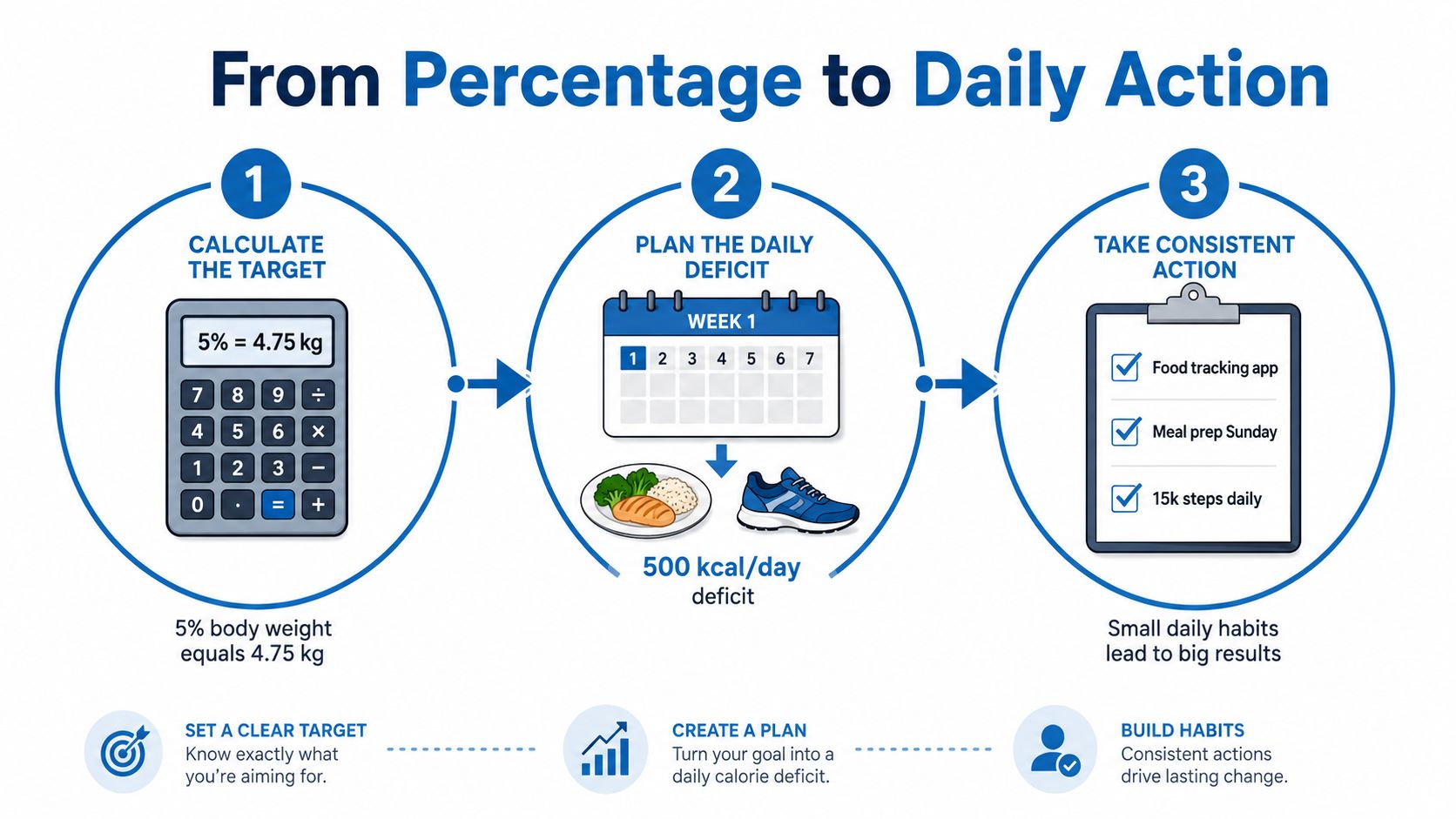
How do you turn a percentage from a calculator into habits that survive busy working days? A result such as 5% gives you a destination, while daily actions provide the route. The task is to divide the target into manageable food and movement choices, rather than treating the kilogram figure as a deadline.
Irish guidance describes a roughly 500 kcal daily deficit from diet plus physical activity as one approach to weight management, while recognising that smaller deficits may be easier to sustain. The National Dairy Council similarly recommends about 500 kcal per day of restriction combined with exercise (National Dairy Council weight-loss guidance). These figures are planning references, not instructions to force the same deficit every day.
A practical framework might pair a modest dietary adjustment with a short exercise session. For example, reducing energy intake by around 300 kcal and using BionicGym to contribute roughly 200 kcal illustrates how a daily gap could be assembled. Those numbers are examples, not guaranteed personal results. Energy expenditure varies, and BionicGym's contribution depends on the session's intensity and how consistently you use it.
Make the routine easy to repeat
BionicGym is a wearable exercise system with app-guided programmes and leg wraps that deliver electrical impulses to stimulate the leg muscles. You can use it while sitting for suitable activities, such as emailing or watching television, or during safe household tasks. That desk-friendly option may help people who find a gym journey difficult to fit into the day.
Start at an intensity you can repeat. A demanding setting that leaves you too tired for the next session does little for long-term adherence. A raised heart rate, sweating or breathlessness can indicate genuine exertion, but adjust effort responsibly. BionicGym was invented and developed by a medical doctor and is FDA-cleared. It does not guarantee weight loss. Diet and exercise remain the foundation.
Safety first: Anybody with a serious medical condition or injury should consult with their medical practitioner before starting any new exercise program.
Food logging can reveal portion drift, including oils, drinks and small tastes. For exercise, treat calorie estimates as approximations. Give greater weight to consistent sessions, perceived effort and the longer-term percentage trend than to trying to “earn” an exact calorie number.
The cumulative calorie-burn guide explains how longer, lower-intensity sessions can add to total daily activity. Build the habit around manageable use, not extreme sessions or promises of a particular result.
Tracking Progress and Adjusting Your Plan
How can you tell whether your plan is working without overreacting to every weigh-in? Track the percentage trend under similar conditions. Weigh at a consistent time, such as in the morning before eating, with the same scale, then record each result in a spreadsheet or app. Fluid, food volume and other short-term changes can move the scale up or down. The broader line matters more than one reading.
Use milestones as practical checkpoints, not medical guarantees. A 2% change can show that your routine is moving in the intended direction. A 5% loss is a useful initial target in Irish guidance, while 10% sits at the upper end of the HSE's initial target range, as noted earlier.
| Milestone | What it can show | Adjustment trigger |
|---|---|---|
| 2% body-weight loss | An early sign of progress that may support motivation | Review consistency if the trend has not moved |
| 5% body-weight loss | A meaningful initial health and weight-management milestone | Recalculate the next target from your current weight |
| 10% body-weight loss | The upper end of the initial target range | Discuss maintenance or the next phase with a healthcare professional |
Know when to change the plan
If the trend has stalled for several weeks, check the basics before changing everything. Review portions, drinks, meal timing, missed sessions and whether the routine still fits your working day. Add one manageable adjustment, such as a short BionicGym session, a cautious extension to an existing session or another safe activity. Changing several major habits at once makes it harder to identify what helped.
Recalculate after a clear milestone or at a regular monthly review, using your current weight as the new reference point. The maths then reflects the person you are now, rather than making every future target depend on an older starting weight.
Progress also appears outside the scales. Clothing fit, energy during ordinary tasks, exercise tolerance and the number of sessions completed can improve while the percentage changes slowly. These signs help distinguish a temporary fluctuation from a genuine change in routine and capacity.
If you use the BionicGym weight-loss calculator app content, treat its outputs as planning information. Compare the estimate with your recorded percentage trend, daily habits and recovery, then adjust gradually when the evidence supports it.
A Real-World Example of Percentage-Based Success
What does a percentage target look like in daily life? Consider a fictional desk-bound professional in Dublin who starts at 95 kg. A first target of 5% equals 4.75 kg, calculated as 95 × 0.05. The percentage makes the goal proportionate to their starting point, rather than treating the same kilogram loss as suitable for everyone.
They create a modest dietary deficit and complete two short BionicGym sessions during lunch breaks. Meals and weight trends are recorded, while the routine is adjusted when work becomes demanding. Weekend walks can be added if they fit comfortably, but repeatable habits remain the foundation.
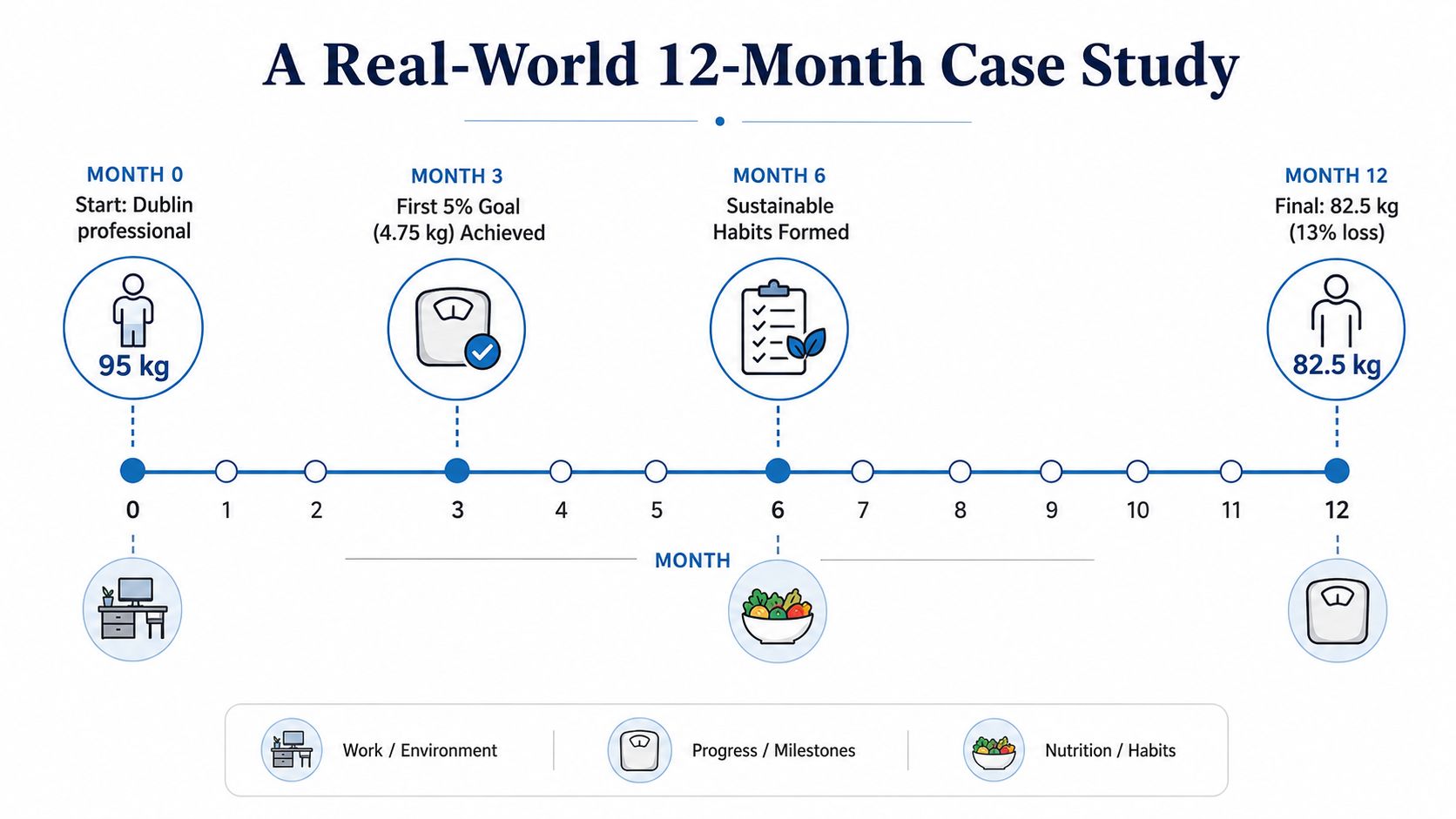
After reaching the first milestone, they recalculate from their current weight instead of measuring every result against 95 kg. Each percentage checkpoint then works like a nearer marker on a route, making progress easier to interpret than one distant “ideal weight”. If the trend slows, they review food intake, session frequency, sleep and general activity before making one cautious change.
The result remains individual. A calculator or exercise device cannot guarantee a particular percentage, body-composition change or health-marker result. BionicGym offers a desk-friendly exercise option, but its contribution depends on appropriate use, a suitable diet and consistent participation.
Anyone with a serious medical condition or injury should consult a medical practitioner before starting a new exercise programme. BionicGym is a way to exercise, not a medical treatment. Consult your doctor if you have a serious condition.
Use the Weight Loss Recommendations and Fat Loss Calculator to turn starting weight into a proportionate target. Visit BionicGym to explore a wearable, app-guided option that can fit around desk work, television or safe household tasks.