

How to Lose Weight Fast Safely with Diet Plus Exercise
In Ireland, 56% of adults reported being above a healthy weight range in the 2024 Healthy Ireland Survey, with 21% living with obesity and 35% living with overweight. At the same time, 38% said they were trying to lose weight, up 4 percentage points from 2022, which tells you something important about how to lose weight fast without making the plan reckless, the demand is huge, but the starting points are very different. A fast result has to be built on Diet PLUS exercise, not a crash diet that strips water, muscle, and sanity before the scale bounces back. Healthy Ireland Summary Report 2024
The clients who keep the weight off usually stop chasing “fast” as a fantasy and start treating it as accelerated, sustainable fat loss. That means a realistic calorie deficit, enough activity to protect lean mass, and a plan that fits desk work, family life, and the days when motivation is low. A good primer on the basics is XO's weight loss guide, but the key lever is making the plan specific enough that you can repeat it on an ordinary Tuesday.
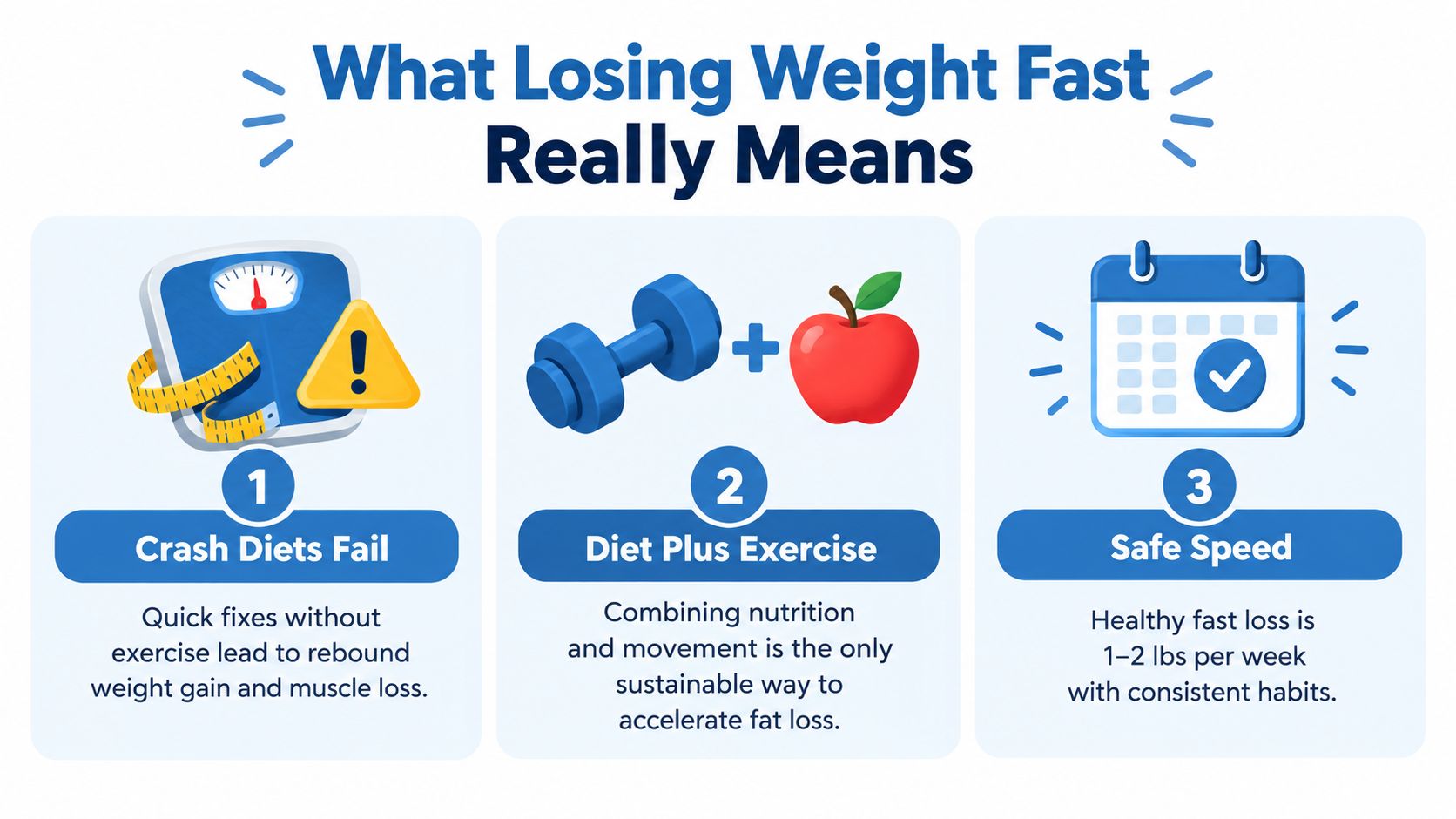
What Losing Weight Fast Really Means for Sustainable Results
Fast weight loss only works when speed is earned through structure. If the first move is severe restriction, the body, the routine, and the appetite usually push back. That's why credible guidance in Ireland points toward a combined deficit of about 500 kcal/day from food and physical activity, rather than a promise that you can eat anything and still drop weight quickly. National Dairy Council weight-loss guidance
The baseline matters more than the headline
The number on the scale doesn't tell the full story, because two people can start from very different places. One may have been sedentary for years, another may already be active but carrying more body fat, and both will respond differently to the same plan. Ireland's broader health profile shows the activity gap has narrowed, but only a minority of adults are still meeting the recommended weekly physical activity threshold, which helps explain why a one-size-fits-all shortcut usually disappoints. OECD Ireland country health profile 2023
Practical rule: if the plan doesn't account for your starting point, it isn't a plan, it's a guess.
Muscle preservation matters here too. When people slash intake too hard, they often lose more than fat, and that makes future maintenance harder because less active tissue means less room for error. I've seen busy, desk-bound clients chase rapid drop-offs, only to stall hard once hunger, fatigue, and low movement catch up.
What sustainable speed looks like
The cleaner benchmark is steady progress, not dramatic short-term punishment. Irish guidance points to an initial target of 5% body-weight loss in the first 3 months or 5 to 10 cm waist reduction, with sustainability and adherence doing more work than hype. If you want a useful planning tool before you change anything, the BionicGym Weight Loss Calculator gives a more honest timeline than most quick-fix promises.
For context on the calorie side of fat loss, this explainer on calories in a pound of fat is worth keeping open while you set expectations. The point isn't perfection. It's knowing that fast should still mean controlled, repeatable, and muscle-aware.
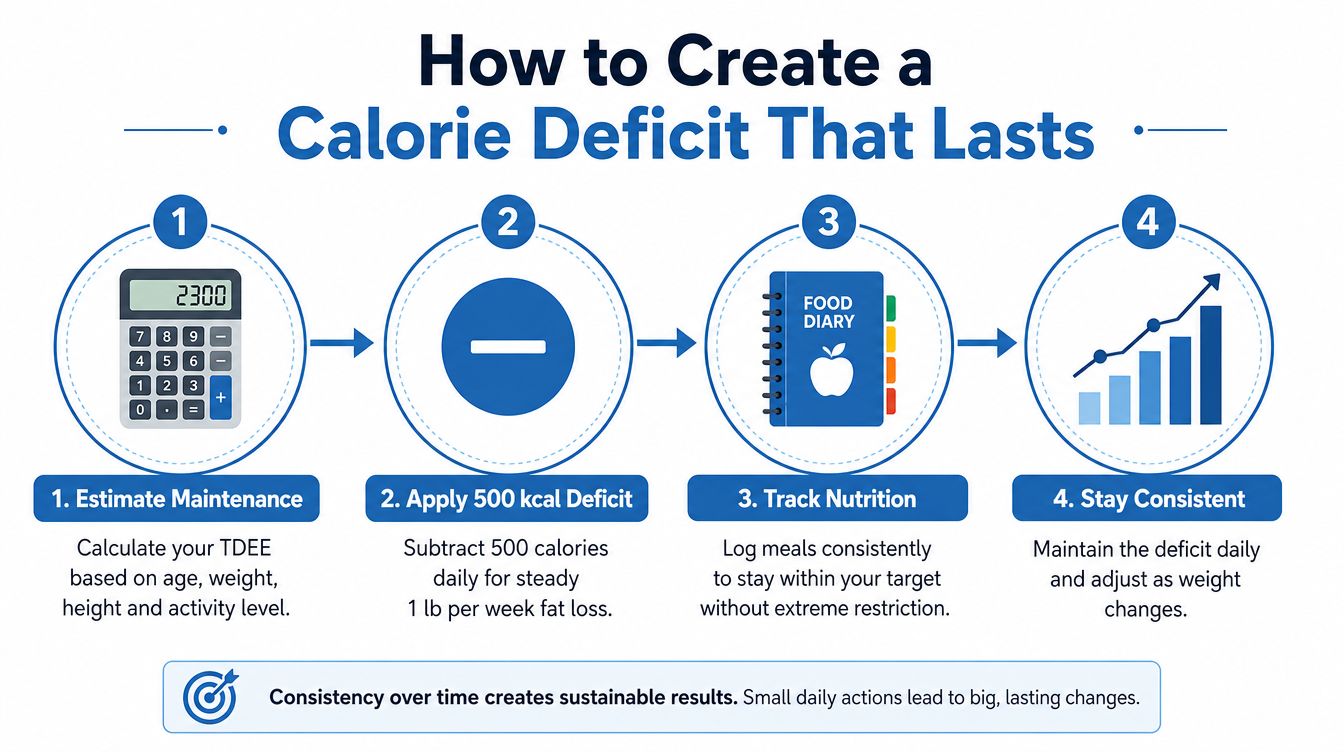
How to Create a Calorie Deficit That Actually Lasts
A lasting deficit starts with math, then gets filtered through real life. You do not need an extreme eating window, a detox, or a punishment workout. You need a daily intake that sits below maintenance often enough to produce fat loss while still letting you work, sleep, and stop thinking about food every ten minutes.
Start with maintenance, then trim intelligently
Estimate your maintenance from your usual body size, activity level, and eating pattern, then reduce intake by about 500 kcal/day from food and movement combined. That approach aligns with Irish guidance and is usually easier to maintain than slashing meals until lunch feels like an emergency. The goal is not to eat as little as possible, it's to create enough gap that the body has reason to use stored energy. National Dairy Council weight-loss guidance
If you like having a fixed target, use the BionicGym calorie deficit guidance as a planning reference, then sanity-check your own routine against it. A good deficit still leaves room for protein, fibre, and normal social meals. A bad one turns every dinner into a negotiation.
Useful standard: track enough to stay honest, but not so much that you start obsessing over every bite.
Make the deficit livable
The easiest way to fail is to build a plan you can only follow on days when you're unusually disciplined. I usually tell people to set three anchors.
- Protect meals: Keep protein and vegetables present at main meals so you're not relying on willpower alone.
- Watch the hidden calories: Liquid calories, snacks at the desk, and “just a few” extras are where many plans leak.
- Adjust, don't panic: If weight is drifting, change one variable at a time, either intake or activity, not everything at once.
The Weight Loss Calculator is useful because it makes the timeline visible. Once people can see the likely path over weeks and months, they're less tempted to crash diet for three days and quit on day four. The most reliable deficit is the one you can keep while still living like a person.
How Much Exercise You Need Each Week to Accelerate Fat Loss
Ireland's national guidance gives you a practical target, not a vague “move more” slogan. Adults should aim for at least 2 hours 30 minutes to 5 hours of moderate-intensity aerobic activity, or 1 hour 15 minutes to 2 hours 30 minutes of vigorous-intensity aerobic activity, or an equivalent mix each week for substantial health benefits. That range matters because fat loss gets easier when movement is enough to matter, but not so punishing that you quit after a week. HSE physical activity guidelines
Moderate and vigorous are not the same thing
The HSE defines vigorous activity by the feeling, heavy breathing, a raised heart rate, and being unable to talk comfortably, and the technical threshold is 6.0 METs or more. That's a useful benchmark because it keeps the conversation grounded in something you can feel, not wellness language that sounds impressive but says little. If a workout barely changes your breathing, it probably isn't doing the job you think it is. HSE activity guidance
| Weekly Activity Targets to Support Faster Fat Loss | |||
|---|---|---|---|
| Intensity Level | Weekly Target | How It Feels | Example Mix |
| Moderate | 2 hours 30 minutes to 5 hours | Breathing quicker, but you can still talk | 30 to 45 minute brisk walks on most days |
| Vigorous | 1 hour 15 minutes to 2 hours 30 minutes | Heavy breathing, raised heart rate, talking is hard | Short hard sessions mixed with recovery days |
| Combined approach | Equivalent of the two above | Some sessions comfortable, some demanding | A few vigorous blocks plus regular walking |
Why consistency beats heroic workouts
For people trying to lose weight, especially those sitting most of the day, a mix of moderate and vigorous work tends to be more realistic than all-out training. The Irish Society of Chartered Physiotherapists notes that 30 to 60 minutes of aerobic activity at moderate to vigorous intensity on most days can help support cardiorespiratory fitness and muscle maintenance during weight loss. Irish Society of Chartered Physiotherapists guidance
I'd rather see someone walk every day, lift or resist a few times a week, and hit a couple of demanding sessions than chase one exhausting burst and then disappear for ten days. The heart-rate training zones guide can help you judge whether your effort is moderate or vigorous, which is more useful than guessing.
Using BionicGym to Increase Daily Calorie Burn Without Joint Strain
A lot of busy people don't need another promise, they need a way to add burn without reorganising the day. That's where a wearable cardio system can fit, because the problem for many desk-bound adults is not a lack of information, it's a lack of time, space, and energy for long workouts. Used properly, BionicGym is a wearable cardio system invented and developed by a medical doctor, and it's presented as an FDA-cleared way to do vigorous exercise while sitting, standing, or moving around at home.

The reason this matters for weight loss is simple. Trained users can reach about 500 calories per hour at a vigorous level, which lines up with the idea that the session should look and feel like exercise, not a passive gadget. The product is also built around the kind of sugar-hungry form of exercise that many low-carb and fasted users look for, which is why some people pair it with a ketogenic or intermittent fasting routine, as long as the overall calorie deficit still exists.
Real-world use has to look like exercise
That means the visual signs matter. If a session is vigorous, people should look warmed up, more breathless, and more likely to sweat. Good content shows that clearly, because people are rightly suspicious of claims around any device that promises cardio while the user is sitting down.
If it doesn't raise heart rate and breathing, it's not the same conversation as training.
The safest use cases are ordinary ones, like watching TV, answering emails, gaming, or pottering about the house. It should not be shown while driving, crossing roads, or using stairs. If you want a closer look at the device's role in calorie burn, the EMS muscle stimulator page gives useful context, and the product pages for the Standard model and PRO+HIIT model show the difference in session style and intensity.
Background sessions add up
The other practical advantage is cumulative burn. Long, low-intensity sessions of 4 to 6 hours can create 1,000 to 2,000 calories of burn across a day, which is why people who work from home or spend evenings at a desk sometimes use it as a background tool rather than a standalone workout. That doesn't replace food control. It gives your calorie deficit a wider margin so a normal meal doesn't wipe out the day's progress.
For readers who already use treadmill walks or run intervals, the most relevant comparison is how to stack tools without overdoing impact. The article on how a treadmill improves speed training is useful for that side of the equation. A treadmill gives you traditional cardio, while a wearable like this adds a different kind of session you can repeat on tired days.
Protecting Muscle and Metabolic Health While You Lose Weight Quickly
Fast loss gets risky when people forget that body weight is not the only thing dropping. Muscle matters for how you move, how you train, and how well you maintain the result once the scale stops. That's why the better question isn't just “how do I lose weight fast?”, it's “how do I lose it fast enough to stay motivated without hollowing out the parts that keep me healthy?” Cardio without losing muscle
Keep the weight loss from costing too much tissue
If your diet is aggressive, the fix is not more aggression. It's protein, resistance exercise, and enough daily movement to remind the body that lean tissue still has a job. The Irish Society of Chartered Physiotherapists notes that aerobic activity can help optimise maintenance of muscle mass during weight loss, and that is one reason exercise belongs beside diet instead of being treated as optional decoration. Irish Society of Chartered Physiotherapists guidance
BionicGym can sit in that muscle-preservation conversation because it's a sugar-hungry form of exercise and can be used without loading or flexing the joints, which is relevant for people who can't tolerate pounding, plus people who want movement without aggravating a busy, stiff body. It's a useful option for joint-sensitive users, but anybody with a serious medical condition or injury should consult with their medical practitioner before starting any new exercise program. BionicGym is a great way to exercise. It is not a medical treatment. Consult your doctor if you have a serious condition.
Match the method to the person
The same logic applies whether someone is using low-carb eating, intermittent fasting, or a GLP-1 medication. The diet can help create the deficit, but exercise helps preserve routine, stamina, and, where possible, muscle. If a person is trying to lose weight quickly and all the movement disappears, the plan may work on paper while becoming less sustainable in real life.
- Protein first: Anchor meals around a protein source so the deficit doesn't turn into under-fuelling.
- Use resistance work: Keep some kind of load-bearing or resistance stimulus in the week, even if it's modest.
- Support arthritis-friendly activity: HSE guidance for arthritis still recommends staying physically active at a moderate intensity for at least 2 hours 30 minutes a week, so joint sensitivity is not a reason to give up movement. HSE arthritis guidance
- Avoid the all-or-nothing trap: The fastest path is often the one that feels boring enough to repeat.
For people comparing joint-friendly options, the key point is not that one tool replaces all others. It's that a device, a walk, a strength session, and a diet plan can work together when the goal is fat loss without wrecking your energy.
Your Practical Plan to Lose Weight Faster and Keep It Off
The cleanest plan is the one you can repeat when work is busy and motivation is average. Start with a Diet PLUS exercise target, use a calculator to set a realistic timeline, and then build a weekly routine that includes enough movement to matter. If you want to keep score without getting obsessive, a simple progress tracker for iPhone widgets can help you watch trends instead of panicking over daily noise.
Keep the routine simple
A practical week usually looks like this.
- Set the calorie target: Use a modest deficit, not a crash approach.
- Schedule movement: Mix moderate and vigorous activity across the week.
- Add background burn: Use low-friction sessions on days when you'd otherwise sit for hours.
- Review weekly, not hourly: Judge progress by the pattern, not one meal or one scale reading.
The Weight Loss Calculator is the best place to turn that into a timeline you can believe. It helps anchor expectations in a real deficit, which is a lot more useful than promising instant change and then trying to explain the rebound later.
What to remember when speed matters
Quick results still need a calm head. The National Dairy Council's guidance points to 0.5 to 1 kg per week as a sustainable rate, and the Irish Heart Foundation's warning that there is “no quick way” to lose weight is basically a reminder that fast enough is better than reckless. The win is not the dramatic first week, it's the result you can still live with after month one.
If you want to keep the plan honest, make it measurable, visible, and kinder than crash dieting. Keep the calorie deficit real, keep exercise in the picture, and keep your expectations tied to what you can repeat. That combination is what turns how to lose weight fast from a search phrase into an actual routine.
BionicGym gives you a way to add exercise on autopilot, with app-guided sessions that fit around work, TV, or chores while still aiming for real cardio effort. If you want a practical way to support a calorie deficit without adding more gym time, visit BionicGym and look at the calculator, product options, and training resources before you decide what fits your routine.