

Cardio Without Losing Muscle: The Complete Guide
Most advice about cardio without losing muscle starts with avoidance: don't run too often, don't train too hard, don't create too large a calorie deficit. That caution has a useful place, but it can leave desk-bound adults treating cardio as the enemy when the problem is poorly managed training.
Cardio doesn't automatically strip muscle from your frame. The trade-off depends on modality, intensity, total volume, resistance training, food intake, and recovery. Ireland's national guidance makes the balance clear. Adults are advised to accumulate 2 hours 30 minutes to 5 hours of moderate aerobic activity, or 1 hour 15 minutes to 2 hours 30 minutes of vigorous activity each week, alongside muscle-strengthening work on 2 or more days (HSE's Every Move Counts guidance).
The practical question, then, isn't whether you should do cardio. It's how to create a strong cardiovascular stimulus without allowing endurance volume, under-fuelling, or missed strength work to undermine lean tissue.
Rethinking the Cardio and Muscle Trade-Off
The popular belief says that cardio and muscle growth are opposing goals. Do too much running or cycling, the argument goes, and your body will become smaller, weaker, and less muscular. That outcome can happen, but it usually reflects a combination of high endurance volume, inadequate energy intake, insufficient protein, and neglected progressive resistance training, rather than cardio alone.
Practitioners often call the underlying problem the interference effect. Endurance and strength training create different demands. Endurance work asks the body to improve its ability to sustain repeated effort, while resistance training asks it to produce force and retain or increase muscle tissue. The signals can compete when sessions become excessive, closely stacked, or poorly recovered from. They don't compete equally under every condition.
Volume creates more risk than the word cardio
Long, repetitive sessions can consume recovery capacity. They can also reduce the quality of your next lifting session, especially if your legs remain fatigued. That matters because resistance training is the primary driver of muscle retention, particularly during ageing or weight loss. A review found that younger adults could maintain muscle size and strength for up to 32 weeks with just 1 strength session weekly and 1 set per exercise, provided the relative load stayed high (review of training maintenance).
That finding doesn't mean one set is an ideal growth programme. It shows how powerful a clear strength signal can be, and why replacing lifting with endless endurance work is a poor preservation strategy.
Practical rule: Keep the strength signal non-negotiable, then fit cardio around it rather than allowing cardio to consume the entire training week.
Ireland's activity history makes efficient formats especially relevant. Earlier national evidence found that just under 40% of adults met minimum activity recommendations, while about 22% were completely inactive (Sport Ireland's adult participation and health report). The Healthy Ireland Survey 2019 also found that most adults spent at least 5 hours per day sedentary, according to the HSE's current guidance.
For someone who sits through work, commuting, gaming, or caring responsibilities, the answer may be a shorter, more purposeful cardio dose rather than an attempt to become an endurance athlete. Moderate work can support health and recovery. Vigorous, low-impact intervals can provide a stronger stimulus in less time. The winning approach is the one you can repeat without compromising your lifts, meals, sleep, or joints.
The Physiology of Muscle-Sparing Cardio
Your body doesn't interpret every cardio session in the same way. A long, easy session mainly trains repeated oxidative work, with a strong contribution from slow-twitch fibres. Shorter, harder efforts recruit more fast-twitch and glycolytic fibres, which depend more heavily on carbohydrate availability and create a more demanding local muscle stimulus.
That distinction matters for lean-mass retention. Cardio that asks large muscles to contract forcefully can send a different signal from gentle, uninterrupted endurance work, even when both raise energy expenditure. The goal isn't to turn every session into an exhausting sprint. It's to choose a dose that challenges the cardiovascular system without creating so much fatigue that strength training suffers.
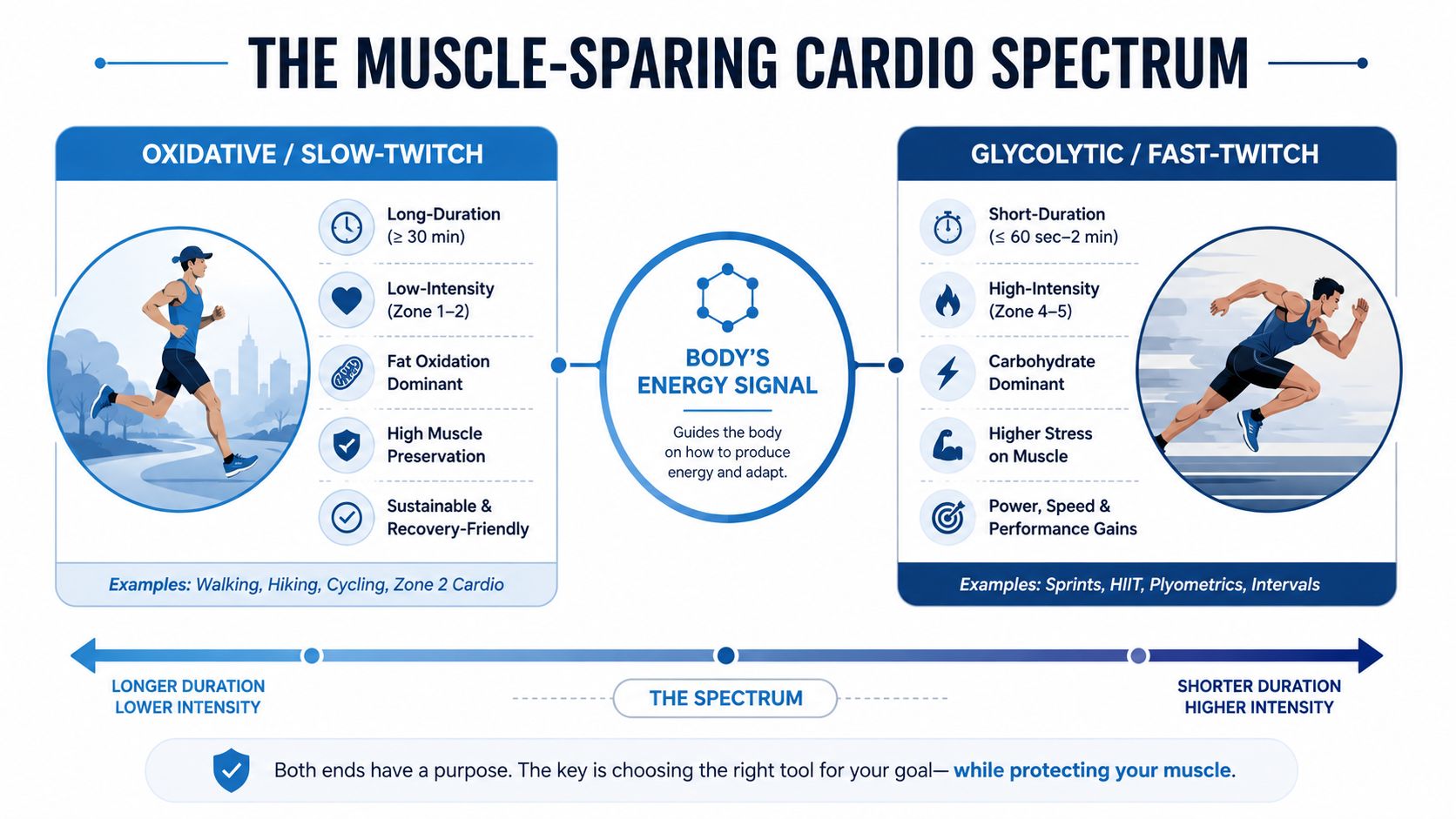
Why “sugar-hungry” exercise is useful
Electrical muscle stimulation cardio is often described as a sugar-hungry form of exercise because working muscle fibres draw on glucose and glycogen during demanding contractions. That doesn't make the exercise magical, and it doesn't remove the need for resistance training. It does make the metabolic demand different from passive movement or very light activity.
BionicGym uses leg-wrap electrical stimulation to contract large leg muscles while the user sits, works, watches television, or completes safe household tasks. Its product materials describe app-guided programmes and adjustable intensity, but outcomes still depend on consistent use and an intensity that produces a genuine exercise response. The relevant signs should be visible: heart rate rises, breathing becomes harder, skin warms, and a vigorous session can produce sweat.
The Irish guidelines define vigorous activity as 6.0 or more METs and recommend 1 hour 15 minutes to 2 hours 30 minutes of vigorous aerobic activity weekly, or an equivalent mix with moderate work (Ireland's national activity guidelines). They also state that 1 minute of vigorous activity can count as 2 minutes of moderate activity. Sensory markers help too. Moderate work raises your heartbeat and leaves you warm and slightly out of breath, while vigorous exercise makes you sweat and become breathless (Irish physical-activity intensity guidance).
For a deeper explanation of how this approach fits aerobic conditioning, read BionicGym's guide to muscle stimulation for aerobic conditioning.
The limitation practitioners shouldn't ignore
A sugar-demanding cardio session can complement muscle preservation, but it cannot replace progressive overload. If you want to retain size and strength while dieting, keep heavy or challenging resistance work in your programme. Cardio supplies a cardiovascular and metabolic stimulus. Lifting tells the body that force-producing tissue still has a job.
The safest combination is therefore simple: use a manageable cardio dose, keep its intensity purposeful, and protect the quality of your strength sessions. If an interval leaves your next squat, hinge, press, or pull session noticeably worse, reduce the volume or separate the sessions further.
Structuring Your Weekly Training Split
A reliable weekly plan starts with the movement that most directly protects muscle, then adds cardio where it supports fitness rather than competing with recovery. Resistance training should use progressive overload, meaning you gradually challenge the muscles through load, repetitions, range of motion, or exercise difficulty. Cardio should have a clear purpose, such as improving aerobic capacity, increasing daily activity, or helping create a calorie deficit.
The Irish framework gives adults a target of 75 to 150 minutes of vigorous activity weekly, or 150 to 300 minutes of moderate activity, alongside strength work (Ireland's national guidelines). Treat that as a health framework, not a requirement to begin at the top end.
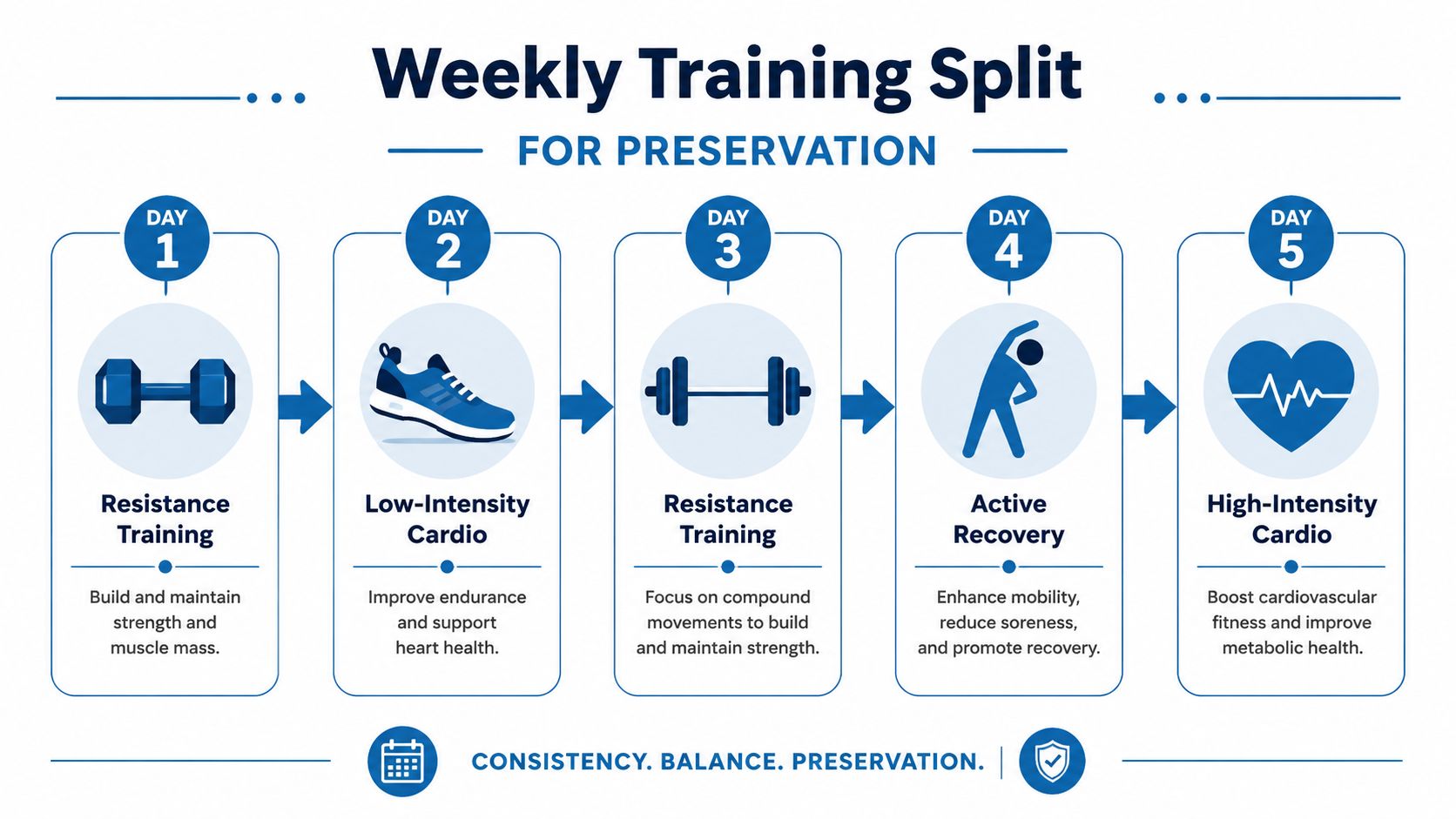
A practical five-day arrangement
| Day | Main work | Why it belongs there |
|---|---|---|
| Day 1 | Resistance training | Establishes the week's primary muscle-retention signal |
| Day 2 | Low-intensity cardio | Adds movement without demanding another hard leg session |
| Day 3 | Resistance training | Reinforces progressive overload after recovery |
| Day 4 | Active recovery | Keeps you moving while reducing accumulated fatigue |
| Day 5 | Vigorous cardio | Delivers a concentrated cardiovascular stimulus |
| Remaining days | Rest, walking, or easy movement | Adjusts the plan to your recovery and schedule |
Separate demanding cardio and heavy lifting by at least 6 hours when they must happen on the same day. Separate days are often better, especially if both sessions use the legs. Put the priority session first when you have no choice. If preserving muscle is the main objective, lift before cardio rather than exhausting the target muscles and then attempting quality strength work.
The split can also fit a desk-bound routine. A short walk at lunch, easy movement during breaks, and one concentrated vigorous session can be more sustainable than reserving all activity for a single long evening workout. The European Commission's Ireland factsheet frames adult activity around 30 minutes of moderate activity on 5 days per week, or 150 minutes weekly, while noting that shorter sessions count when they last at least 10 minutes (European Commission Ireland activity factsheet).
Training check: If your strength numbers, technique, mood, or sleep deteriorate, cardio volume is too high for your current recovery budget.
Use the progressive overload training guide to keep the resistance side organised. A maintenance phase may need less volume than a muscle-building phase, but it still needs meaningful effort and a load that remains challenging.
Nutrition and Protein Timing for Retention
Cardio can't preserve muscle if the rest of the plan signals scarcity and inactivity. During weight loss, the body has less energy available for training and repair, so food quality, protein intake, carbohydrate availability, and recovery become part of the training programme rather than separate lifestyle details.
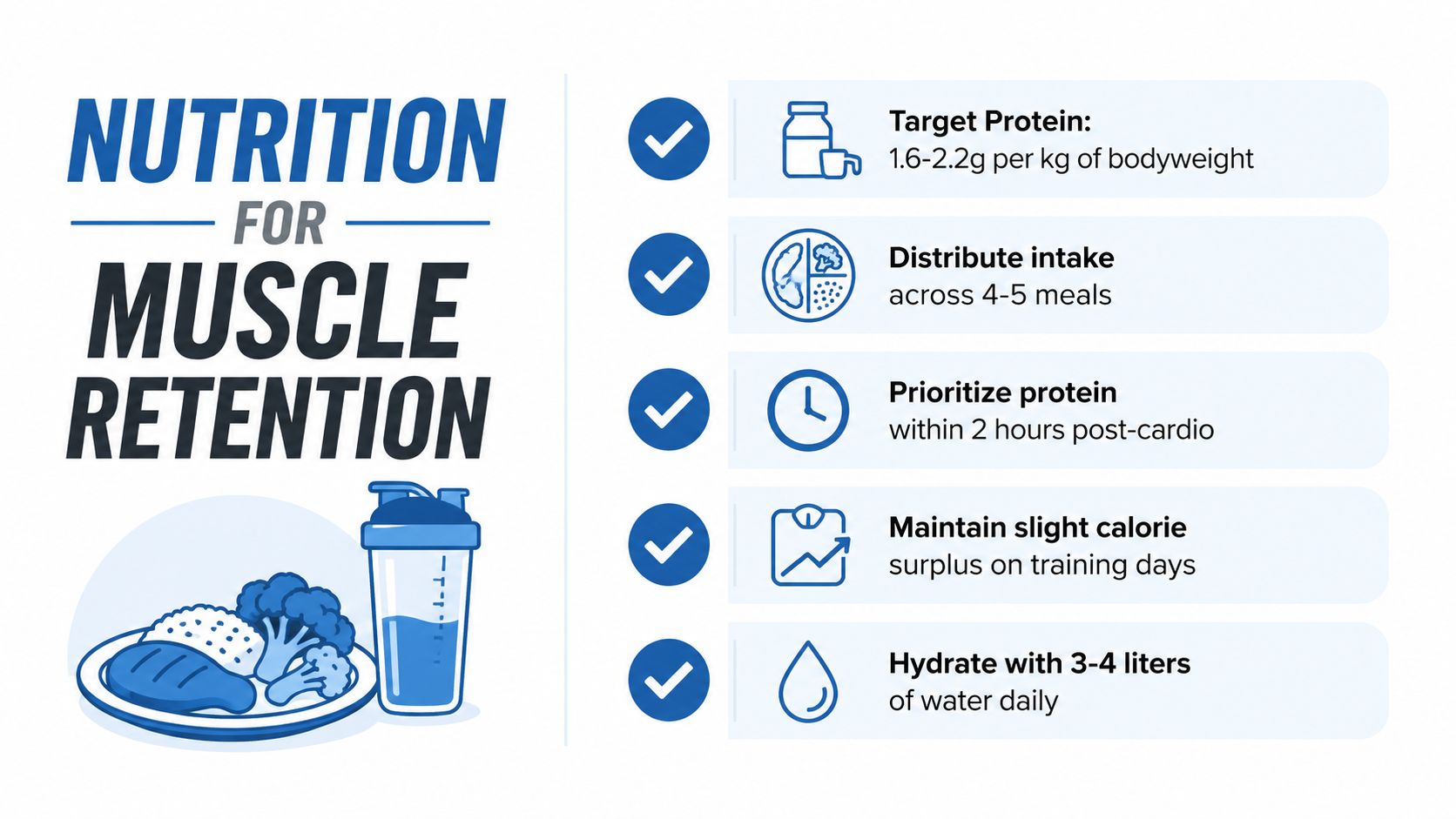
A commonly used protein range for preserving or building muscle is 1.6 to 2.2 grams per kilogram of body weight daily, but this figure comes from the supplied editorial framework rather than the verified Irish evidence. If you use it, apply it as a practical planning range, not a promise of a particular result. People with kidney disease or another serious medical condition should seek individual medical advice before making major dietary changes.
Build meals around the training demand
Sugar-hungry exercise can draw substantially on carbohydrate stores. That doesn't mean you need a high-carbohydrate diet, and it doesn't make low-carbohydrate or ketogenic eating incompatible with cardio. It does mean that repeated hard sessions can feel worse when you under-eat, fail to replace food, or expect the body to maintain high output without adequate recovery resources.
A useful structure is:
- Protein anchor: Include a clear protein source in each main meal.
- Training fuel: Place digestible carbohydrate before or after demanding sessions if it improves performance and recovery.
- Food quality: Build meals around minimally processed foods, vegetables, fruit, pulses, dairy or alternatives, eggs, fish, meat, tofu, nuts, and whole grains where they suit your diet.
- Deficit control: Use a controlled calorie deficit for fat loss. A deficit is necessary for weight loss, so exercise alone can't guarantee a change on the scales.
- Hydration: Drink consistently and adjust to thirst, sweat, climate, and medical advice.
The timing doesn't need to become obsessive. A protein-containing meal within a reasonable period after training is sensible, especially if the previous meal was several hours earlier. For practical meal ideas that support recovery, best muscle recovery foods offers a useful food-focused reference.
Keep the diet and exercise message honest
BionicGym, walking, swimming, cycling, and lifting can all contribute to energy expenditure, but none guarantees weight loss without dietary alignment. The responsible message is diet plus exercise, with enough protein and resistance training to protect function and lean tissue.
The sustainable weight-loss guide is useful for people who want to connect training with an eating plan instead of treating cardio as a way to compensate for unrestricted intake. Your best plan is the one that leaves you able to train, recover, and repeat the process.
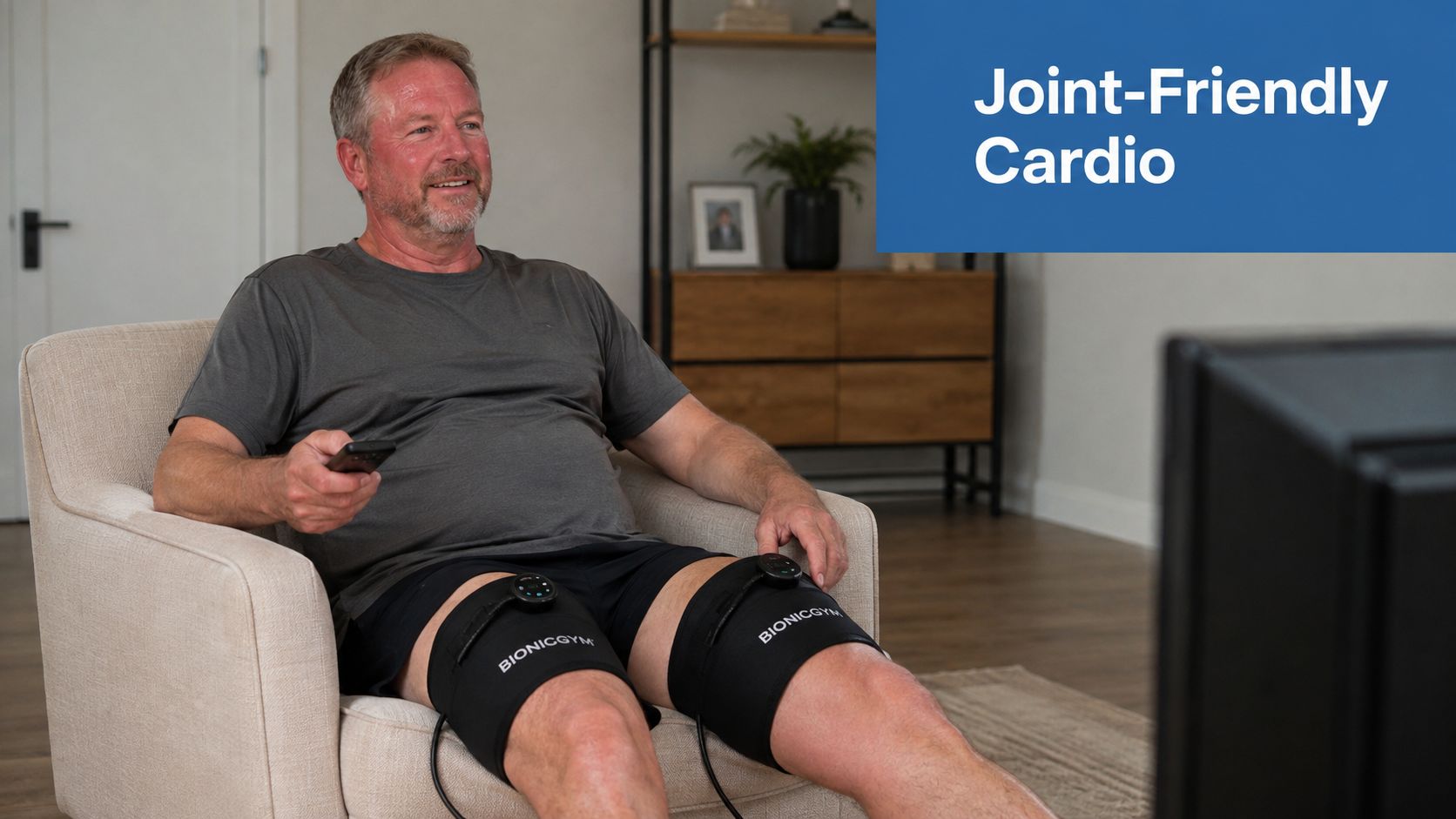
Low-Impact Devices and Joint-Friendly Options
Running is effective, but it isn't compulsory. Cycling reduces impact compared with running, although it still requires repeated joint movement and can create substantial local fatigue. Swimming removes much of the loading challenge, but access, technique, travel, and changing time can make it difficult for a desk-bound person to use consistently.
Electrical muscle stimulation offers a different route. BionicGym uses wearable leg wraps and app-guided programmes to stimulate leg muscles while the user remains seated or moves through safe, ordinary tasks. The contractions can create a real cardiovascular response, and the user should judge the session by what the body demonstrates, including rising heart rate, increased breathing, warmth, and sweat, rather than by the presence of a device alone.
Comparing the options
| Option | Main advantage | Main limitation |
|---|---|---|
| Running | Simple, accessible, weight-bearing | Can be unsuitable when impact aggravates symptoms |
| Cycling | Adjustable effort and familiar progression | Still involves repeated joint movement |
| Swimming | Low-impact whole-body conditioning | Requires pool access and technical confidence |
| Electrical stimulation cardio | Can be performed seated with little joint loading | Requires correct setup, gradual intensity, and consistent use |
| Resistance training | Direct muscle-retention signal | Needs equipment, technique, and progressive planning |
BionicGym's device information describes a lower-limb, non-weight-bearing approach that can fit around email, television, gaming, or household chores. That convenience matters because adherence often determines whether a plan produces any meaningful training effect. Gentle use may suit longer sessions, while more demanding programmes require the same caution as other vigorous exercise, including warm-up, monitoring, and recovery.
Read more about non-weight-bearing cardio equipment if running, walking, or cycling doesn't fit your current circumstances. Anyone with arthritis, an injury, or another medical condition needs a clear boundary between fitness information and medical advice.
Anybody with a serious medical condition or injury should consult with their medical practitioner before starting any new exercise programme.
BionicGym is a great way to exercise. It is not a medical treatment. Consult your doctor if you have a serious condition.
The product is FDA-cleared, not FDA-approved. That distinction matters because it describes a medical device clearance rather than a drug approval. It also doesn't remove the need to use the product according to its instructions or to stop if something feels unsafe.
Preserving Muscle on GLP-1 and During Weight Loss
People using GLP-1 medicines, including Ozempic or Wegovy, often focus on the weight that comes off. The more useful question is what proportion of that change comes from fat, water, and lean tissue, and whether strength and daily function remain stable. Recent evidence summarised in the supplied material describes substantial fat loss with relative preservation of skeletal muscle in GLP-1RA or GIP/GLP-1 RA therapy, while another report described average losses of 10.8 kg of fat and 0.63 kg of muscle in women over 6 months. Those findings don't make muscle loss irrelevant, and they don't justify treating cardio as a replacement for lifting.
Use a diet plus exercise approach. Keep resistance training as the primary muscle-preservation tool, maintain adequate protein, and add cardio that you can perform consistently without worsening fatigue or reducing your strength-session quality. For people who struggle to leave a desk or tolerate weight-bearing exercise, seated, muscle-stimulating cardio may provide a practical way to increase activity while keeping the legs engaged.
Readers considering medication during perimenopause may also find this overview of what perimenopausal women should know about GLP-1 useful, but medication decisions belong with a qualified clinician. For exercise planning around Wegovy or Ozempic, see BionicGym's guidance for Wegovy and Ozempic users.
Use the Weight Loss Calculator to explore how your food intake, activity, and intended schedule fit together. It won't guarantee a result, but it can make the relationship between calorie deficit and exercise more concrete.
Anybody with a serious medical condition or injury should consult with their medical practitioner before starting any new exercise programme.
BionicGym is a great way to exercise. It is not a medical treatment. Consult your doctor if you have a serious condition.
BionicGym offers app-guided leg-wrap electrical stimulation for adjustable, low-impact cardio that can fit around seated work, television, gaming, and safe household tasks. If you're building a routine focused on cardio without losing muscle, explore BionicGym, keep resistance training in place, and choose an intensity you can recover from and use consistently.