

How to Lose Weight Calculator Guide for Real Results
Have you failed at weight loss because your maths was wrong, or because the calculator gave you a promise it could never keep? A how to lose weight calculator is useful, but only if you treat it as a planning tool, not a crystal ball. It turns your body data and activity level into a starting calorie target, then you use that number to build a diet plus exercise plan that you can live with.
That matters in Ireland, where weight management is a real and ongoing concern. The Irish government's Healthy Weight for Ireland strategy reported that about 60% of adults were overweight or obese in the 2015 Healthy Ireland Survey, including 37% overweight and 23% obese, and a later 2022 survey found 35% reported being overweight, 21% reported being obese, and roughly 34% said they were trying to lose weight (Healthy Weight for Ireland). A calculator is only helpful if it leads to a practical plan, not wishful thinking.
Why a Weight Loss Calculator Only Works If You Use It Right
A calculator should answer a simple question, what should I do next? It should not tell you that weight loss is guaranteed, because it can't. Results still depend on what you eat, how consistently you move, and whether you keep following the plan after the first motivated week fades.
The most useful calculators do three things well. They estimate your maintenance calories, they subtract a sensible deficit, and they give you a starting point you can test against your real-world progress. That is why the right mindset matters more than the right app. If you expect certainty, you'll feel let down. If you expect an estimate, you can work with it.
In Ireland, the need for grounded guidance is even clearer because the official data show both the scale of the issue and the size of the audience actively trying to change it. The 2022 Healthy Ireland Survey found that about one-third of the population was currently trying to lose weight, which makes calculator-based planning especially relevant (Healthy Weight for Ireland). A good guide starts with the numbers, then shows you how to use them.
Practical rule: a calculator gives you a starting estimate, your habits decide the outcome.
If you want a simple way to think about the process, use this sequence, gather honest inputs, read the output as a range, build a diet plus exercise plan around it, then recheck the trend after a few weeks. For a broader primer on calorie deficit thinking, see the BionicGym guide on calorie deficit for weight loss.
Gathering the Right Inputs Before You Calculate
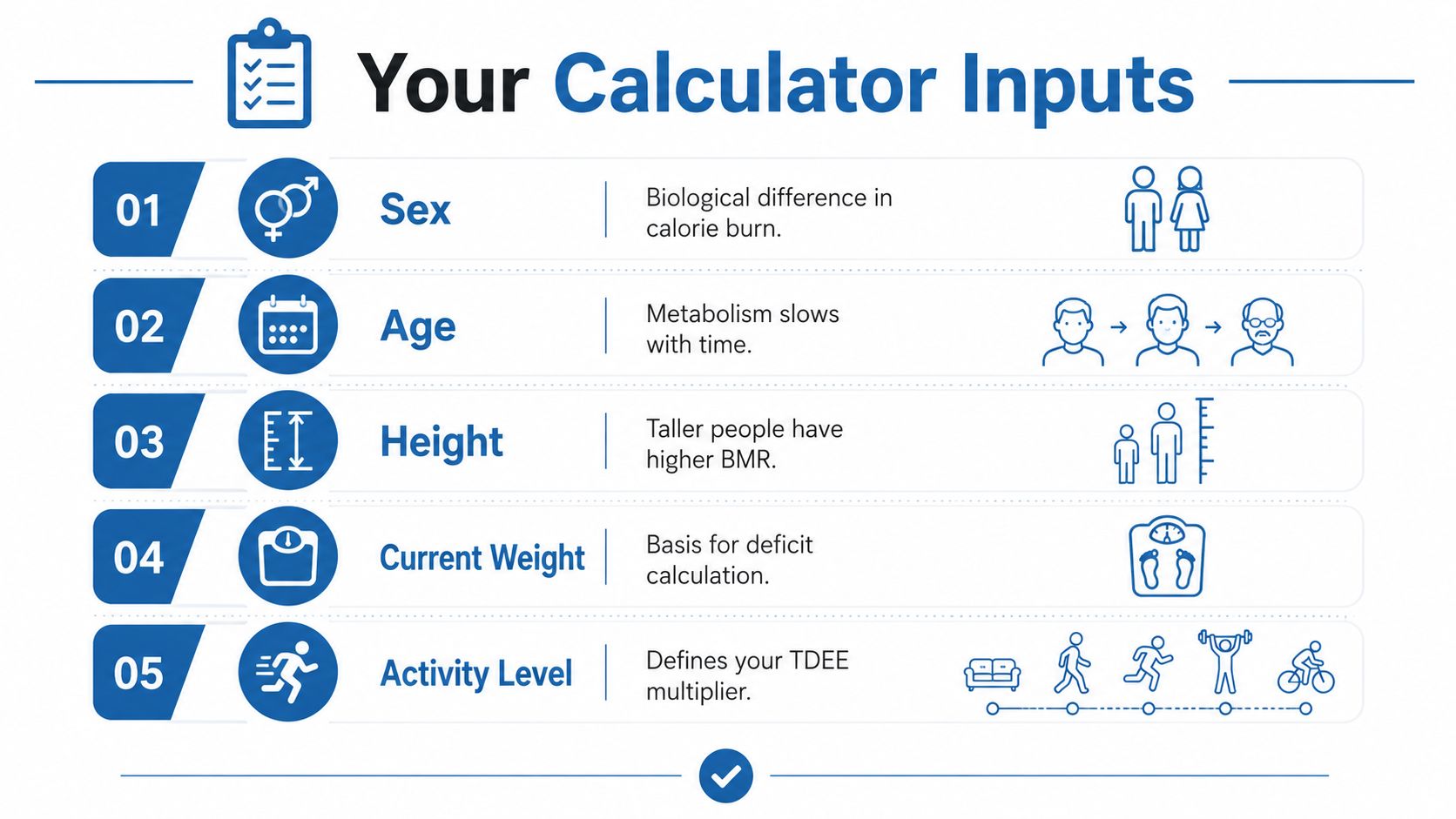
A useful calculator starts with five basics, sex, age, height, current weight, and activity level. Those fields matter because they shape both your BMR, your basal metabolic rate, and your TDEE, your total daily energy expenditure. In plain language, BMR is what your body burns at rest, while TDEE is the fuller number that includes everything from walking to workouts to ordinary daily movement.
Why each field changes the answer
Sex affects the estimate because male and female bodies often burn energy differently at the same size. Age matters too, because metabolism tends to slow over time. Height influences the total because taller bodies usually need more energy to run. Current weight is the base figure the calculator uses to estimate maintenance and a deficit. Activity level is the lever that can move the result the most, because it determines how much of your day is sedentary versus active.
The two inputs people get wrong most often are weight and activity. Many people guess their activity is higher than it really is, especially if they exercise a few times a week but sit for most of the day. Others rely on a stale number from months ago and ignore the fact that their weight has drifted.
Honest inputs produce honest outputs.
The easiest way to avoid bad data is to weigh yourself under consistent conditions, ideally at the same time of day, and choose the more conservative activity setting if you're unsure. If you need help turning that number into an actual fitness target, BionicGym's realistic fitness goals guide is a good companion resource.
For Irish users, these inputs fit the local context well. The Central Statistics Office's Irish Health Survey 2025 reported that obesity was highest among adults aged 55 to 64, affecting 30.6% of females and 29.3% of males in that age band (Irish Health Survey BMI results). That's another reason to be precise rather than optimistic when entering your details.
Reading Your Results Without the Wishful Thinking
The cleanest way to read calculator output is to separate maintenance calories, target intake, daily deficit, and projected weekly loss. Maintenance is the number that should keep your weight roughly stable. Target intake is the number below that. The daily deficit is the gap between the two, and the projected weekly loss is the estimate that follows from that gap.
Irish obesity-management guidance says that consistent loss of 0.5 to 1 kg per week is a realistic pace toward about 10% total body-weight reduction, and that this usually requires a daily deficit of about 500 to 1,000 calories (HSE-aligned weight guide). That is a helpful rule because it keeps your expectations tied to a real pace, not a fantasy timeline. It also makes clear why crash deficits are a problem, they look fast on paper but are harder to sustain and easier to rebound from.
Daily deficit versus expected loss
| Daily Calorie Deficit | Expected Weekly Loss | Notes |
|---|---|---|
| 500 calories | About 0.5 to 1 kg | A realistic starting point for many adults |
| 750 calories | Between the moderate and faster end | Better only if you can sustain it calmly |
| 1,000 calories | About 1 kg or more | More demanding, not ideal for everyone |
Treat those numbers as ranges, not deadlines. Bodies adapt, water shifts hide fat loss, and plateaus happen. A calculator can't promise the scale will drop in a straight line every week, because human physiology doesn't work like a spreadsheet.
A simple way to think about the math is this, if your deficit is too small, the trend may be slow, and if it's too large, the plan may collapse. The point is not to win the first week. The point is to keep the plan going long enough for it to matter.
For a deeper breakdown of calorie targets, BionicGym's weight loss calculator calories guide is worth reading alongside your own numbers.
Why Diet Plus Exercise Beats Either One Alone
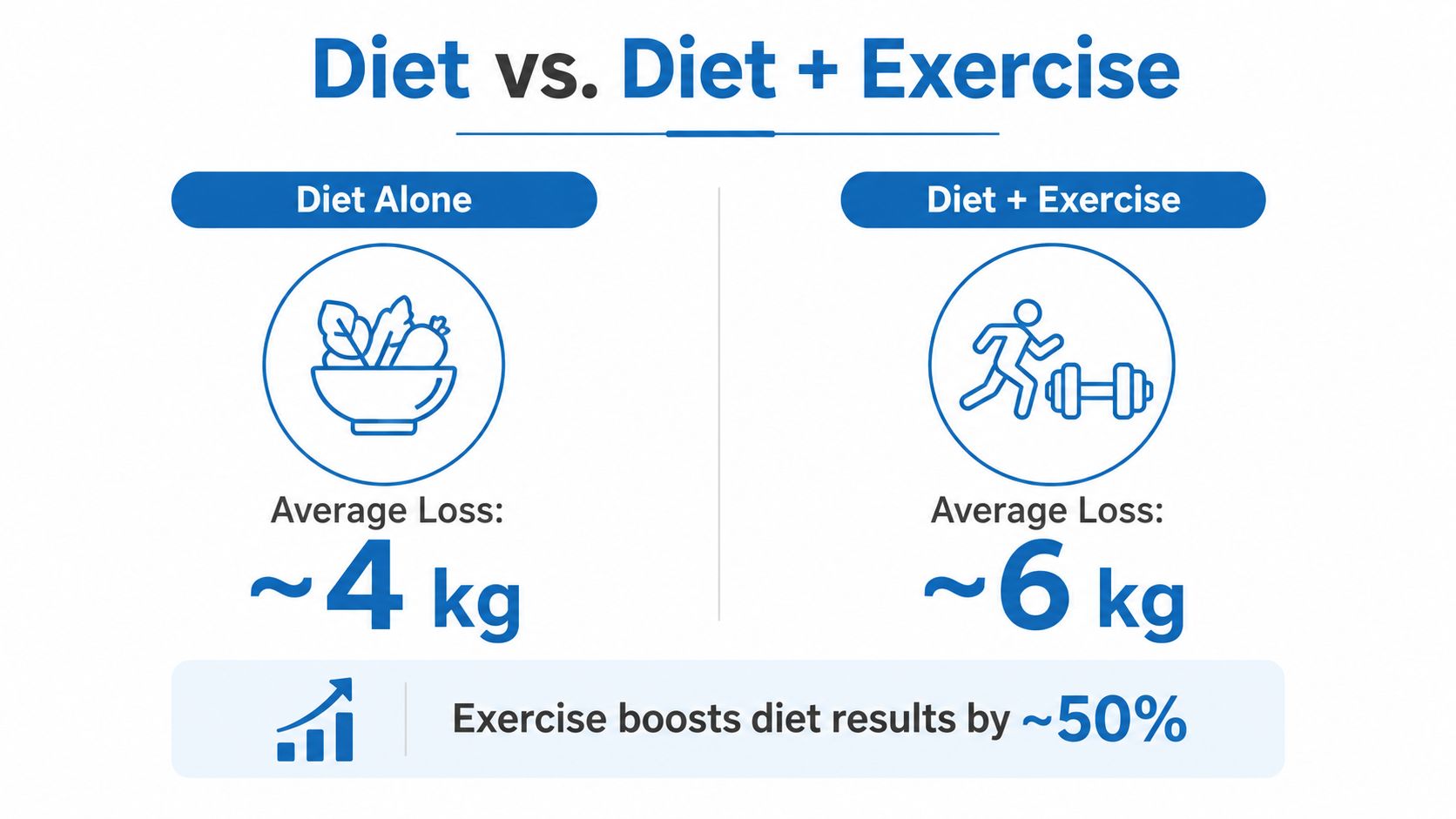
A lot of people assume the answer is just “burn more calories.” That sounds tidy, but Irish obesity-management evidence suggests the picture is more balanced. In one summary, physical activity alone produced about 2 to 3 kg of loss, while activity paired with dietary strategies produced about 6 kg (HSE weight guide). The point is not that exercise is weak. The point is that exercise works better when diet is part of the plan.
Exercise also does a different job during weight loss. It helps preserve muscle mass and physical function, which matters because the goal is not just a smaller body, but a body that still works well. Irish guidance also says that adults should do at least 150 minutes per week of moderate activity for general health, while weight loss usually requires more, about 60 to 75 minutes per day of moderate activity, or roughly one-third more than the standard adult guideline (HSE weight guide).
The activity targets that make the plan real
Irish guidance gives a second useful benchmark, adults need to use at least 350 calories per day in physical activity to avoid gaining weight, which is roughly 60 minutes of brisk walking or 30 minutes of jogging each day (Physical activity guidelines). That's a practical way to think about the exercise side of your calculator output.
Diet creates the deficit, exercise protects the body you're losing weight with.
If you want to support the food side of the equation, BionicGym's diet and healthy eating guide gives a sensible companion frame. And because every calculator should point you back to practical application, not abstract arithmetic, it helps to keep the local Irish activity standard in mind too, the national guidelines describe 2 hours 30 minutes to 5 hours of moderate activity per week, or 1 hour 15 minutes to 2 hours 30 minutes of vigorous activity per week, or an equivalent mix (Ireland physical activity guidelines).
Fitting Your Activity Target Into a Desk-Bound Life
The hard part isn't the maths, it's the calendar. If you sit most of the day, it can feel unrealistic to find the extra movement your calculator implies. That's exactly where a more flexible approach matters, because the Irish guidance now also says shorter bouts can count and sedentary time should be limited (Every Move Counts).
One practical option is BionicGym, an FDA-cleared wearable cardio system invented and developed by a medical doctor that lets users do exercise while working, watching TV, or doing chores. It's built around the idea that a workout doesn't always have to mean leaving your desk, and it fits the calculator problem because it helps people turn a weekly target into a usable daily habit. For a desk-bound user trying to match a calculator output, that can be the difference between a plan that exists on paper and one that gets done.

The most honest proof that exercise is real is visible. Raised heart rate, sweating, and breathlessness are the signs to look for, not vague claims. The Irish guidance also defines vigorous-intensity exercise as activity at 6.0 or more METs, which gives a clear threshold for how calculator-style exercise estimates should be understood (Ireland factsheet).
How the weekly dose adds up
The local evidence also gives a concrete calorie target for movement, roughly 1,000 to 2,000 kcal of movement energy per week is described as an efficient range for weight reduction in obesity-management guidance (obesity management evidence summary). That supports a more realistic question than “Can I burn it all at once?” The better question is, “Can I accumulate enough activity across the week to support the deficit my calculator gave me?”
For some people, the answer is yes with ordinary walking and scheduled workouts. For others, especially those with back pain or joint sensitivity, a no-impact approach may be easier to keep up. If that applies to you, SunnyBay's easy tips for chronic back pain is a useful read because it focuses on movement without pushing pain.
The main thing to remember is simple. A calculator can tell you the size of the gap, but your daily routine closes it.
Tracking Progress and Knowing When to Seek Advice
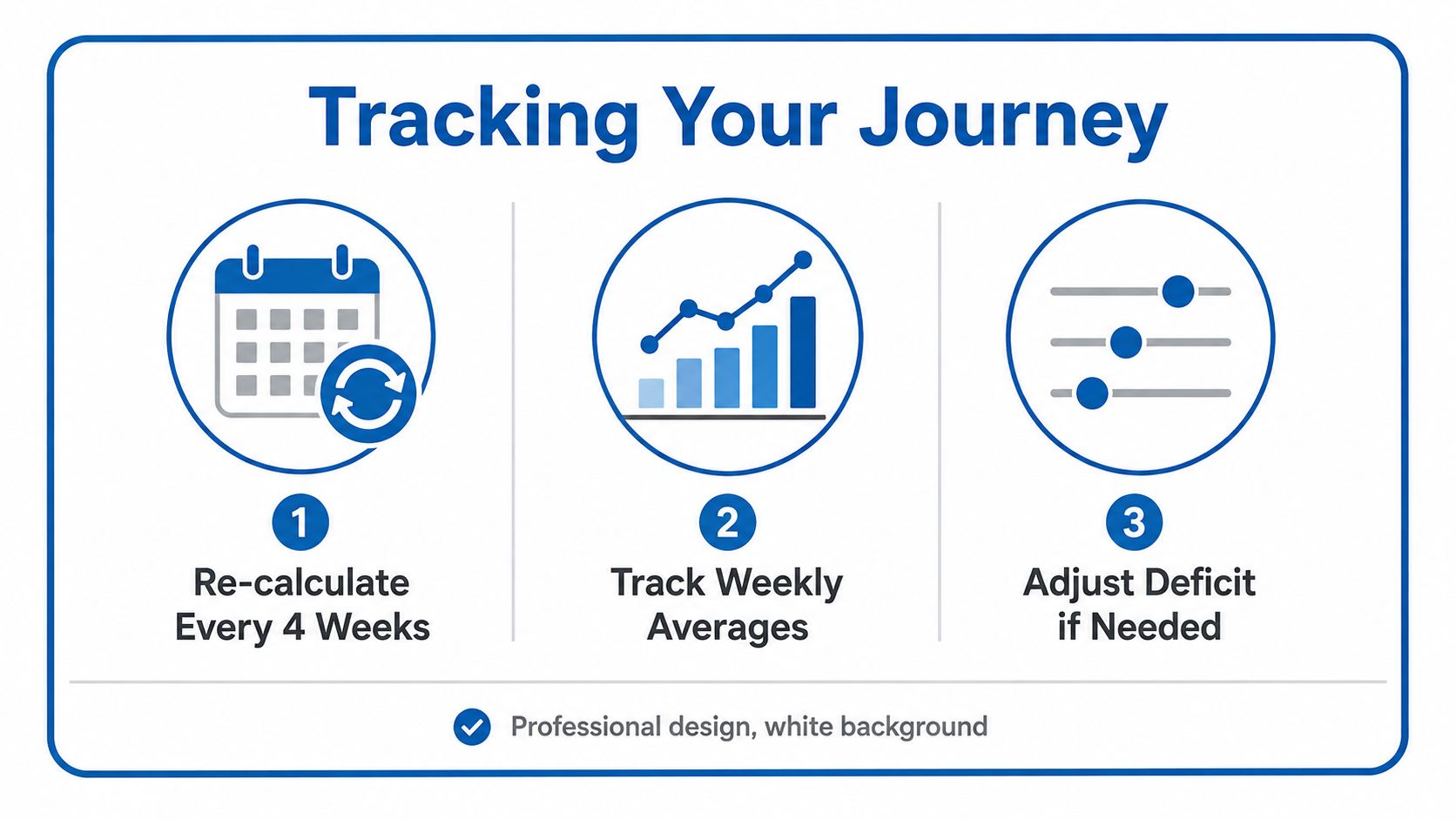
A calculator result isn't something you use once and forget. Re-run it every few weeks as your weight changes, because your maintenance needs change too. The most useful habit is to watch your weekly average weight, not a single day's reading, then adjust if the trend stalls for three or more weeks.
A simple follow-up routine
- Re-calculate every 4 weeks: Your body size and maintenance calories shift as you lose weight.
- Track weekly averages: Day-to-day scale swings are noisy, weekly trends are more honest.
- Adjust the deficit if needed: If the line stalls, tighten food intake slightly or increase your movement dose.
If you want to put the whole thing into practice, the sequence is straightforward, run your numbers on a how to lose weight calculator, choose your diet approach, schedule your daily activity, and review the trend monthly. That rhythm keeps the plan grounded in data rather than emotion.
Anybody with a serious medical condition or injury should consult with their medical practitioner before starting any new exercise program. BionicGym is a great way to exercise. It is not a medical treatment. Consult your doctor if you have a serious condition. If you'd like more social proof and ongoing motivation, explore BionicGym's reviews and community resources as part of your own routine.
BionicGym gives you a practical way to turn a calorie target into real movement, especially if you spend most of the day at a desk. It's built for people who want a realistic diet plus exercise plan, not a promise that ignores how life works. Visit BionicGym to see how it fits your weight-loss calculator results and your daily routine.