

Best Calorie Burn Tracker: A Clear Buyer Guide
The wrong question is often asked about the best calorie burn tracker. Comparing brands, obsessing over app screens, and assuming the fanciest device wins is backwards. If the tracker's measurement method doesn't match the way you train, the calorie number is just decoration.
Ireland is a good example of why this matters. A 2024 report found 81% of adults had used a connected health or fitness tracking device in the previous 12 months, and 71% had used an online fitness tracking app, with another 71% using a nutrition or food tracking app (RTE on Irish fitness and wellbeing spending). That kind of adoption means calorie tracking isn't niche anymore. It's a daily habit, which is exactly why the error pattern matters more than the marketing.
| Tracker category | What it's really good at | What it gets wrong most often | Best fit |
|---|---|---|---|
| Wrist wearable | Convenience and all-day wear | Calorie estimates during mixed or non-steady activity | People who want a general activity picture |
| Chest strap | Heart-rate precision during cardio | Comfort, convenience, all-day use | Serious cardio sessions |
| EMS system | Creating exercise stimulus while seated | It's not a general-purpose lifestyle tracker | Passive or low-movement training |
If you want the honest answer, the best calorie burn tracker is the one that fits your real training day, not the one with the most features. That means use case first, brand second.
Why the Best Calorie Burn Tracker Depends on You
A tracker can have excellent sensors and still be the wrong choice. Most roundup posts miss that point. They treat calorie burn like a fixed truth, when it is really an estimate built from assumptions about movement, heart rate, and your body profile. If those assumptions do not match the session, the number is weak, whatever the app looks like.
Mismatch is the real failure, not missing features
A wrist wearable that overreads your spin class is failing in one way. A passive training system that undercounts a seated session is failing in another. One issue comes from noisy movement, the other from an estimate built for a different kind of effort. In both cases, the tracker only helps if you know what it is good at before you trust the number.
Feature lists can mislead you fast. More widgets do not fix a bad measurement method. If your day is mostly desk work, the value sits in low-intensity consistency and trend tracking, not in a flashy exercise mode you will barely use.
Practical rule: choose the device that matches your body position and your workout style, not the one with the longest spec sheet.
The Irish wearable data points in the same direction. When 54% of people used internet-connected wearable devices overall in 2024 and 11% used internet-connected devices for health and medical care such as fitness trackers, the market had clearly moved past early adopters (Insight Centre / Irish Times coverage). Once a category is mainstream, the smarter buyer asks which method is least misleading for the actual routine. For a closer look at how resting burn is usually modelled, see the basal metabolic rate calculator guide.
Calorie numbers are only useful inside a realistic routine
Ireland's national activity guidance says adults start getting health benefits from at least 150 minutes per week of moderate activity, and it defines vigorous activity as at least 6 METs (National Guidelines on Physical Activity). That matters because fitness is about repeated behaviour, not one perfect screen readout. A tracker should support that habit, not pull attention away from it.
If your workouts are steady and repetitive, a heart-rate device may be enough. If your day is fragmented, your joints are sensitive, or your sessions happen while sitting down, the right category changes. The answer follows the session.
How Calorie Burn Trackers Actually Measure Effort
Three measurement philosophies dominate this market, and they don't work the same way at all. While only the front-end app is immediately visible, the key difference lies in the signal the device trusts. Heart rate, movement, and direct muscle stimulation each tell a different story.
Heart rate and motion are not interchangeable
Heart-rate-based trackers use beats per minute, then infer calorie cost from personal data like age, weight, and fitness estimates. That works best when effort is continuous and the heart rate reflects the work being done. It's weaker when the wrist is compressed, the motion is erratic, or the workout is mostly static strength.
Motion-based systems do something else. They read acceleration and movement patterns, then map those patterns to energy estimates. That's fine for step counts and running cadence, but it can miss hard work that doesn't look dramatic on an accelerometer.
Heart rate is a strong proxy for cardio demand, but it is still a proxy.
Physiological systems are different again. EMS platforms stimulate muscle contractions directly, so the system is creating measurable work rather than guessing from movement. That gives them a clear advantage in seated or low-movement use cases, but it also means they're not a general-purpose tracker in the same way a watch is.
| Measurement Methods at a Glance | Core Signal | Best For | Common Failure |
|---|---|---|---|
| Heart rate | Beats per minute and recovery response | Steady cardio, trend tracking | Static lifting, wrist compression, interval noise |
| Motion sensing | Acceleration and movement pattern | Steps, cadence, general activity | Workouts where effort doesn't match movement |
| Physiological stimulation | Muscle contraction and session intensity | Seated or low-movement training | Broad lifestyle tracking |
The reason this matters for Irish users is simple. In 2024, 71% of adults used an online fitness tracking app and 71% used a nutrition or food tracking app (RTE). That means plenty of people are already combining activity and intake data. The tracker that wins is the one whose signal is the least misleading for the workout they repeat most often.
Choosing the Right Tracker Category at a Glance
The fastest way to choose is to match your dominant workout with your dominant body position. If you spend your day moving between desk, car, and home, the answer is different from someone training for road cycling or someone trying to keep active while protecting sore joints. The device should fit your life first, your ambition second.
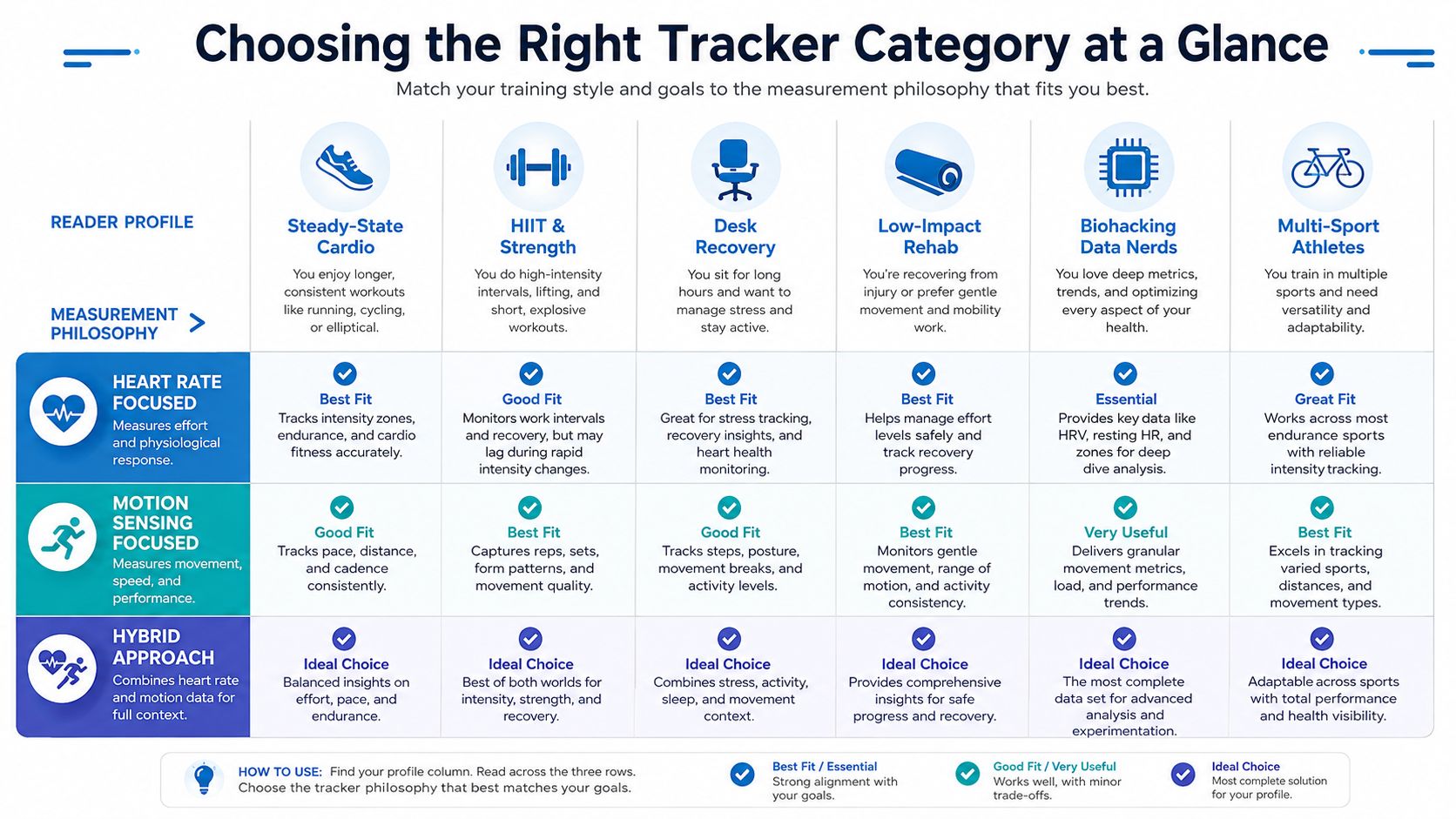
Quick decision matrix
- Steady-state cardio, choose a heart-rate wearable or a chest strap if you care about tighter exercise data.
- HIIT and strength, chest straps usually beat wrist-only trackers because they handle rapid heart-rate changes better.
- Desk recovery, a wearable or a seated physiological option makes more sense than a sports-first device.
- Low-impact rehab, pick the method that gives you effort without forcing joint load.
- Biohacking data nerds, choose the tool with the cleanest data export and the least vague calorie math.
- Multi-sport athletes, look for a category that stays reliable when the session changes shape.
That's the useful lens. Not “Which model has more features?” but “What does my week look like?” If your training is built around walking, cycling, or mixed cardio, heart-rate systems usually make more sense. If you need better second-by-second data during intervals, a chest strap earns its place. If your priority is training stimulus without much movement, the category shifts again.
For a broader look at how wireless options are being discussed in the market, the wireless fitness tracker update is worth a read. The point isn't to collect more product names, it's to narrow the field fast. Match the sensor to the session, not the session to the sensor.
Eight Features That Matter in a Tracker
If you are comparing devices seriously, stop staring at colour screens and start asking harder questions. Most day-to-day value comes from whether the tracker gives you believable data, usable zones, and a setup you will keep wearing. The rest is noise.
Use the features that affect real decisions
- Signal accuracy against a known benchmark. If a tracker cannot stay close to a reference standard, its calorie output is just a guess with nicer branding.
- Heart-rate zones tied to your thresholds. Generic zones are lazy. Personal zones make the data more useful.
- VO2max estimates with realistic error bars. You want trend value, not a magic number.
- MET reporting that turns into usable calorie math. If the app cannot explain the output, it is hard to trust.
- Battery life that holds up in real use. A device that dies mid-week is a bad habit waiting to happen.
- All-day comfort. If it is annoying at your desk or in bed, you will stop wearing it.
- App depth and export options. Your data should move cleanly into the systems you already use.
- HSA or FSA eligibility. If a device can be partly offset by pre-tax funds, that affects the cost.
| Eight Tracker Features and Why Each Matters | What It Measures | Threshold to Demand | Real Cost of Skipping It |
|---|---|---|---|
| Accuracy | Closeness to a benchmark | Consistent trend reliability | You act on bad calorie numbers |
| Heart-rate zones | Intensity bands | Personalised thresholds | Training stays generic |
| VO2max estimate | Aerobic capacity proxy | Trendable, not absolute | You cannot see fitness change clearly |
| MET reporting | Exercise intensity math | Readable output | Calorie data becomes opaque |
| Battery life | Endurance of the device | Multi-day usability | You charge too often and stop wearing it |
| Comfort | Wearability | All-day tolerance | Sleep and desk use suffer |
| App ecosystem | Data syncing and export | Works with your tools | Your data gets trapped |
| HSA or FSA use | Pre-tax cost offset | Eligible if possible | You overpay for the same hardware |
A useful Irish benchmark is daily spending on fitness and wellbeing services. The same 2024 report estimated total annual spending at €562 million, with the average adult spending €143 in the prior year, and men averaging €213 versus €122 for women (RTE). That does not tell you which device to buy, but it does show people pay for convenience and repeat use. If a tracker fails on comfort or app flow, the money is wasted.
For a practical example of a device built around workout control and tracked output, BionicGym's wearable cardio system shows how a structured training tool can make the session itself easier to measure.
Comparing Wearables, Chest Straps, and EMS Systems
The three main categories solve different problems. Wrist wearables are the most convenient, chest straps are the most precise for heart-rate work, and EMS systems create a training session from muscle stimulation rather than motion. If you try to force one category to do all three jobs, you'll be disappointed.
Wearables win on convenience, not on perfect calorie math
Wrist devices are easy to wear, easy to sync, and good enough for many people who want a broad activity picture. They work best when you care about consistency over clinical precision. Their weakness is obvious during intervals, gripping, cycling, or anything that distorts optical heart-rate readouts.
Chest straps are the accuracy-first choice for cardio sessions. They're better when you care about second-by-second heart-rate response and cleaner data during hard efforts. The trade-off is simple, they're less comfortable, less versatile, and useless when you're not wearing them.
EMS systems sit in their own lane. They're designed to stimulate muscle and create exercise stimulus even when you're seated, which is why they appeal to people who want a training session that doesn't depend on body movement. The limitation is scope, because they're not trying to be your all-day lifestyle device.
A useful outside perspective comes from the newest fitness trend guide, which helps place device trends in a broader fitness context. That matters because consumer buyers often confuse novelty with usefulness. The newest thing isn't automatically the right thing.
| Tracker Category Comparison: Wearables vs Chest Straps vs EMS | Accuracy | Comfort & Wear Time | Calorie Method | Best For | Main Limitation |
|---|---|---|---|---|---|
| Wearables | Moderate, activity-dependent | High for all-day use | Heart rate plus motion | Everyday activity tracking | Calorie drift during harder sessions |
| Chest straps | High for cardio heart-rate work | Lower for all-day wear | Heart rate only | Serious cardio and intervals | Limited comfort and no lifestyle use |
| EMS systems | Session-specific | Depends on setup | Muscle stimulation and session intensity | Seated or low-movement training | Narrower use case |
Ireland's physical activity guidance for adults with chronic conditions recommends 2 hours 30 minutes to 5 hours of moderate-intensity aerobic activity per week, or 1 hour 15 minutes to 2 hours 30 minutes of vigorous activity per week, plus muscle-strengthening activity on 2 or more days per week (gov.ie guideline summary). That's the backdrop. The best tracker is the one that helps you do the work your life can sustain.
For people using an EMS approach, BionicGym's EMS muscle stimulator overview is the relevant reference point. It belongs in this comparison because it solves a different problem from a watch, not because it pretends to be one.
Best Calorie Burn Tracker by Real-Life Use Case
The right choice changes once you stop pretending every reader trains the same way. A desk-bound person, a low-impact mover, and a data-heavy biohacker want different things from the same screen. Good buyers pick the device that makes their actual life easier.
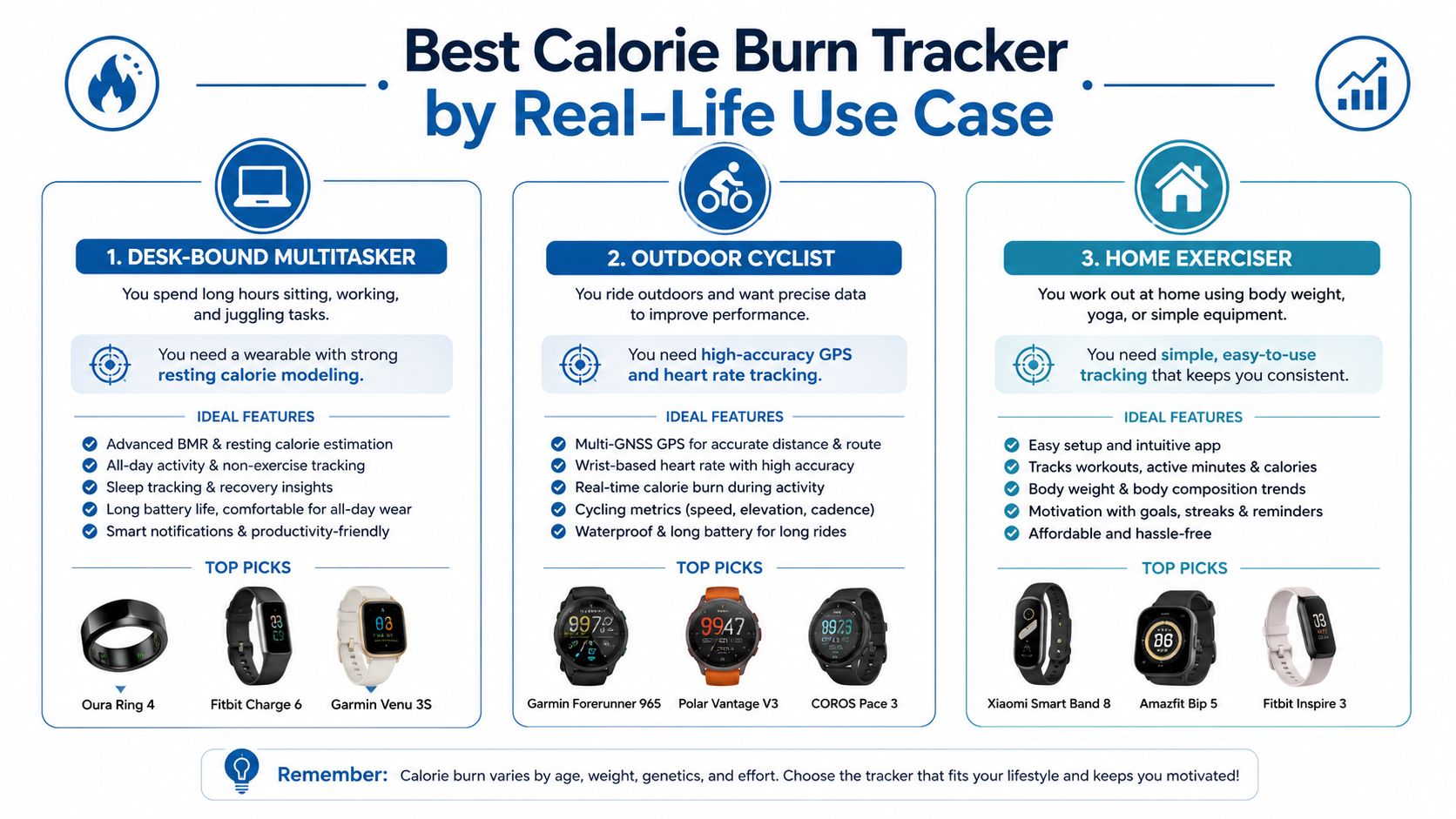
Desk-bound multitasker
If most of your day is spent at a desk, your best option is a tracker that handles low-intensity movement well and doesn't become annoying to wear. You care about sleep, steps, recovery, and how much of the day you've spent sitting. A device with stable resting estimates and decent heart-rate capture during light movement is enough.
That's the category for people who want to stay honest about sedentary time without turning exercise into a second job. A rigid sports-only device is overkill here. A tool that disappears on the wrist is usually the smarter buy.
Low-impact seeker
If you prefer walking, swimming, joint-friendly training, or you're managing soreness, the tracker has to be honest without being fussy. The priority is capturing effort without making your joints or your schedule pay for it. That rules out anything that only shines during high-motion workouts.
In practice, that means choosing a device that stays usable when you're not pounding the pavement. People in this group need consistency, comfort, and a calorie estimate they can treat as a trend, not a verdict. If a tracker only feels accurate when the workout is intense, it's the wrong fit.
Biohacker
If you care about data quality, export, thresholds, and training load, buy for information depth. You want to see whether the numbers relate to your broader routine, not just whether a single workout looks impressive. More serious users stop caring about vanity metrics and start caring about signal quality.
For people who also want a seated cardio option, BionicGym is one example of a system built around muscle stimulation rather than movement, with the app used to control intensity and track estimated calories burned. That makes it relevant for multitaskers and low-movement sessions, but it's still a training tool, not a magical shortcut. The data should be read as session estimates and long-term trends, not a promise.
Bottom line: if your main workout is moving, pick a movement-first tracker. If your main workout is seated or low-movement, pick a tool built for that reality.
Ireland's use patterns make these use cases more than theoretical. The same 2024 report noted 71% of adults used video workouts and 50% used online gaming platforms (RTE), which tells you plenty of people are already trying to fit training into a home-based, screen-heavy day. The best tracker for that person is the one that fits the environment they already live in.
Your Final Calorie Tracker Decision Framework
Stop chasing a perfect calorie number. No consumer tracker gives you precise calorie burn, and pretending otherwise just creates bad decisions. The right device is the one whose error pattern you can live with.
Use a three-step filter
First, define your dominant activity. If your week is mostly steady cardio, heart-rate tracking belongs at the top of the list. If it's steps, short reps, or mixed movement, motion sensing becomes more relevant. If it's seated or low-movement training, a physiological approach starts to make more sense.
Second, decide how much the screen number should matter. If you only need a trend, a wearable is usually enough. If you need tighter exercise data, lean harder towards heart-rate precision. If the point is to create a training session while staying in place, pick the tool built for that.
Third, check comfort, battery, and app fit. A tracker you tolerate for weeks beats a more accurate one that stays in a drawer. The device has to survive your routine, not an idealised version of it.
| Step | What to Ask | Decision |
|---|---|---|
| 1 | What do I do most often? | Choose the matching measurement method |
| 2 | How precise do I need the calorie number? | Set your trust level |
| 3 | Will I actually wear it all day? | Filter by comfort and battery |
| 4 | Does the app fit my workflow? | Check syncing and export |
| 5 | Would a bad number change my behaviour? | If yes, lower the reliance on it |
A strong reality check comes from the accuracy evidence in Ireland-linked coverage. Calorie estimates can be off by roughly 20% to 80% depending on device and activity, while heart-rate tracking is usually much better than calorie math (Kygo accuracy article). That's why the useful question is not “Which tracker is best at calories?” It's “Which tracker is least misleading for the way I train?” For a device designed around seated training and intensity control, visit BionicGym and judge it against your own routine, not against hype.