

Best Wearable Fitness Device: Top 2026 Picks & Reviews
Most advice about the best wearable fitness device starts from the wrong assumption, that better tracking automatically means better health. A watch that counts steps, heart rate, and sleep can be useful, but it still leaves the hardest part untouched, you have to do the exercise yourself. For many people in Ireland and the UK, the main question is not which device records the most data, it is which one helps you get meaningful cardio done in a busy day.
The market has clearly outgrown the niche-gadget phase. Analysts have described a large, established category, with consumer adoption now broad enough that buyers should expect more than novelty. That means accuracy, battery life, comfort, and real-world value matter as much as features on a spec sheet.
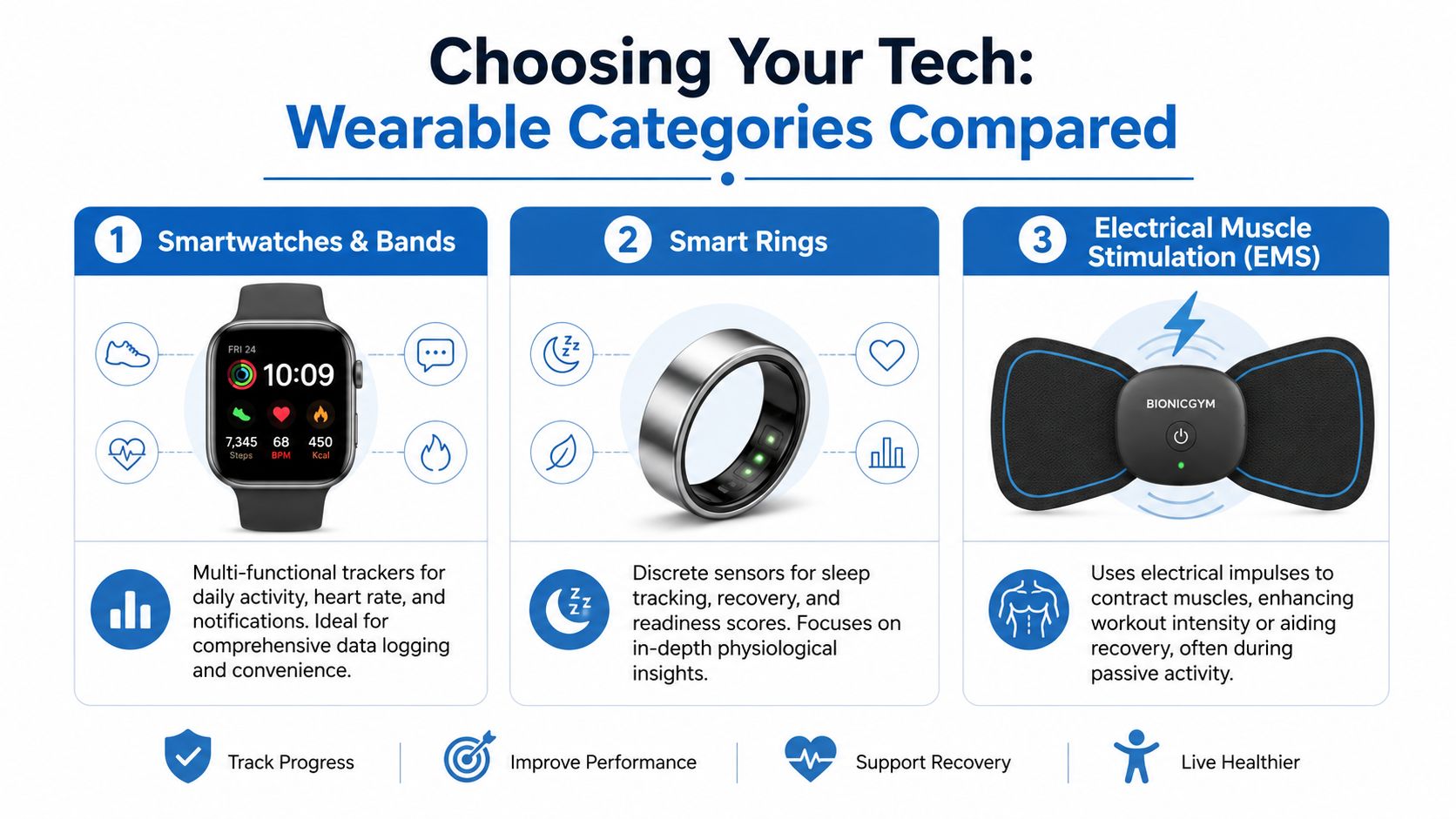
| Category | What it does well | Main limitation | Best fit |
|---|---|---|---|
| Smartwatches and bands | Broad tracking, notifications, coaching | Still passive, you must create the workout | People who want all-in-one logging |
| Smart rings | Discreet sleep and recovery tracking | Limited active workout utility | Users who prioritise recovery data |
| EMS exercise systems | Delivers exercise while multitasking | Narrower focus than a full smartwatch | People who want exercise delivery, not just tracking |
The sensor side matters, but only up to a point. WatchClick's sensor tech guide gives a clear look at how modern devices collect movement and physiological data, and why sensor quality affects what the device can report. The limitation is unchanged, sensors can inform decisions, but they cannot replace the workout itself.
That distinction matters most for people who sit for long stretches, travel often, or prefer low-impact exercise that can fit around work and family life. A passive tracker can tell you what happened. An active system changes what happens next. The broader product discussion also sits alongside the wireless fitness tracker update, which shows how the category has moved toward devices that support actual exercise delivery rather than logging alone.
Rethinking Fitness Wearables Beyond Data Collection
A fitness tracker that only measures activity can still be useful, but it does not solve inactivity on its own. That is why so many people end up with a polished dashboard and the same habits. The device has no physiological effect unless the user acts on the numbers.
Tracking is not the same as training
The modern category is built on measurement, and measurement has limits. The market has expanded around familiar device types and established ecosystems, which tells you more about product maturity than about any sudden breakthrough. The real question is whether the device changes behaviour in a way that matters to the body.
Heart-rate and activity data can support smarter training, but only if they are tied to a plan a person will consistently follow. A watch that gets ignored after the novelty wears off is just an expensive reminder.
Practical rule: if the device only reports effort, you still need a separate plan for doing the effort.
That is why WatchClick's sensor tech guide matters. It explains how modern devices collect movement and physiological data, and why sensor quality affects what a device can report. The limitation remains the same, sensors can inform decisions, but they cannot replace the workout itself.
A useful comparison point is the body's own response to exercise. Wearables are strongest when they help you match intensity to a purpose, not when they merely fill charts. That is why many consumer devices focus on heart rate, sleep, and distance, while specialised systems aim to create a larger training effect during the time you already have.
The current crop of consumer reviews leans heavily toward general-purpose tracking. That is not wrong, but it is incomplete. For people with desk-heavy lives, the better metric is often not how much data you collected, but how much actual work your body did while the rest of life kept moving. For that use case, the most relevant shift is toward exercise delivery, which is why the conversation increasingly includes tools like the wireless fitness tracker rather than watches alone.
The Six Critical Criteria for Choosing Your Device
Start with heart rate. It is still the baseline signal for exercise intensity, and the PPG sensor remains the most common sensor in wearables. A review of wearable fitness devices reported that 71% of new devices included PPG, while 50% also included GPS (PMC review of wearable fitness devices). If a device cannot measure heart rate with reasonable consistency, then effort zones, aerobic training, and calorie estimates all become less dependable.
1. Sensor quality comes first
Heart-rate sensing is the foundation. More sensors do not automatically mean better results, because extra features only help if the signal is clean and the app turns that signal into something useful. A device that looks impressive on the box can still give poor feedback if its measurements drift during movement or if the software obscures the meaning of the data.
Validation work has shown that accuracy varies even among familiar consumer devices. One peer-reviewed comparison reported indoor walking accuracy of Withings Pulse at 99.90%, Fitbit at 99.60%, and Jawbone at 97.70%. Another repeatability study found Withings Pulse was the most accurate and repeatable wearable studied for step and distance tracking, with 99.90% accuracy and 0.86 repeatability for indoor walking (PMC repeatability study). That is a practical reminder that popularity is not a substitute for measurement quality.
2. Battery life and wearability affect adherence
If a device is uncomfortable or always dead, it will not be worn consistently. The device that gets used is the one you can forget about until you need the data. Comfort matters because adherence depends on it, and a tracker that stays in the drawer produces no physiological benefit.
3. Subscription cost changes the real price
Recurring fees can turn a reasonable purchase into an expensive habit. Engadget's roundup highlights fitness trackers that do not lock core features behind a monthly subscription, and that matters because buyers need durable value rather than another bill (Engadget on subscription fatigue). Judge the total cost of ownership, not only the sticker price.
4. Decide whether you want tracking or exercise delivery
This split matters more than brand names. Most devices record what you did. A smaller class of systems is built to deliver the workout itself, which is a different proposition for people whose schedules make standard training hard to repeat. If the goal is to create actual exercise during the time you already have, that difference should drive the choice.
5. Low-impact options are essential for some users
For joint-sensitive users, the device should fit the body rather than force the body to fit the device. The practical goal is usable cardio without provoking pain. That matters for desk-bound people, deconditioned users, and anyone who needs a way to stay active without pounding the knees, hips, or back. The FDA-cleared wearable cardio device is a useful reference point for this category because it shows how exercise delivery can be built around low-impact use.
6. App ecosystem and data access should be transparent
A good app does not bury the important numbers behind layers of prompts. It should make the basics easy to read and the progress easy to understand, especially if you want to compare workouts or see whether the device is doing what you bought it for. If you cannot interpret the data, you cannot use it.
The practical question before buying is simple. Does this wearable help me train better, or does it mainly help me watch myself fail to train?
Comparing Wearable Categories Watches Rings and EMS
The category matters more than the brand name. Smartwatches, smart rings, and EMS systems solve different problems, and treating them as interchangeable leads to disappointing purchases. The right choice depends on whether you want broad lifestyle tracking, discreet recovery data, or actual exercise delivered with minimal friction.
Smartwatches and bands
Watches are the familiar option because they combine several functions in one device. They track daily movement, heart rate, and workouts, and they usually make the most sense for people who want one tool for life, work, and training. The trade-off is straightforward, they still rely on you to create the training stimulus.
For a broad consumer benchmark, TechGearLab recommends the Garmin Vivoactive 5 as best overall because of its tracking, wearability, and coaching features (TechGearLab fitness tracker review). That kind of recommendation fits someone who wants a general-purpose tool. It does not make it the right answer for people who need something more passive.
Smart rings
Rings are strong for discreet monitoring, especially sleep and recovery, and they fit well when the goal is low-friction data collection. They are less useful during active exercise because they do not deliver the workout, and they are not built for the same hands-on training experience as a watch. If your question is, “How did I sleep?”, a ring can help. If your question is, “How do I get cardio while working?”, it is the wrong category.
EMS exercise systems
EMS systems sit in a different lane. Instead of just logging activity, they use electrical impulses to create muscle contractions and turn idle time into exercise time. That makes them attractive for desk-bound users and for people who struggle to fit traditional workouts into the day.
A useful company-specific reference is BionicGym's EMS exercise page, because it shows the core contrast in this category, exercise delivery rather than pure data capture. The logic is practical. If you can work, read, watch TV, or handle chores while the device is doing the training work, consistency becomes easier to maintain.
The best category is the one you will actually use on ordinary days, not the one with the longest spec sheet.
Subscription fatigue also changes the picture. As noted by Engadget, some mainstream wearables hide core features behind recurring fees, which makes ownership more expensive over time (Engadget on subscription fatigue). That matters if you want durable value, not a device that behaves like a rental.
Which Wearable Fits Your Life Matching Device to Persona
A desk-bound professional doesn't need the same tool as a runner, and a person with joint sensitivity shouldn't be sold a device that assumes high-impact training. The best wearable fitness device is the one that fits the body, the schedule, and the actual problem. For some people, that means a watch. For others, it means a system that creates exercise while the day continues.
Desk-bound high performers
If your working day is mostly seated, discreet, non-watch solutions fill a real gap. Wareable has highlighted the demand for wearable options that fit around work and sedentary routines, and the underlying question is simple, what can you wear for hours without interrupting productivity? (Wareable on discreet fitness tracking) That is where exercise-delivery systems make the most sense.
For this user type, the value is not just calorie burn, it's continuity. A device that can be worn while emailing, gaming, or doing admin work is easier to sustain than a workout plan that depends on a perfect calendar slot. In the BionicGym material, the passive calorie burn for remote workers angle is aimed exactly at that problem.
Low-impact seekers
If you have knee, hip, back, or general joint sensitivity, the priority is straightforward, get the heart working without loading or flexing the joints. That makes the case for no-impact cardio much stronger than the case for a more complex watch. A device can be advanced and still be the wrong fit if it encourages movements you can't tolerate.
BionicGym is one option in this space because it's designed as exercise rather than tracking. BionicGym is a great way to exercise. It is not a medical treatment. Consult your doctor if you have a serious condition. Anybody with a serious medical condition or injury should consult with their medical practitioner before starting any new exercise program.
Biohackers and low-carb users
People using Keto, low-carb, or fasting protocols often care about sugar-hungry exercise, not just calories on a screen. That's a physiology question, not a gadget question. Exercise that drives a real cardio response while fitting a constrained schedule can make consistency easier without demanding extra gym time.
GLP-1 users and weight-management planners
For people using GLP-1 medications, the bigger concern is often preserving lean mass while continuing to move regularly. A wearable that only reports passive metrics doesn't solve that. You need exercise in the plan, and you need a system that's realistic enough to keep using.
A live example of the product angle is BionicGym's weight-loss calculator, which is built around planning rather than hype. That kind of tool is more useful than vague promises because it anchors expectations to actual use.
Maximising Results With Diet and Realistic Expectations
No wearable guarantees weight loss. A calorie deficit still matters, and that means diet plus exercise, not one in place of the other. Devices help most when they make the exercise side of the equation easier to repeat.
Treat the wearable as a tool, not a verdict
Consumer wearables are useful for steps, sleep, heart rate, and distance, but energy-expenditure estimates can be unreliable, so they should be treated as wellness data, not infallible truth (Women's Health on tracker limitations). That is a healthy way to think about the whole category. The device can guide decisions, but it can't override physiology.
The same is true for weight change. If intake stays high, output alone won't solve it. If intake improves and exercise becomes more consistent, the device becomes much more valuable.
Build around sustainable use
The best plan is the one you can repeat without drama. Short bursts of motivation don't matter much if they collapse after two weeks. Steady use, paired with food choices you can live with, is what changes body composition.
Internal guidance on that principle is in sustainable weight loss with diet plus exercise. The practical takeaway is that the wearable should support your routine, not become another complex project.
If a device supports longer sessions without demanding a full workout slot, that can help adherence. Some users prefer a traditional watch for that reason, others prefer a system that turns otherwise passive time into exercise time. Either way, the principle doesn't change, results come from what you do.
Safety Disclaimers and Final Considerations
Most consumer wearables are excellent for guidance, but they're not medical diagnosis tools. That's why heart rate, sleep, and energy estimates should be used as decision support rather than absolute truth. The point is to improve habits safely, not to turn a wrist device into a lab instrument.
BionicGym sits in a different regulatory category, and it should be described correctly as FDA-cleared, not FDA approved. It's also important to keep the claims grounded in exercise, not treatment. BionicGym is an excellent form of exercise, which is a pillar of treatment for metabolic health. It is not a medical treatment. Consult your doctor if you have a serious condition. Anybody with a serious medical condition or injury should consult with their medical practitioner before starting any new exercise program.
The best wearable fitness device is the one that matches your goals, your body, and your willingness to keep using it. If your priority is passive tracking, choose a device that does that cleanly. If your priority is actual exercise delivery, choose a system built for that job, and judge it by whether it helps you train consistently without making your day harder.
If you want a wearable that goes beyond passive tracking and helps create real exercise time in a busy day, visit BionicGym. It's built for people who want cardio that fits around work, home life, and low-impact routines. If that's the kind of wearable fitness solution you've been looking for, take a look at the device, the app, and the weight-loss tools today.