

Weight Loss Calculator Time: Setting Realistic Horizons
You enter your weight, height, age and target, then the calculator hands you a neat finish date. It looks authoritative. It may even feel motivating. Then real life arrives, your workday keeps you in a chair, a weekend meal pushes calories higher, and the date suddenly looks more like fiction than a plan.
That's why weight loss calculator time needs an honest interpretation. The result isn't a promise, and it isn't a verdict on your effort. It's a planning estimate built from energy intake, estimated maintenance calories, activity and the horizon you choose. In Ireland, that realism matters. The HSE says 60% of adults and more than one in five children and young people live with overweight and obesity, while Central Statistics Office data classified 21.5% of people in Ireland as obese in 2025. The HSE's obesity information makes the wider point clear, this is a persistent public-health issue, not a niche fitness problem.
Use the calculator to set a sensible direction, then adjust it as your body and routine provide better information. The date should serve your habits, not pressure you into a crash diet.
Why the Time Field in a Weight Loss Calculator Matters
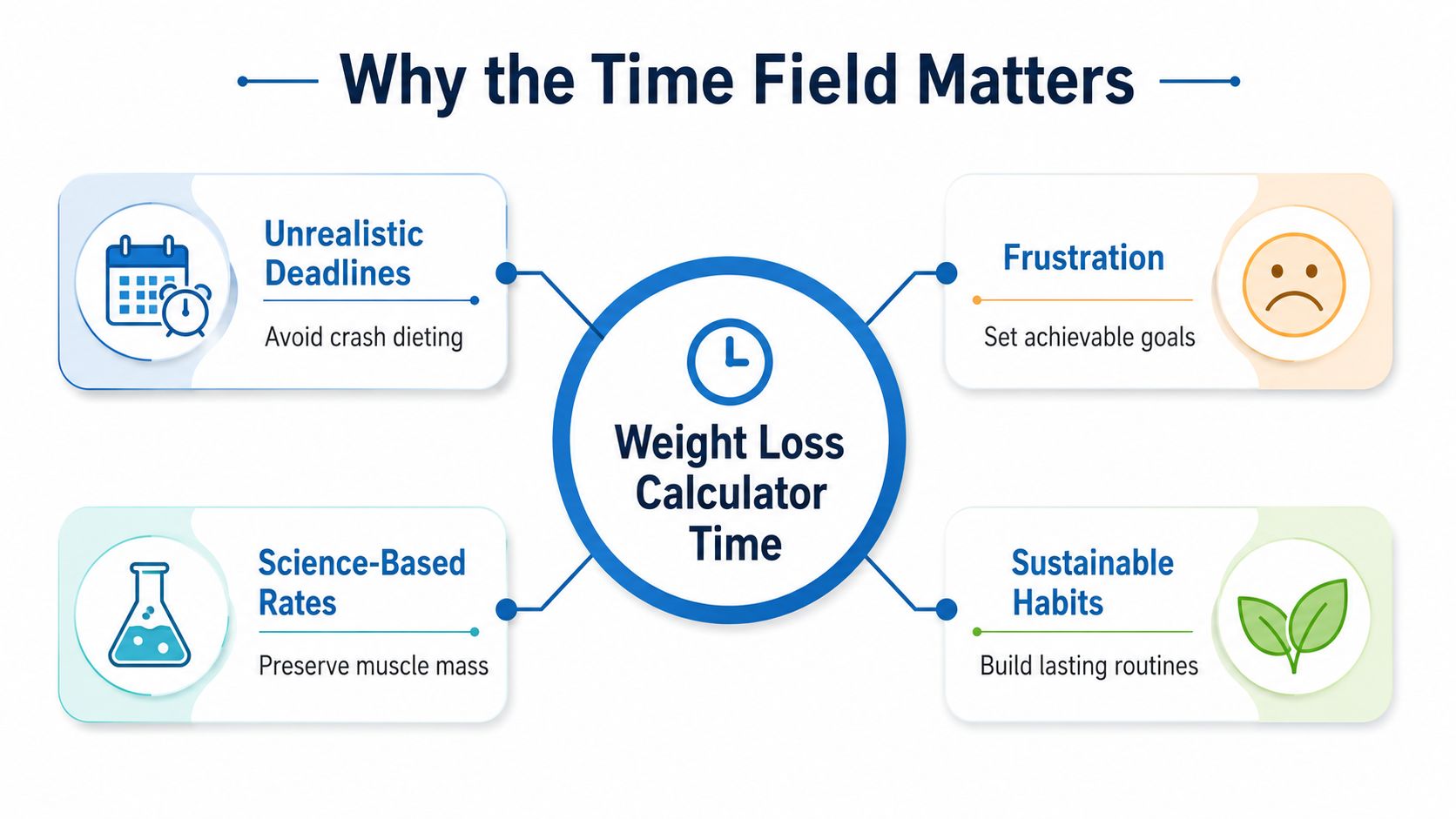
You've probably had the same frustrating experience. You plug in your numbers, enter a goal, and receive a deadline that would require you to eat very little or train far more than your life allows. The calculator hasn't necessarily failed. You've asked it to solve an unrealistic timeline.
The time field is a planning lever. It tells the calculator how quickly you want to reach the target, which determines the size of the daily energy deficit required. A short horizon demands a larger gap between calories consumed and calories used. A longer horizon allows a smaller deficit, more flexibility with meals and a more realistic amount of activity.
Treat the date as a testable assumption
The same age, height, starting weight and goal can produce very different graphs when you change the horizon from eight weeks to twelve months. The shorter option may force severe restriction or an unrealistic training load. The longer option can fit a moderate food adjustment alongside ordinary movement.
Irish nutrition guidance commonly starts with a deficit of about 300 to 500 kcal per day, while some people with a BMI of at least 30 may be advised to consider a larger 500 to 1,000 kcal daily deficit with appropriate professional oversight. Apex Nutrition's Ireland-based calorie calculator guidance supports the stepwise approach, establish maintenance first, then apply a measured deficit.
That doesn't mean the calculator knows your exact finish date. It assumes your inputs remain reasonably consistent, but work stress, illness, travel, appetite and activity rarely behave so neatly.
Practical rule: If the deadline requires a plan you can't imagine following through a difficult month, extend the horizon before you start.
A credible horizon protects adherence. It also gives you room to preserve strength, learn portions, build movement into your day and recover from ordinary disruptions. The aim isn't to make the graph look impressive on day one. The aim is to still be following it when motivation has faded.
How to Enter Your Numbers and Pick a Horizon
Start with the BionicGym weight loss calculator, then treat its result as a planning estimate. It should help you choose a workable intake and timeline, not push you toward the lowest possible calorie target.
Step one, enter honest starting data
Add your current weight, goal weight, age, height and sex. Use a consistent recent weigh-in if your weight fluctuates, rather than selecting the lowest reading. Set a specific goal that the calculator can test without requiring an extreme deficit.
Step two, estimate maintenance calories
The tool starts with basal metabolic rate, or BMR, then adjusts the estimate according to activity. Irish guidance uses multipliers from about 1.2 times BMR for sedentary adults to near 1.9 times BMR for very active people. This Irish calorie calculator resource explains how the selected activity level changes estimated maintenance calories.
Choose the lowest category that matches your normal week. Do not select “very active” because you plan to train more later. Use that category only when the activity is already routine. For a clearer explanation of resting energy needs, read the basal metabolic rate calculator guide.

Your sedentary hours matter as much as formal workouts. A low-intensity BionicGym session may add background movement without changing your whole day, while PRO+HIIT can justify a different activity assumption if you complete it consistently. Enter the routine you follow, then compare how each realistic activity setting changes the projected date on the graph.
Step three, choose the deficit
For most users, begin within the 300 to 500 kcal daily range. Build the deficit through food, movement or both. Keep the food reduction manageable and let activity support it, rather than expecting exercise to rescue an unsustainable diet.
Step four, choose the horizon
Enter the number of weeks if the calculator allows it, or let the tool estimate the timeline from your goal and deficit. If the projected date looks implausibly close, extend the horizon. Do not force the calendar to match impatience.
Step five, read the outputs together
Review projected weight, target date, weekly rate, assumed activity and deficit as one picture. A date without those assumptions provides little guidance. Recheck your inputs every two to four weeks, especially after changes in weight, movement or routine, following BionicGym's calculator guidance.
The common errors are predictable: activity set too high, maintenance calories overestimated and a horizon chosen for urgency rather than a plan you can keep.
Short-Term Versus Long-Term Projections
An eight-week deadline can look attractive because it creates urgency. The problem is that urgency often gets converted into an excessive calorie cut. If the target requires a deficit above 1,000 kcal per day, the plan may depend on severe food restriction, a punishing training schedule or both. That's not a clever shortcut. It's a fragile arrangement.
A horizon of six to twelve months gives the same goal more room. The required deficit can sit closer to the 300 to 500 kcal daily range, supported by modest activity and repeated adjustments. The timeline may look slower, but it has a better chance of surviving work pressure, family commitments and social meals.
| Horizon | Daily Deficit (kcal) | Weekly Loss (kg) | Adherence Risk |
|---|---|---|---|
| Eight weeks | May require an aggressive deficit | Faster projected rate | High |
| Six months | Often fits a moderate deficit | Gradual projected rate | Lower |
| Twelve months | Allows smaller adjustments | Slower projected rate | Lower, if reviewed regularly |
The exact weekly result depends on the person and the quality of the inputs. Water shifts, inconsistent tracking and changes in movement can all make the scale disagree with the graph for a while. Read the trend, not one weigh-in.
Activity assumptions can move the date
A calculator using an activity multiplier of 1.55 may produce an earlier finish than one using 1.2, even when the starting information is identical. The first assumes substantially more daily energy use. The second reflects a mostly sedentary routine.
That difference matters because many people choose the activity level they hope to achieve instead of the level they currently maintain. When the expected activity never arrives, the projected date drifts.
For a plain explanation of the energy relationship behind these estimates, see how calories relate to fat loss. The useful conclusion isn't that a fixed calculation can predict your body perfectly. It's that the deficit must be realistic enough to repeat.
How Activity Level Changes Your Timeline
A desk-bound day and a moderately active day produce different maintenance estimates before any workout is counted. Irish calculator guidance places sedentary activity near 1.2 times BMR, while active categories rise through approximately 1.55 to 1.7, with very active people approaching 1.9. Ireland's total daily energy expenditure guidance explains why the activity multiplier can shift a weight-loss projection more than people expect. Use this guide to calculating total daily energy expenditure to understand how BMR and daily movement combine.
Run the calculator twice with the same weight, age, height and intended deficit. Enter 1.2 for a largely seated day, then choose the multiplier that matches the activity you maintain. The projected finish date changes because estimated daily energy expenditure changes.
| Activity Level | BMR Multiplier | Projected Weekly Loss | Weeks to Lose 8kg |
|---|---|---|---|
| Sedentary desk routine | 1.2 | Depends on the chosen deficit | Calculator output varies |
| Moderately active | 1.55 | Depends on food intake and movement | Calculator output varies |
| Very active | Up to 1.9 | Depends on recovery and adherence | Calculator output varies |
The table leaves the final rate open for a reason. Without your actual BMR, calorie intake and repeatable activity, a precise projection would be invented. Set the multiplier from your current routine, then update it only when that routine has become consistent.
Sitting time counts even when workouts exist
A short workout does not erase a long day of sitting. Irish public-health guidance defines sedentary behaviour as waking activity at 1.5 METs or less, and national guidance stresses reducing prolonged low-movement periods. Ireland's physical-activity and sedentary-behaviour guidelines support counting movement across the whole day, not only formal exercise.
Light housework, work-related walking, standing, household tasks and daily steps all help describe your activity category. Do not count them as structured training, but do not ignore them either. A calculator estimate fails when one hard session is treated as proof that the rest of the day is active.
A multiplier isn't a personality type. It's a snapshot of what you repeatedly do.
Treat activity as a variable you can improve. Add ordinary movement first, then use structured options such as BionicGym sessions to raise expenditure without claiming an activity level your daily life does not support.
Mapping BionicGym Sessions to Your Calculator Output
The calculator gives you a target deficit. Your job is to decide how much comes from food and how much comes from activity. BionicGym can be one option for adding exercise while sitting, working or doing household tasks, but its effect depends on intensity, session length and consistent use.
The product's Standard format is intended for gentler, sustained sessions. PRO+HIIT is designed around harder intervals. Communications about performance should stay realistic: a typical vigorous level should be presented as about 500 calories per hour, and long, low-intensity sessions can create substantial cumulative expenditure. Individual burn varies with intensity, body size, conditioning and heart-rate response.
Build the week around the target
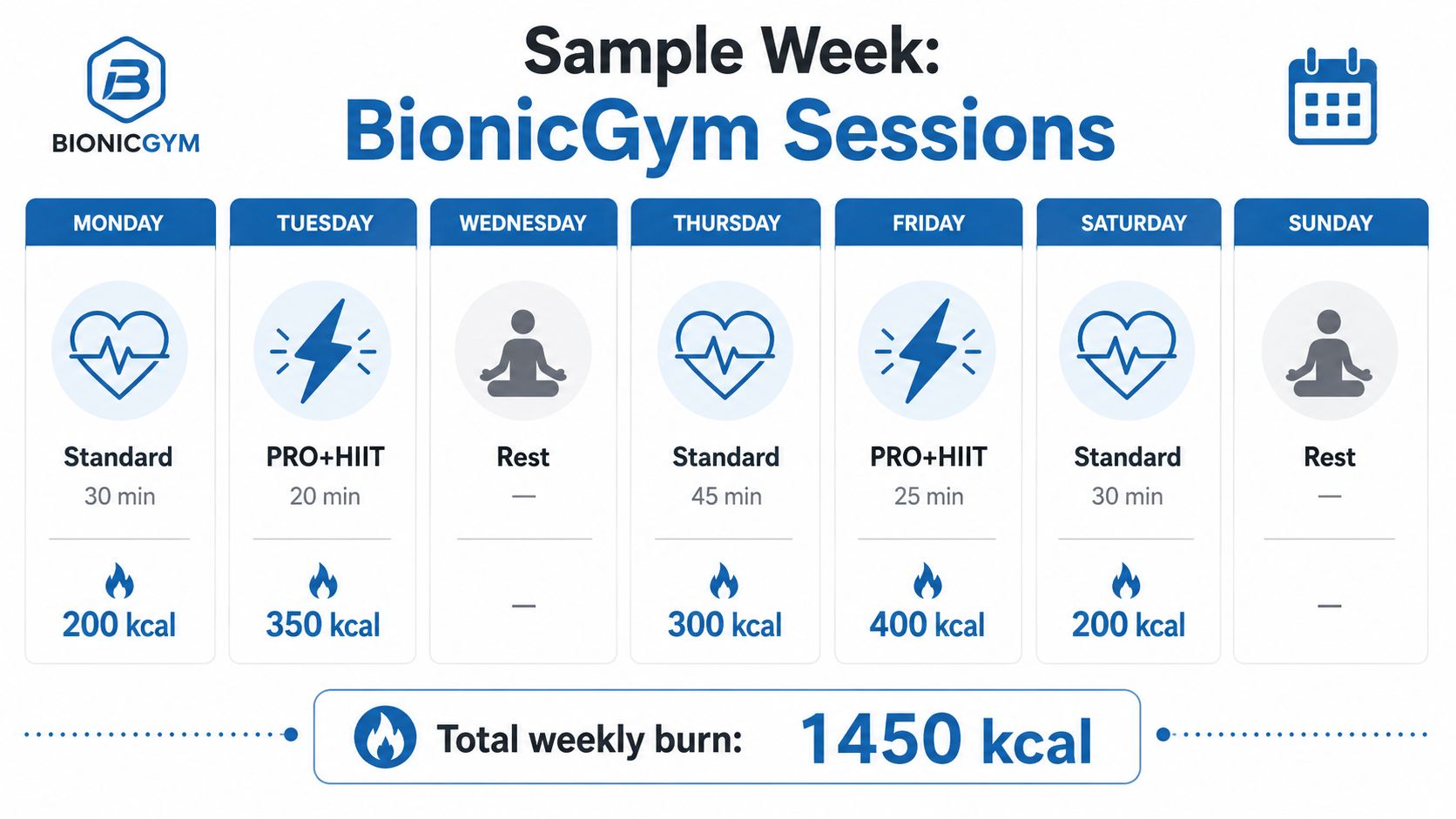
For a calculator target near 0.5 kg per week, start with a schedule you can repeat rather than one that looks heroic:
- Standard sessions: Use gentle background sessions during desk work or television.
- PRO+HIIT session: Reserve harder intervals for a day when you can focus on effort and recovery.
- Walking: Add short walks to raise ordinary daily movement.
- Review: Feed your actual usage back into the calculator instead of assuming every session reaches its maximum.
The infographic's example week shows a 1,450 kcal total weekly burn, with sessions ranging from 200 to 400 kcal. Treat those figures as a visual planning example, not a personal promise. Your own result may be lower or higher.
Watch the accompanying demonstration for how session intensity looks in practice:
A calculator graph may move the projected date earlier when additional activity is logged, but don't manufacture a new deadline from estimated burn. Heart-rate data, body composition and session adherence change the picture. The BionicGym weight-loss targets guide is useful for connecting planned sessions to the calculator rather than treating exercise calories as guaranteed credit.
BionicGym is a wearable electrical-stimulation exercise system, developed with medical expertise and cleared by the FDA. It can provide exercise without loading or flexing the joints, but it isn't a replacement for a balanced diet or professional advice.
Why Diet Plus Exercise Holds the Timeline Together
A 500 kcal deficit can disappear quickly. One missed walk and one large dinner may erase the gap the calculator assumed. The tool can't see the extra cooking oil, the untracked drinks, the poor sleep or the week when work keeps you at your desk.
Food creates the primary energy boundary. Exercise gives you another route to support that boundary, while helping you maintain a routine that doesn't depend on eating less and less. That combination is more resilient than relying on restriction alone.
Use the Irish activity benchmark
Ireland's national guidance recommends at least 150 minutes per week of moderate activity, or 75 to 105 minutes of vigorous activity, and says physical activity combined with a healthy diet supports faster loss and better maintenance than diet alone. The Every Move Counts guidelines provide the practical benchmark.
A sensible split might be a manageable food reduction plus regular exercise. For example, combining a 300 kcal food adjustment with activity that contributes roughly 200 kcal on an exercise day can feel more flexible than demanding the full 500 kcal from food every day. Those figures describe the planning logic, not a guaranteed outcome.
The food side still needs quality. Choose meals that make the target easier to hold, and use resources such as smart choices for weight loss when you need practical snack ideas without turning every afternoon into a willpower contest.
Make the plan durable
Exercise also gives you a way to increase output without continually shrinking portions. The HSE notes that people who have lost significant weight may need 60 to 90 minutes per day of moderate activity to help prevent regain, so your long-term plan may need more movement than your initial loss phase.
The most useful rule is simple: protect the food number, grow the activity number and let the timeline reflect both. This guide to sustainable weight loss through diet and exercise puts the same principle into a practical framework.
Realistic Expectations, Safety Notes, and When to See a Doctor
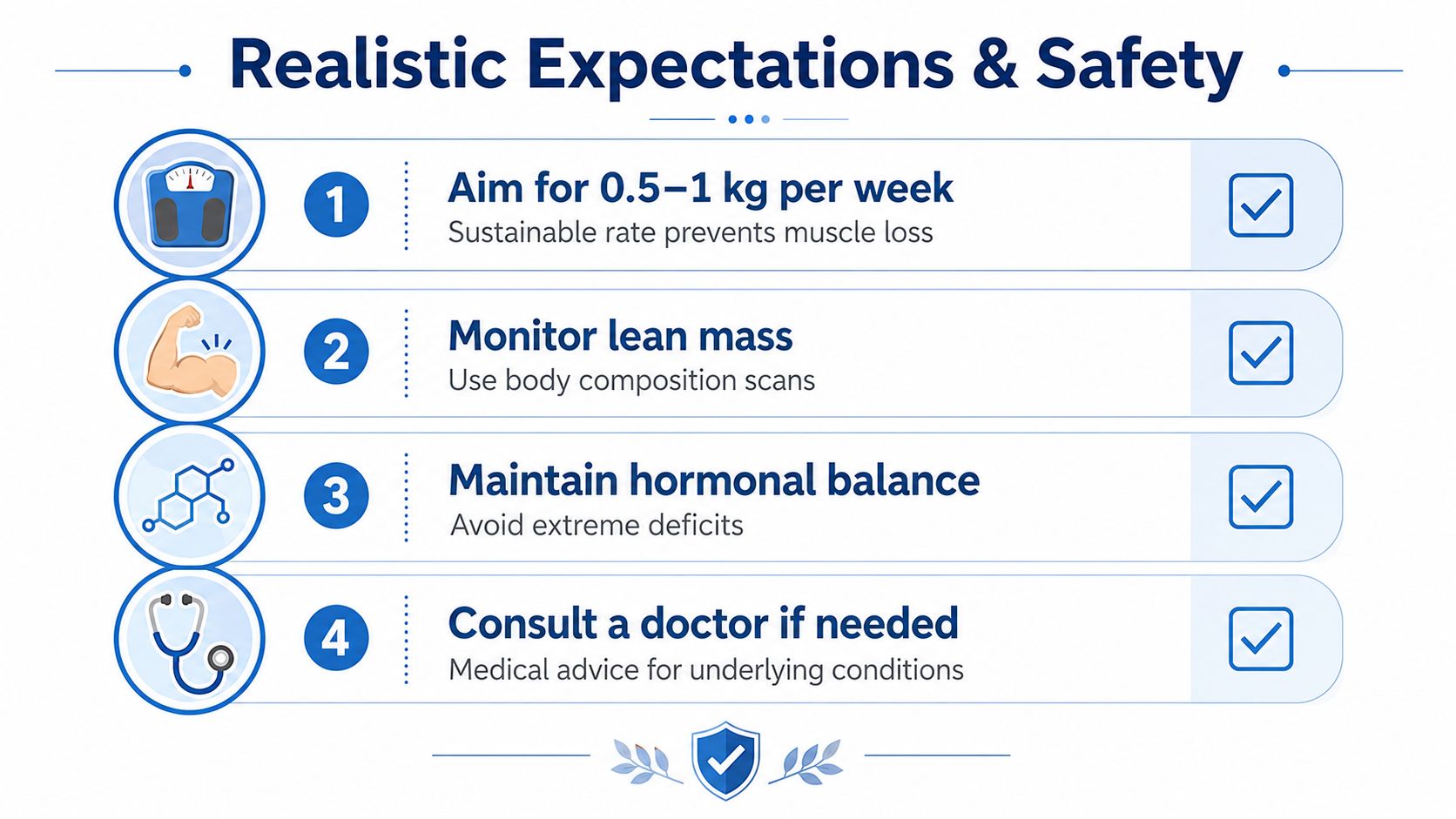
Aggressive timelines are usually sold as motivation. In practice, they often create a cycle of restriction, fatigue, missed sessions and rebound eating. Losing beyond roughly 0.5 to 1 kilogram per week can compromise lean mass, hormonal balance and adherence, especially when the person has little room to reduce intake or increase activity.
A calculator assumes a reasonably consistent energy balance. Travel, illness, stress and changing routines break that assumption, so a horizon longer than six months should be treated as a moving target. Re-enter your numbers every four weeks, compare the trend with your energy levels and adjust the plan instead of forcing the original date.
Stop guessing when health changes the equation
Speak with your GP before extending or intensifying a plan if you have unexplained fatigue, chest discomfort during exercise, a BMI under 18.5, pregnancy, recent surgery, diabetes or a cardiac condition. If you have type 2 diabetes, the HSE recommends at least 150 minutes per week of moderate-to-vigorous aerobic activity, spread across at least three days, with no more than two consecutive inactive days. The HSE diabetes guidance supports a dose-dependent approach, not a miracle promise.
People with arthritis can adapt activity too. HSE guidance recommends 2 hours 30 minutes per week of moderate activity, alongside balance, flexibility and strength work on two days weekly, while advising against vigorous exercise during a flare-up. The HSE arthritis guidance also supports staying active within tolerable limits.
Anybody with a serious medical condition or injury should consult with their medical practitioner before starting any new exercise program.
BionicGym is a great way to exercise. It is not a medical treatment. Consult your doctor if you have a serious condition.
Use this decision checklist
- Keep the horizon: Your trend is moving gradually, energy is acceptable and the plan fits ordinary life.
- Adjust the horizon: Progress is slower than projected, or your activity is lower than the calculator assumed.
- Pause and seek advice: You have red-flag symptoms, worsening fatigue or a relevant medical condition.
- Recalculate: Your weight, activity or routine has changed enough that the original estimate no longer describes your week.
The honest finish date is the one supported by behaviour you can repeat. Visit BionicGym to explore a wearable exercise system that can add structured, low-impact activity to desk time, home routines or chores, then use its weight-loss calculator to set a horizon your diet and movement can support.