

Patellar Tendon Pain: A Complete Guide to Recovery
Most advice about patellar tendon pain starts in the wrong place. If you're told to treat it like a simple inflammation problem, you're already being nudged toward the wrong solution, because the condition is best understood as a load-management problem driven by repeated mechanical stress, microscopic tearing, and tendon degeneration rather than a one-off flare-up that ice alone can calm down JOSPT definition of patellar tendinopathy, clinical review of overuse and tendon degeneration.
That shift matters. It changes the goal from “make it disappear quickly” to “restore the tendon's ability to tolerate force again,” which is why a careful rehab plan usually works better than prolonged rest. If you're trying to keep your fitness while protecting the knee, that same load-based thinking also explains why some cardio options are fine and others need to be pulled back for a while.
Why Patellar Tendon Pain Is a Load Problem, Not an Inflammation Problem
Patellar tendon pain is often still called tendinitis, but that label can mislead people into thinking the main issue is short-lived inflammation. Current clinical thinking treats it as tendinopathy, which means the tendon has been exposed to more load than it can currently handle, so its structure and pain response change over time rather than becoming hot, swollen, and inflamed in the classic sense Mayo Clinic overview of patellar tendinitis, JOSPT definition of patellar tendinopathy.
What is happening inside the tendon
Repeated jumping, landing, acceleration, deceleration, and too little recovery can create cumulative microtrauma. Over time, that repeated stress can weaken collagen and reduce how well force moves through the extensor mechanism, which is why the knee starts to object during the very tasks that ask the tendon to store and release energy mechanical loading and microtrauma review.
The common mistake is to protect the tendon from all load every time it hurts. Tendons usually need the opposite, the right load, in the right dose, at the right time. Prolonged rest can lower tolerance, so people often feel briefly better and then get irritated again as soon as they return to training.
Practical rule: if the pain shows up when the tendon is asked to work, the lever to change is usually workload, not just symptom relief.
That is the basis for a staged rehab plan, and it is also why training choices matter while you recover. If you want to keep some aerobic work in place without repeatedly provoking the tendon, the answer is usually to adjust the loading pattern rather than stop all activity. For a broader look at how progressive loading is used in training, see https://bionicgym.com/blogs/updates/progressive-overload-training.
Why the “ice and wait” approach can stall recovery
Ice, rest, and anti-inflammatories can quiet a painful tendon for a moment, but they do not rebuild capacity. The better question is how much peak tendon load and how much weekly training load the tissue can currently tolerate, then how to build from there.
That logic is what drives the rehab approach later in this guide. It begins with pain-modulating loading, then moves into progressive strengthening, then finishes with higher-speed energy-storage work, because the tendon has to relearn the exact jobs that triggered the pain in the first place.
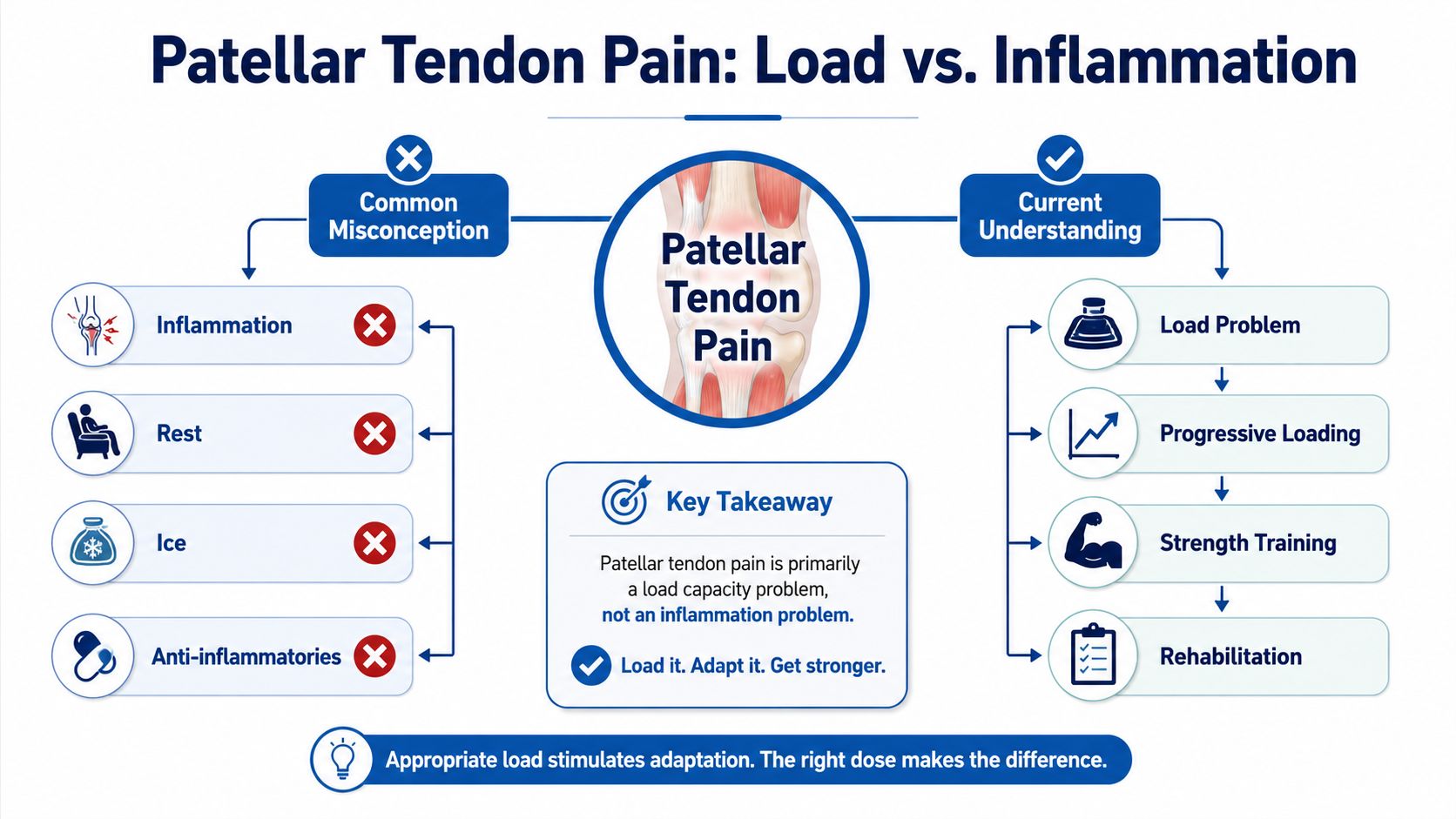
A useful way to frame it is simple. The tendon is not “broken” in the dramatic sense many people fear, but it is also not something you can fix by ignoring it. The response is structured loading, patience, and a return plan that respects how tendons adapt.
What Patellar Tendon Pain Feels Like and Where It Sits
The usual pattern is pain localised to the inferior pole of the patella, the lower edge of the kneecap. It often shows up during knee-extensor loading, especially when the tendon has to absorb and return force in jumping, landing, deep squats, or stair descent. That pattern fits the JOSPT definition of patellar tendinopathy.
The pain pattern that matters most
People often describe a very specific spot, almost as if they can point to it with one fingertip. The pain may feel sharp when the knee is loaded, then turn into a dull ache afterwards. Some people notice it most at the start of activity, it eases as they warm up, then returns later when the tendon is irritated again.
That pattern helps separate tendon pain from other knee problems. A tendon that hurts during energy-storage tasks is showing that its current load tolerance has been exceeded. That is different from simple stiffness, and different again from pain coming from the joint, cartilage, or meniscus.
Activities that often set it off
Jumping is the obvious trigger, but it is not the only one. Landing, repeated squats, quick changes of direction, and any task that asks the quadriceps to brake the body quickly can provoke symptoms because they all increase demand on the tendon.
If you want something to help with comfort while you work through the bigger rehab plan, some people look at symptom-relief options such as THC-free CBD from HempWell USA. That is a comfort strategy, though, not a substitute for proper tendon loading or a clinical assessment.
Pain that is local, load-related, and reproducible with the same movements is much more suspicious for patellar tendinopathy than for a random knee ache.
The main confusion for patients is expecting the pain to behave like a cut or bruise. Tendons do not usually settle because you have stopped using them for a few days. They settle when they are reintroduced to load in a way the tissue can tolerate.
Who Gets Patellar Tendon Pain and Why Athletes Are Hit Hardest
Patellar tendon pain shows up most often in sports that ask the tendon to absorb, store, and release force over and over. Jump-heavy training is the clearest example, because each take-off and landing asks the quadriceps to pull hard through the tendon. In a systematic review and meta-analysis, prevalence among athletes was 18.3% overall, with 20.8% in basketball players and 24.8% in volleyball players, while soccer players were 6.1%. Athletes aged 18 and older also had higher prevalence than those under 18, 21.3% versus 10.1%.
Why indoor court sports are hit hardest
Basketball and volleyball place the tendon under repeated high force with very little recovery between efforts. That repeated loading pattern explains why these sports show up so often in clinic, and why patellar tendon pain is a familiar problem in indoor court environments. The same review also noted a higher burden in sport systems where jumping and landing are built into training culture.
A separate elite athlete review reported 32% prevalence in professional basketball players, 45% in professional volleyball players, and 14.2% overall in elite athletes across nine sports. The condition is not limited to elite competition, though. Another study of 891 non-elite athletes found 8.5% overall prevalence, with 14.4% in volleyball, 13.3% in handball, and 11.8% in basketball systematic review and meta-analysis.
That wider spread matters. A weekend player who trains hard, jumps often, and recovers poorly can still overload the tendon in the same way a professional can, just with less support around the training plan.
The Irish biomechanics clue
The Irish biomechanics study helps explain why two athletes with similar sport exposure do not always respond the same way. Increased vertical ground reaction force during the take-off phase of spike and block jumps was associated with greater risk, along with altered landing mechanics such as increased knee flexion at landing and greater external tibial torsion moment at take-off.
That matters because it turns the problem into something a coach or clinician can look at. Jump count, landing style, and force production are all part of the load picture, and they can be adjusted before the tendon becomes a long-term issue. When those inputs are changed early, the tendon is less likely to be asked to cope with more force than it can currently tolerate.
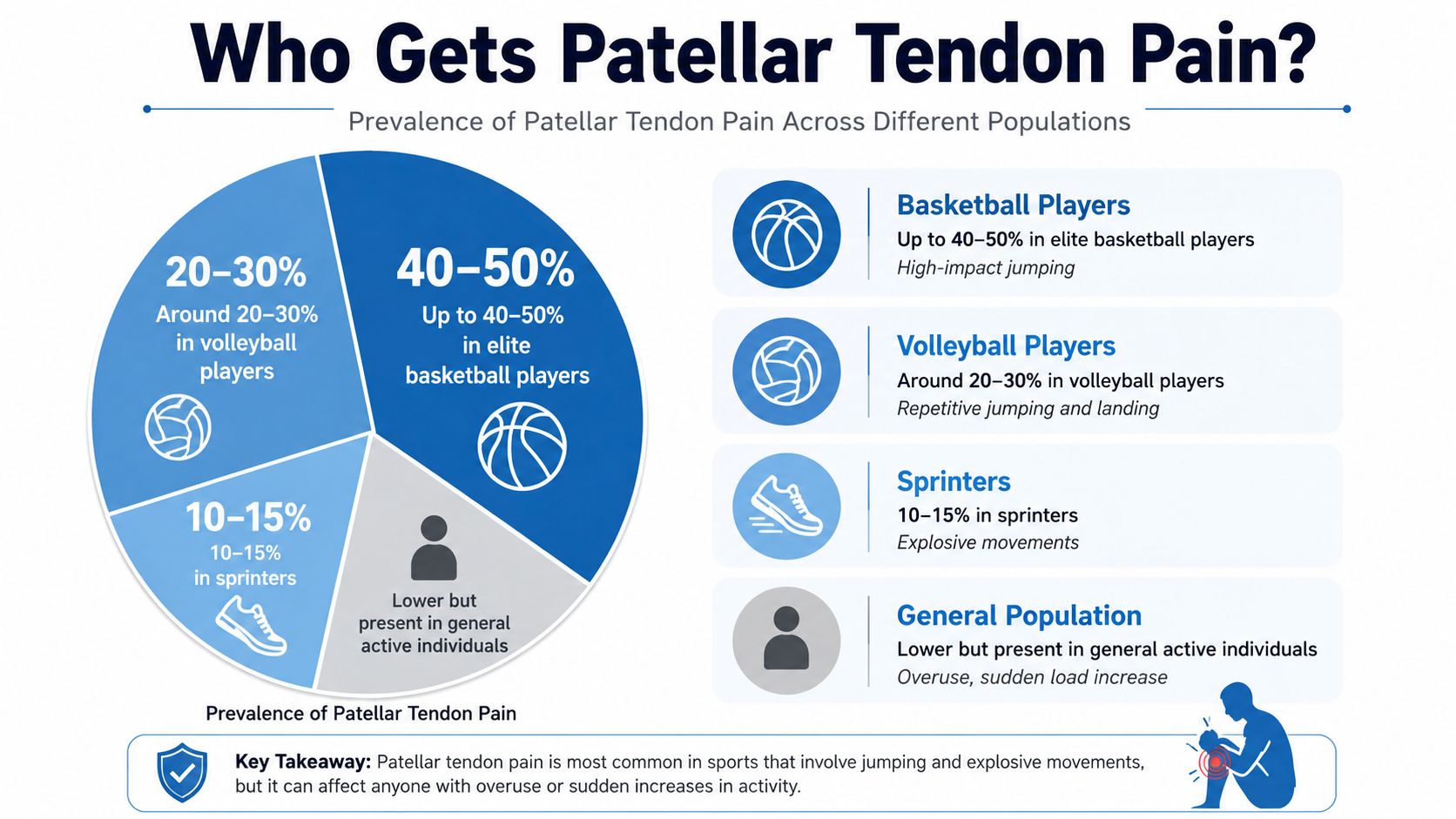
The big picture is straightforward. Athletes are not unlucky; they are exposed to more of the exact loading pattern that irritates the tendon. More jumping, more landing, more force, and more rapid changes of direction create more chances for the tendon to cross its tolerance threshold.
Red Flags, Diagnosis, and Ruling Out Other Knee Problems
A clear diagnosis starts with the story the knee is telling. A clinician will ask where the pain sits, which movements bring it on, how training has changed, and whether the pattern fits tendon loading rather than joint irritation or a traumatic injury. Patellar tendon pain usually shows up with palpation at the inferior pole of the patella and with load tests such as a single-leg decline squat, because both reproduce the mechanical demand on the tendon.
When the picture is probably tendinopathy
A local, load-related pain pattern tied to sport history makes patellar tendinopathy more likely. Imaging can help when the picture is unclear, but it can also distract if structural changes are interpreted too strictly, because tendons can look abnormal without causing symptoms.
A clinician's judgment matters more than a scan by itself. The scan does not replace the history, the movement test, or the exact spot where the pain is felt.
Signs that need urgent assessment
Some symptoms point to a different problem altogether. Acute traumatic onset, locking, giving way, significant swelling, fever, and pain at rest are not typical of straightforward patellar tendinopathy, so they need prompt assessment rather than routine overuse management.
If the symptoms do not fit a tendon pattern, compare them with other knee problems that follow a different pathway, including stress injury. Stress fracture treatment guidance is a useful place to start, especially if the pain feels more diffuse, persistent, or not tied to one clear tendon-loading movement.
A tendon problem usually has a very repeatable load trigger. If the pain behaves like something else, do not force it into the jumper's knee box.
The goal of the first appointment is not to label every sore knee as the same thing. It is to work out whether the tendon is the main structure involved, whether something more serious is being missed, and how much load the tissue can safely take next.
A Staged Rehab Plan From Isometrics to Heavy Slow Resistance
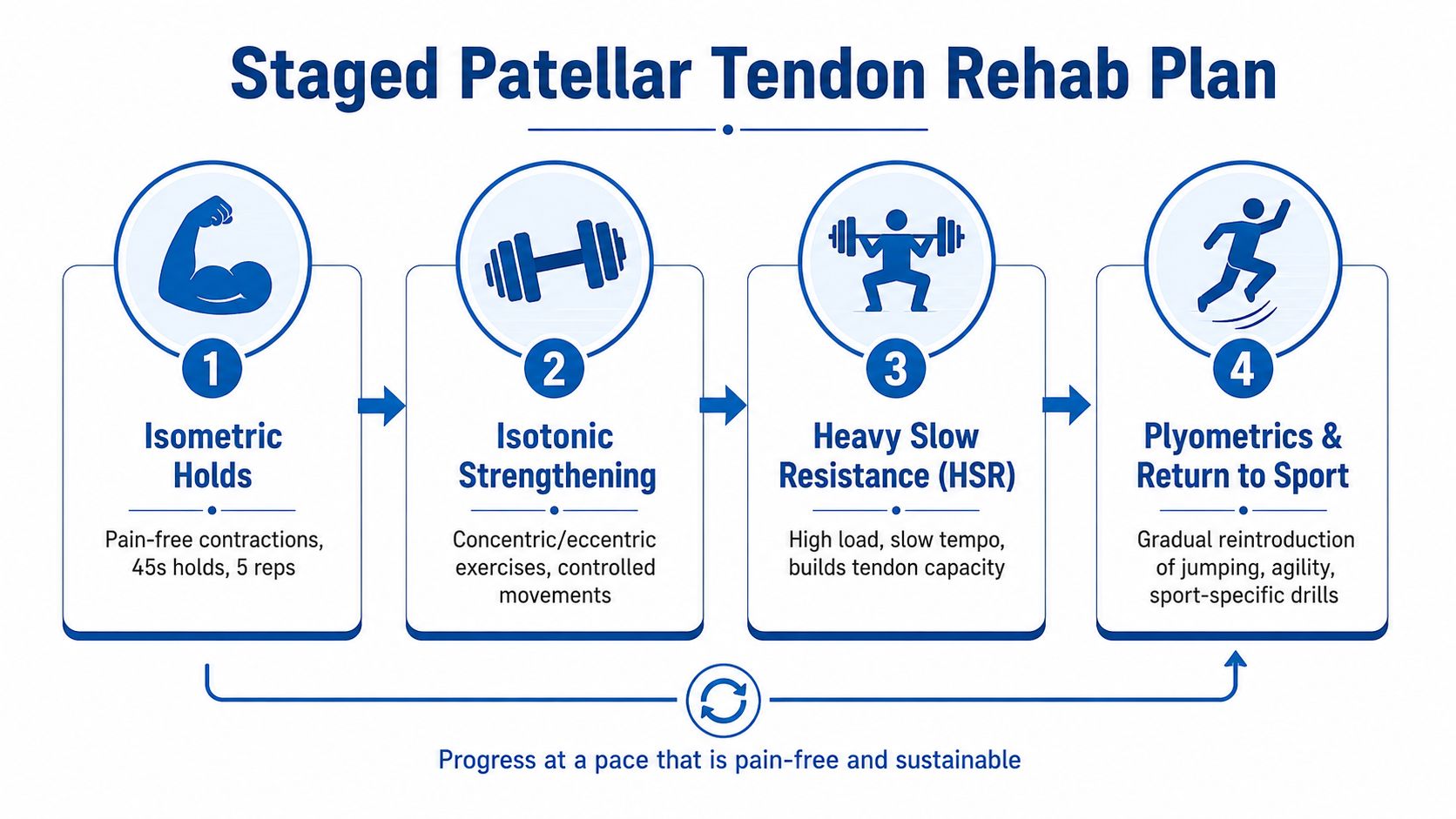
Rehab works best as a sequence, because the tendon is adapting to load, not waiting for silence from inflammation. Early on, the goal is to give it a dose it can tolerate, then build that dose in steps. That is why many plans start with isometric loading, then move into heavy slow resistance, and only later return to plyometrics.
Start with pain-modulating isometrics
Isometrics let you contract hard without the same movement demands as jumping or repeated squatting. A typical starting point is a 45-second hold, repeated 5 times, with enough rest to keep the effort controlled rather than sloppy.
The aim is not to repair the tendon in one session. It is to calm symptoms enough that you can train with some consistency, instead of drifting into the stop-start cycle that keeps people stuck.
Build capacity with slow, heavy loading
Once the tendon tolerates simpler work, move into heavy slow resistance and controlled isotonic strengthening. The goal is to raise the tendon's capacity by making the quadriceps, hips, and calf work under load while keeping the tempo slow and deliberate.
A practical rule is to choose a load that creates manageable pain during the session and settles again afterwards, then increase it gradually only when the knee behaves well across the rest of the week. Eccentric work can also fit here, and short-term results across isometric, heavy slow resistance, and eccentric programs may be similar for pain and function, so the main issue is less about choosing the perfect label and more about choosing a plan you can follow consistently clinical summary on loading approaches.
A useful reference for people who want a simple exercise library is strengthening exercises for patellar tendonitis. Use it as a guide, not as a substitute for an individualised plan.
Finish with energy-storage work
The last phase is where you bring back the demands that triggered the flare in the first place. That means plyometrics, jump drills, landing mechanics, and sport-specific work.
The progression needs to stay honest. If the tendon is still sore the next day, or if training volume climbs too quickly, the load has outrun the tissue again. A measured return beats enthusiasm every time.
For more practical training ideas while recovering, the guide on exercise while injured is a helpful companion piece. It reinforces the same principle, keep the body working, but dose the work intelligently.
Safe Low-Impact Cardio and How to Stay Aerobically Fit During Recovery
The part many active people miss most during tendon rehab is the cardio, not the strength work. Running, jumping classes, sprint intervals, and hard court sessions usually need to be reduced while symptoms are active, because those are the loads that keep poking the tendon and slowing its tolerance down.
What usually fits better
Swimming is often the easiest place to start, because the heart and lungs still work while the knee gets a break from impact. Cycling with low resistance can also work if the saddle height and knee bend do not flare symptoms, and deep-water running gives many athletes a way to keep a familiar rhythm without landing forces.
Upper-body cardio and seated conditioning can fill the gap when the knee is sensitive. The goal is simple, keep the aerobic system working while the tendon slowly rebuilds its tolerance.
Where non-weight-bearing options can help
Some people need a way to keep exercising between rehab sessions without adding more joint stress. BionicGym fits that role because it can exercise people without loading or flexing the joints, which makes it a joint-friendly option when knee impact has to be reduced.
BionicGym is a great way to exercise. It is not a medical treatment. Consult your doctor if you have a serious condition or injury before starting any new exercise program.
If you want to keep energy expenditure up while respecting the tendon, the Weight Loss Calculator can help you plan how exercise and diet fit together. You can also look at the main BionicGym product range if you want to compare how the system is set up for seated or home-based use.
The best cardio substitute is the one you'll actually do consistently without flaring the knee.
For a broader look at keeping fitness up during rehab, see BionicGym's recovery and conditioning advice. The same principle applies here. Keep the engine running, but choose a format that does not keep irritating the tendon.
Prevention, Return to Sport, and Your Long-Term Patellar Tendon Playbook
Once pain starts to settle, the next task is preventing the tendon from getting overloaded again. That means paying closer attention to load, especially jump counts, training density, and how many hard lower-body sessions are packed too close together in the week.
The habits that protect the tendon
Landing mechanics matter. Softer landings, better knee-over-toe control, and stronger hips and hamstrings reduce how much the tendon has to absorb on each rep. Warm-ups matter too, and a practical guide to warm up to prevent joint injury is useful if you want a simple way to prepare before training.
Cross-training helps as well. Low-impact cardio on off-days, including seated options and non-weight-bearing sessions, can support conditioning without adding more knee stress. The aim is to keep volume sensible, not to remove effort entirely. For people who want a structured way to keep their heart rate up without repeatedly loading the knee, low-impact HIIT options for bad knees can be a useful place to start.
A sensible return-to-sport sequence
Return should be gradual. Practice comes before partial sessions, and partial sessions come before full competition, with each step earned by how the knee responds rather than by the calendar alone. If symptoms spike after a session, the progression was too fast.
Sleep, nutrition, and regular strength work support the tendon's ability to tolerate future load. So do recovery tools that let you stay active without forcing the knee to absorb more impact than it can handle yet.
A joint-friendly way to stay conditioned between heavier lower-body days is to use BionicGym, which can help you train without loading or flexing the joints. It gives you a way to keep your aerobic base moving while the tendon calms down.
If you are deciding between options, choose the one you'll consistently do without flaring the knee. Keep the tendon calm, keep the engine running, and build back in stages instead of testing it too early.