

Low Impact Aerobic Exercise: A Complete Guide
You've finished a long desk shift, but your body still feels as though it hasn't moved. Perhaps your knees object whenever you consider running, or you're returning from an injury and aren't sure how much activity is sensible. Low impact aerobic exercise offers a practical middle ground: it can raise your heart rate and breathing while reducing the repeated pounding associated with running and jumping.
The important distinction is easy to miss. Low impact describes how your body meets the ground, not how hard your heart has to work. A supported, joint-friendly activity can still be moderate or vigorous when you adjust pace, resistance, duration, or electrical stimulation appropriately.
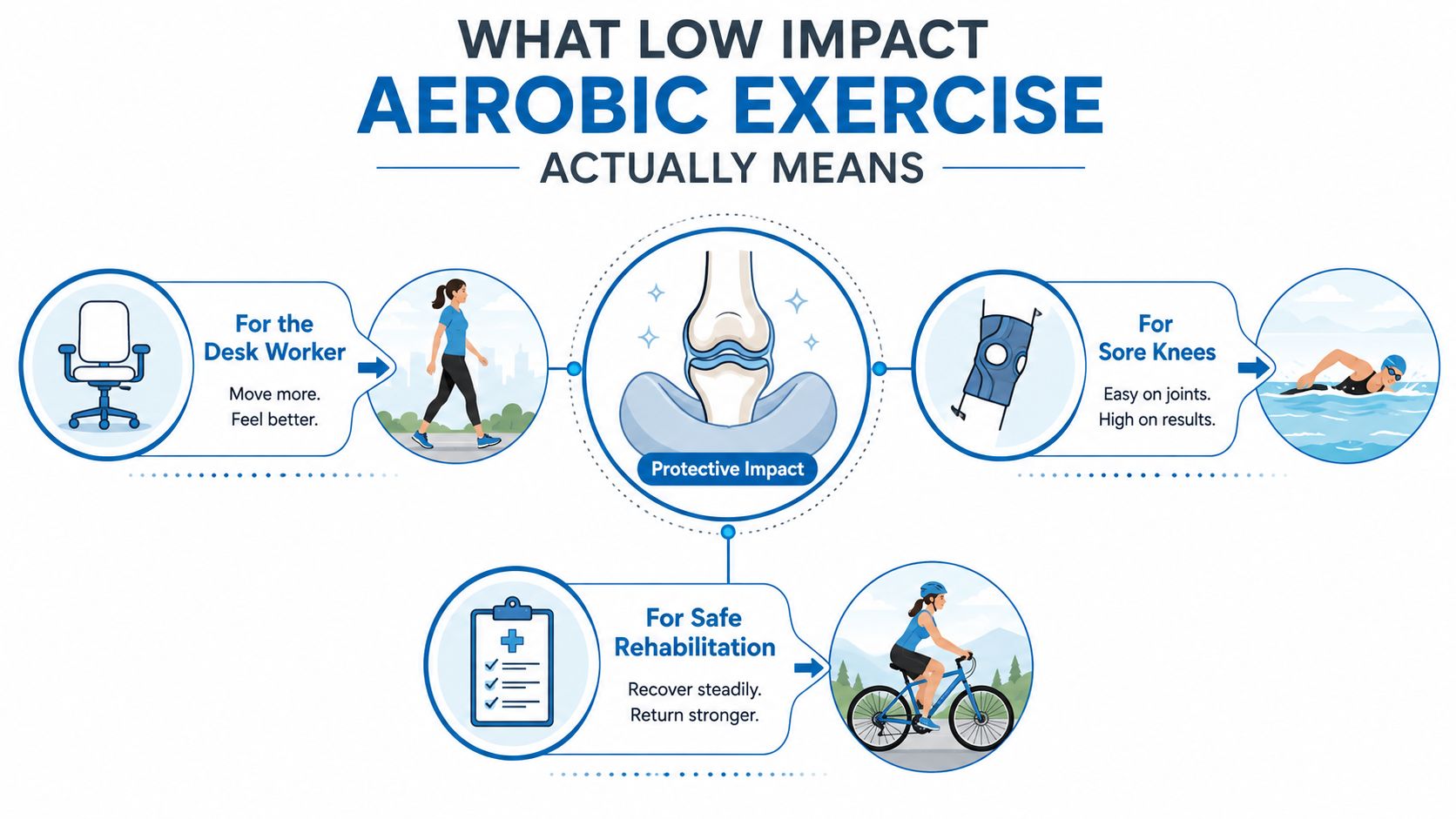
What Low Impact Aerobic Exercise Actually Means
Low impact aerobic exercise is sustained, rhythmic movement that limits forceful contact through the joints. At least one foot generally stays on the ground, or your body is supported by water, a bike, equipment, or a seated position. The activity should involve repeated movement from large muscle groups, such as the legs, hips, back, or arms, so your breathing and circulation have to respond.
A brisk walk, stationary cycling, swimming, rowing, and elliptical training all fit this broad description. Electrical muscle stimulation can also create rhythmic contractions without requiring repeated foot strikes. The result is different from high-impact exercise, where both feet may leave the floor and then land, as happens with running, jumping, and many court sports.
Think of the difference between jogging on concrete and gliding through a swimming pool. In both cases, your heart and lungs may work harder as effort rises. The pool, however, supports your body and reduces the force transmitted through your knees, hips, and ankles. That can make continuous exercise more comfortable for people who find repetitive impact aggravating.
Impact and intensity are separate questions
Low impact doesn't automatically mean easy. A gentle stroll may feel light, while a brisk walk up a slope, a hard cycle, or fast swimming can challenge your cardiovascular system considerably. Conversely, a movement can feel demanding because of muscular fatigue without providing the same sustained aerobic stimulus.
The practical questions are:
- Can you continue the movement rhythmically?
- Does your breathing rise in line with the effort?
- Are your joints tolerating the motion?
- Can you recover between sessions?
This matters for cartilage, tendons, and bone because reducing repeated impact can reduce the mechanical stress that makes some activities uncomfortable. It doesn't remove every possible risk, and technique, resistance, posture, and existing health issues still matter.
For a closer look at how a wearable system can contribute to genuine cardiovascular work, see this explanation of proven cardio. The rest of this guide focuses on the intensity measures, activity choices, joint considerations, and practical scheduling that help you use low-impact training intelligently.
Why Low Impact Aerobic Exercise Still Counts as Cardio
The clearest way to answer scepticism about low-impact cardio is to use METs, a measure comparing the energy your body uses during activity with the energy it uses at rest. Ireland's national guidance classifies light activity as 1.5 to 3 METs, while moderate activity sits at 3 to 6 METs and vigorous activity reaches at least 6 METs, as defined in Irish physical-activity guidance (Irish physical-activity definitions).
That framework separates cardiovascular demand from impact. Swimming, cycling, and rowing can all raise oxygen demand without making your feet repeatedly strike a hard surface. The same principle applies to walking. If pace, incline, or duration increases, the heart and lungs respond to the higher demand even though one foot remains supported.
| Intensity Band | MET Range | Example Activities | Target HR % of Max |
|---|---|---|---|
| Light | 1.5 to 3 METs | Easy mobility, gentle seated movement | Below a challenging training level |
| Moderate | 3 to 6 METs | Brisk walking, steady cycling | Noticeably elevated |
| Vigorous | At least 6 METs | Fast swimming, hard cycling, demanding intervals | High, with marked breathlessness |
Irish guidance recommends that adults aged 18 to 64 accumulate 2 hours and 30 minutes to 5 hours of moderate-intensity aerobic activity each week, or 1 hour and 15 minutes to 2 hours and 30 minutes of vigorous activity (Ireland's national physical-activity and sedentary-behaviour guidelines). The guidance also recognises shorter bouts when they last at least 10 minutes, which helps people build volume around work, caring responsibilities, or fluctuating energy.
The useful distinction: Low impact tells you how much force reaches the joints. METs tell you how hard the body is working.
This is why fun cardio workout ideas can include activities that look very different from running. The cardiovascular stimulus comes from sustained oxygen demand, heart-rate elevation, and muscular work. Foot strike is only one way to create exercise, not the definition of cardio itself.
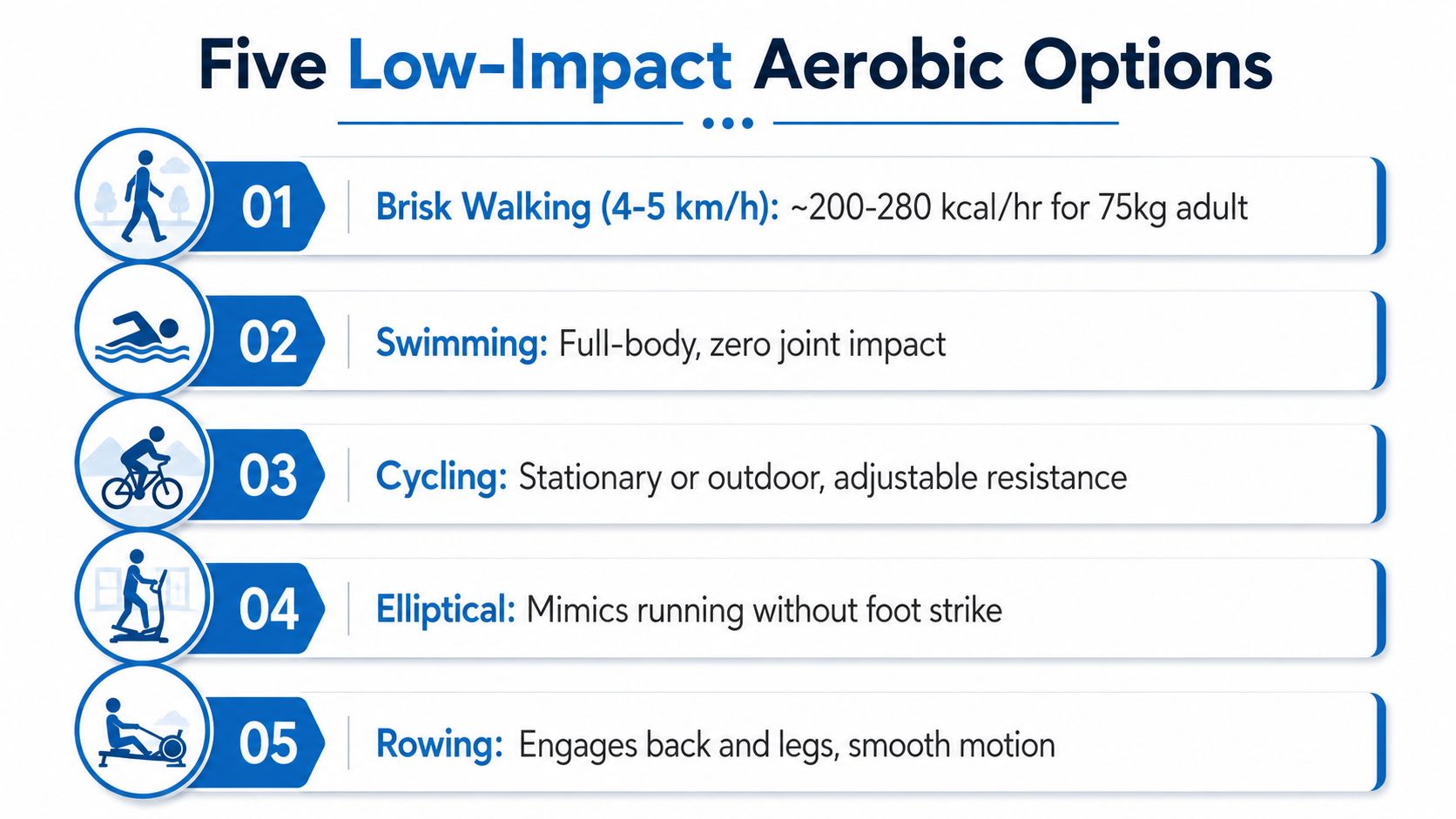
Common Types of Low Impact Aerobic Exercise
A reader with sensitive knees may start with a short walk on level ground. Someone who dislikes walking may prefer water, a bike, or seated movement. The best option is usually the one that feels tolerable enough to repeat and adjustable enough to become more challenging.
Brisk walking
Walking is the simplest starting point because it requires little equipment and can happen indoors, outdoors, or on a treadmill. A brisk pace should make you feel warmer and slightly out of breath, while still allowing you to speak in short sentences. Grass, a level track, or a supportive indoor surface may feel more comfortable than hard pavement.
If long walks leave you tired, these practical ideas for walking farther without fatigue can help you think about pacing, comfort, and gradual endurance.
Swimming
Water supports the body and reduces much of the load transmitted through the lower limbs. Swimming also recruits the upper body, trunk, and legs, although stroke choice and technique change the experience. A pool-based session may suit someone who finds land-based movement uncomfortable, but access, confidence in the water, and shoulder tolerance still matter.
Cycling
Stationary and outdoor cycling keep the movement in a controlled circular pattern. You can change resistance without adding jumping or landing. A correctly adjusted saddle helps prevent excessive knee bending, while a steady cadence makes the session easier to regulate.
Seated cardio and elliptical movement
Chair aerobics, arm ergometers, pedal exercisers, rowing machines, and elliptical trainers offer further choices. Seated cardio can be useful when standing is difficult, while an elliptical keeps the feet supported throughout the stride. Rowing adds a smooth full-body pattern, but it requires attention to technique and trunk control.
EMS-based cardio
An EMS wearable such as BionicGym uses leg wraps to deliver electrical impulses that create repeated muscle contractions. It can be used during seated or lying-down sessions, and an app can guide intensity and programmes. The important point is to judge the session by observable effort, including increased heart rate, breathlessness, and sweat, rather than assuming that a quiet setting means no exercise.
For a structured home option, explore this low-impact cardio workout at home. Product use should remain within the instructions supplied with the device, and gains depend on consistent, appropriate use.
Joint Protection and Aerobic Gains
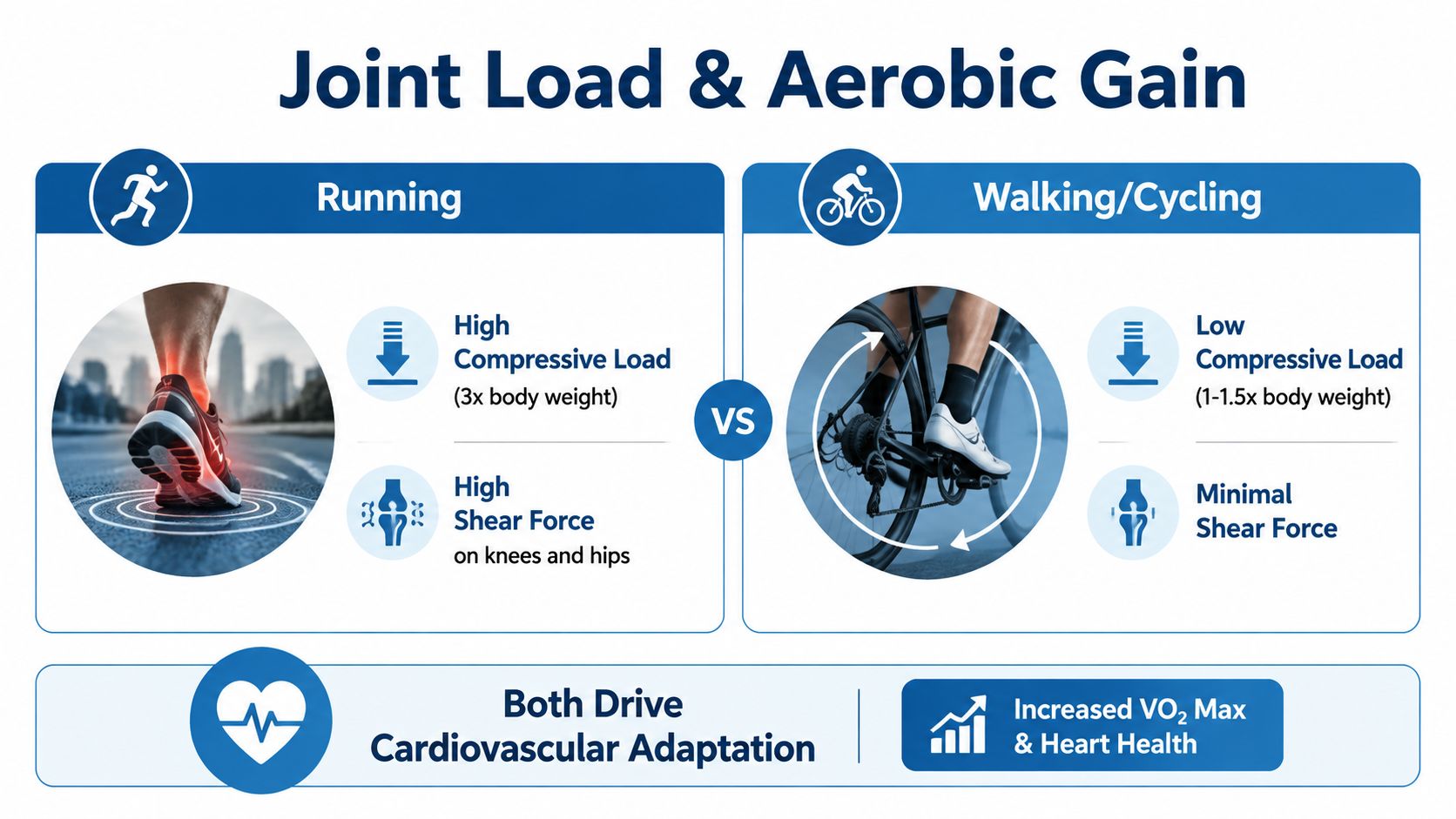
Suppose a brisk walk leaves your knees comfortable, while running produces soreness later that day. Low-impact training lets you keep building aerobic fitness while reducing the repeated landing forces that come with strides and jumps. Running generally creates more compressive and shear loading than walking or cycling, although speed, surface, technique, body position, and equipment all change the result. A label such as “low impact” is therefore a useful guide, not a personal medical prediction.
Joint-friendly exercise still provides purposeful movement. Walking and cycling repeatedly move the hips, knees, and ankles through a manageable range. That rhythm can support mobility and help circulate synovial fluid around joint surfaces. It may also make regular activity easier to maintain. An exercise plan that repeatedly triggers flare-ups is difficult to follow, regardless of how effective it looks on paper.
The cardio bridge
Protecting your joints does not require abandoning cardiovascular training. You can raise pace, incline, water resistance, cycling resistance, stroke rate, or session duration while keeping landing impact low. The Irish public-health framework also distinguishes moderate from vigorous effort, so a supported movement pattern can still become demanding when resistance and intensity rise.
EMS-based cardio adds another route. Systems such as BionicGym use electrical stimulation to create repeated leg-muscle contractions while you sit or lie down. The joints are not loaded or flexed in exactly the same way as during walking or running, yet the session should still produce recognisable exertion as intensity increases. Faster breathing, sweating, a raised heart rate, and a flushed face provide more useful clues than whether the exercise looks dramatic.
For practical ideas on adapting movement around discomfort, see this guide to exercise for joint pain relief. Runners can also review evidence-based running injury advice before changing their training.
Anybody with a serious medical condition or injury should consult with their medical practitioner before starting any new exercise program. BionicGym is an exercise option, not a medical treatment. Consult your doctor if you have a serious condition.
Joint-friendly does not mean low-quality. It means creating a meaningful cardiovascular demand while managing unnecessary mechanical stress.
Sample Weekly Plans for Different Personas
A useful weekly plan fits the person, their symptoms, and their recovery capacity. The examples below show how low-impact aerobic exercise can be distributed across seven days. They are starting points, not universal prescriptions. Rehabilitation and arthritis-related plans should be approved by a qualified clinician.
| Persona | Mon | Tue | Wed | Thu | Fri | Sat | Sun |
|---|---|---|---|---|---|---|---|
| Desk-bound office worker | Brisk walk, moderate | Seated cardio, light to moderate | Rest or easy mobility | Cycling, moderate | EMS-based session, moderate to vigorous as tolerated | Brisk walk or swim, moderate | Rest |
| Arthritis or chronic joint pain | Water-based movement, comfortable | Rest or gentle mobility | Walking, moderate only if tolerated | Seated cardio, light to moderate | Rest | Swimming or cycling, comfortable | Rest |
| Post-injury or cardiac rehab | Clinician-approved seated session | Rest | Clinician-approved walking or cycling | Rest or mobility | Clinician-approved aerobic session | Optional easy movement | Rest |
Ireland's adult activity guidance sets a target of 2 hours and 30 minutes to 5 hours of moderate activity, or 1 hour and 15 minutes to 2 hours and 30 minutes of vigorous activity each week. Use the talk test to judge effort. Moderate work usually leaves you warm and slightly out of breath. Vigorous work makes sustained conversation much harder. EMS-based cardio, including BionicGym, can provide a seated option that reaches higher exertion without the joint loading of walking or running, although tolerance and response vary.
Adjusting the plan
Start with an amount you can recover from. If a joint feels worse during or after exercise, shorten the session, reduce resistance, or switch to a supported activity. A plan that you can repeat is more useful than a harder session followed by several days of soreness.
Older adults may need particularly accessible choices and flexible scheduling. Irish data report that 55% of people aged 65 to 74 and 37% of people aged 75 and over reported enough activity to meet established health guidelines (European Commission Ireland factsheet). Seated cardio, water-based movement, and short walks can make regular training more practical.
Track duration, perceived effort, and recovery rather than chasing one perfect workout. This guide to how to improve aerobic fitness can help you structure those measures around gradual progression.
Pairing Low Impact Aerobic Exercise With Diet
After a comfortable seated cardio session, it can be tempting to “eat back” the calories shown by a device. Weight change depends on the overall balance between energy intake and expenditure over time. That makes a healthy diet plus low-impact aerobic exercise more practical than relying on punishing workouts or severe food restriction.
The familiar 3,500-kcal-per-pound rule is a rough teaching model, not a personal guarantee. Bodies adapt, energy needs vary, and scale weight includes water, muscle, and other tissue as well as body fat. A calculator can show possible patterns, but it cannot predict an exact result for one person.
Think in repeatable contributions
A modest food adjustment combined with regular movement may be easier to maintain than creating the whole deficit through exercise. Build meals around vegetables, fibre-rich carbohydrates, adequate protein, and minimally processed foods to support training and appetite control. Lower-carbohydrate patterns can also suit some people, provided the diet remains nutritionally adequate and sustainable.
Time can add up. Longer, low-intensity sessions may create meaningful energy expenditure because the body is working for longer, while EMS-based cardio, including BionicGym, can offer a seated route to higher effort without repeated joint loading. BionicGym communications describe 500 calories per hour as a lower vigorous level achievable for most users, but individual results depend on intensity, training status, product use, and adherence. Treat that figure as an estimate, not a promise. A relaxed session will not necessarily produce the same result as visibly demanding exercise.
The sustainable weight loss approach combining diet and exercise captures the main principle: exercise can support an energy deficit, while food intake largely determines whether that deficit exists.
Use a planning tool carefully
The BionicGym Weight Loss Calculator lets you explore how session frequency, duration, and food intake may interact. Use its outputs for planning rather than treating them as medical certainty. Record actual sessions, hunger, energy, and progress, then make gradual changes instead of reacting to one weigh-in.
BionicGym is a sugar-hungry form of exercise, meaning its muscle contractions can create a substantial demand for fuel. Exercise supports care for conditions such as type 2 diabetes, but BionicGym is not a medical treatment. Anybody with a serious medical condition or injury should consult with their medical practitioner before starting any new exercise program.
Safety, Misconceptions and Getting Started
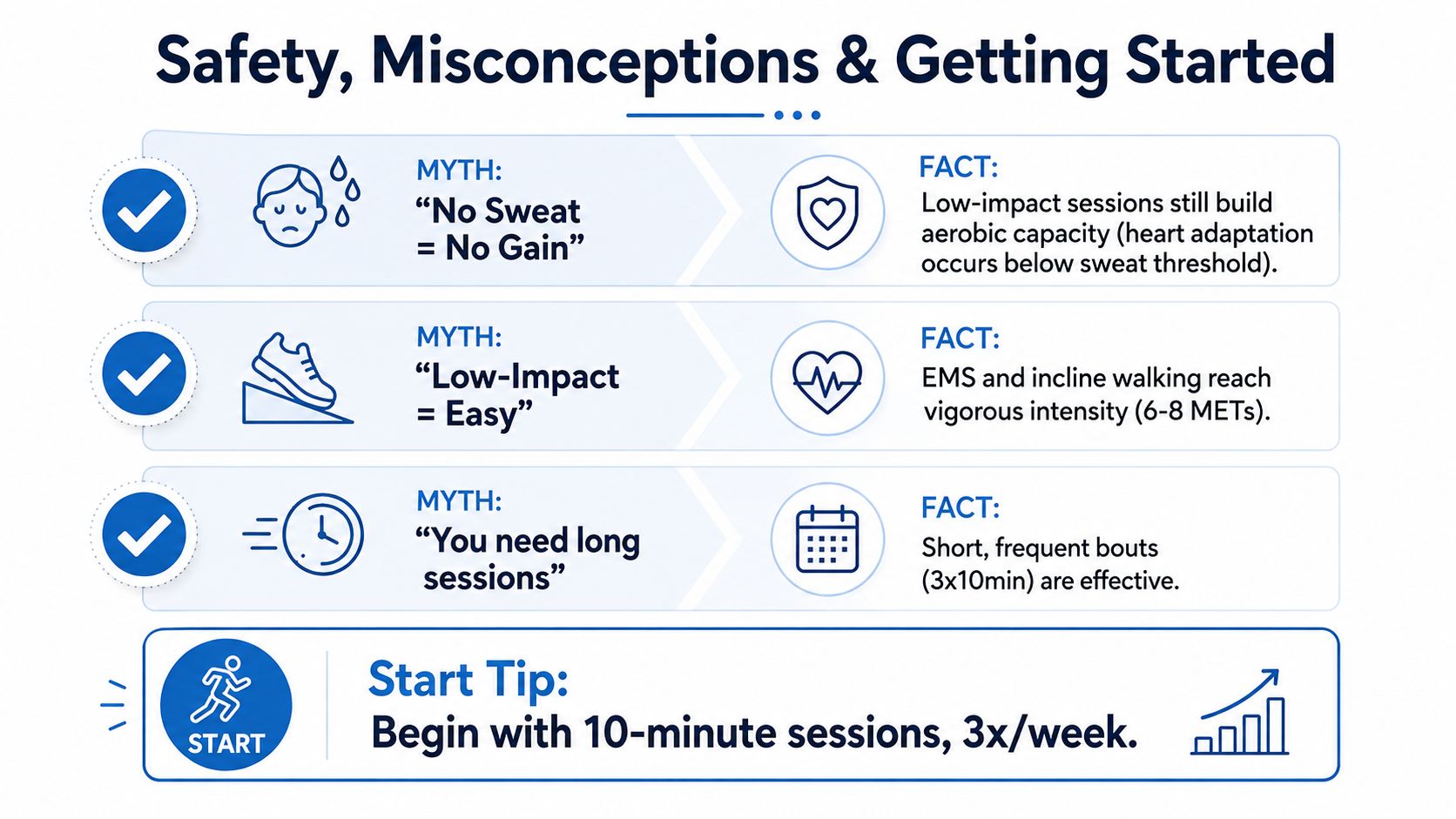
Low impact aerobic exercise is often misunderstood in three ways.
Myth one, no sweat means no benefit. Sweat helps cool the body, but it isn't the definition of aerobic training. A cool environment, individual physiology, hydration, and medication can all affect sweating. Use breathing, perceived effort, and heart rate where appropriate instead of judging a session by your shirt.
Myth two, low impact means low intensity. Irish guidance places vigorous activity at at least 6 METs (Irish physical-activity definitions). Fast swimming, challenging cycling, and appropriately progressed EMS-based exercise can reach vigorous effort without repeated jumping or running impact.
Myth three, only long sessions count. Ireland's guidance recognises shorter bouts of at least 10 minutes as contributing to activity accumulation (Healthy Ireland guidance). Three manageable bouts can be more realistic than waiting for an uninterrupted block of free time.
A sensible starting checklist
- Get clearance when needed: After a cardiac event, joint surgery, serious injury, or during recovery, ask a qualified clinician which activities and intensities are suitable.
- Check medical circumstances: People with chronic conditions, pregnancy, implanted devices, or post-surgery restrictions should consult a qualified clinician before starting EMS-based cardio such as BionicGym.
- Prepare your setting: Use suitable footwear for standing activities, keep water available, and use equipment in a safe seated or supported environment.
- Progress gradually: Add time or resistance only when your current workload feels manageable and recovery remains comfortable.
- Watch for warning signs: Stop and seek professional advice for chest pain, faintness, unusual breathlessness, or sharp and worsening pain.
This article is informational and doesn't replace medical advice. BionicGym is an FDA-cleared medical device, not an FDA-approved drug, and it isn't presented as a treatment or cure. Anyone with a serious condition should consult their doctor before beginning a new programme.
Choose one activity from the options above, schedule it three times this week, and monitor effort with the talk test or a heart-rate monitor. If you want an EMS-based option that delivers app-guided electrical stimulation through leg wraps for seated or supported exercise, visit BionicGym to review how the system works, its available programmes, and safe-use guidance. Start at an intensity you can manage consistently, then build only when your body responds well.