

How to Lose Weight with Exercise: A Practical Guide
You already know the pattern. You sit all day, promise yourself you'll “fix it” with a few walks, maybe skip lunch, maybe do a hard workout on Monday, then the scale barely moves and the whole plan starts to feel broken. It isn't broken. The problem is that people try to lose weight with exercise while pretending diet doesn't matter, and the research keeps showing that exercise alone usually produces modest results unless you control food intake too (NIH review of physical-activity studies).
If you want a practical answer to how to lose weight with exercise, start with this rule and stop arguing with it, diet plus exercise wins. That doesn't mean training is optional. It means training is the lever that works best when it sits inside a calorie deficit, not as a substitute for one. If you've ever wondered whether hormones, appetite, sleep, or stress are part of the reason the scale won't budge, the summary in why hormones block weight loss is worth a read before you blame your workouts.
Why Exercise Alone Rarely Works
A lot of desk-bound adults are doing “enough” exercise to feel virtuous and nowhere near enough to drive meaningful fat loss. That mismatch is why the scale stalls. In the classic review of 61 physical-activity studies, adults who followed public-health exercise recommendations without a dietary plan typically lost only 0 to about 2 kg, while trials combining caloric restriction plus aerobic training produced much larger losses, about 9 to 13 kg (NCBI review).
That is the first hard truth. Exercise matters, but the strongest results come from diet plus exercise, not exercise by itself. The same review also notes that maintaining weight loss commonly requires 60 to 90 minutes of physical activity per day, or roughly 2,000 to 3,000 kcal per week of exercise expenditure. If that sounds higher than the standard advice to just move more, that is because it is.
Stop judging workouts by effort alone
A 30-minute session can feel hard and still be too small to move body weight much. Judge the week, not the workout. For anyone who sits for work, that matters, because a sedentary day burns through most of the calorie gap you think you created.
Practical rule: if your food intake stays the same, your exercise plan needs enough volume to create a real deficit. If your exercise volume is modest, diet has to do more of the work.
That is also why some people search for a metabolic explanation when the maths is simple. If you want context on stalled fat loss and the way hormones can interfere with progress, the article on why hormones block weight loss is worth reading before you blame your workouts. Keep the main rule in front of you. No hormone story changes the calorie balance problem.
For a clearer look at why dieting without a proper training plan keeps failing, see the companion article on why dieting alone fails and why a smarter approach matters.
Calculating Your Calorie Target and Weekly Activity Budget
Set the calorie target first. The Mayo Clinic's standard weight-loss approach starts with a daily calorie cut of 500 to 750, which is the usual starting point for losing about 1.5 pounds, or 0.7 kg, per week (Mayo Clinic). That is aggressive enough to matter, and modest enough to keep your day workable instead of miserable.
Then turn that into a weekly activity budget. For desk-bound people, the exercise side makes more sense when you stop talking in vague “more cardio” terms and look at actual calorie burn. At a reference weight of 160 lb, or 73 kg, Mayo Clinic lists about 606 calories for running at 5 mph, 438 calories for hiking, 423 calories for swimming laps, 365 calories for low-impact aerobics, and 314 calories for walking at 3.5 mph in one hour (Mayo Clinic).
Use the minimums as a floor, not the goal
The public-health floor is 150 minutes per week of moderate-intensity activity, plus muscle-strengthening work on 2 or more days per week (CDC summary). That is enough for general health. It is usually too little if your real target is visible fat loss while you sit most of the day. For that, plan on 200 to 300 minutes per week of moderate exercise, or the higher end of structured aerobic work shown in the dose-response data.
Here is the practical version.
| Weekly Activity | Typical Weight Loss |
|---|---|
| Around 150 minutes/week of moderate activity | Often enough for health, usually modest for fat loss |
| Around 200 to 240 minutes/week of aerobic exercise | Better chance of visible fat loss if diet is controlled |
| Around 250 to 300 minutes/week of aerobic exercise | Stronger fat-loss potential, especially with a calorie deficit |
The weekly exercise budget matters because body weight responds to accumulated work, not good intentions. If you spend most of the day seated, set your calorie target and your movement target together. Do not assume a few hard workouts can rescue a high-calorie diet.
For a quick baseline before you decide how large your deficit should be, use the basal metabolic rate calculator and then build your food plan around that number.
The Three Training Styles That Move the Scale
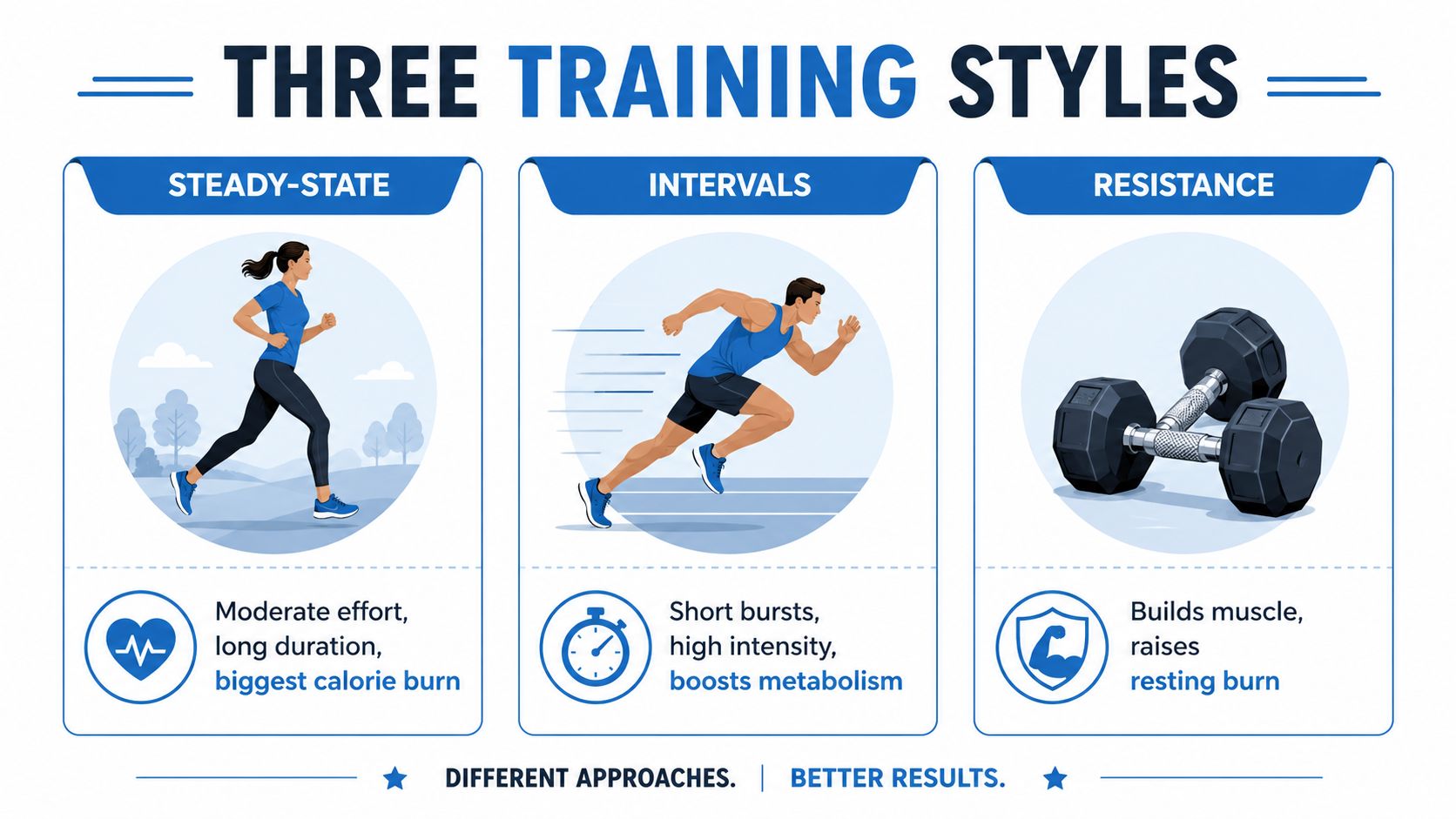
A desk-bound workday changes the job exercise has to do. You need sessions that burn calories, protect muscle, and still fit around long hours of sitting. Steady-state cardio handles the biggest share of calorie burn, intervals let you push harder in a shorter window, and resistance training keeps lean mass from disappearing while the scale drops. That mix lines up with the evidence that exercise improves body weight and body composition, and that aerobic plus resistance exercise is usually the strongest combination for fat loss (PMC overview).
What each style does
Steady-state cardio is the workhorse. A meta-analysis in JAMA Network Open reported that body weight, waist circumference, and body fat fell as aerobic exercise increased, with benefits building up to 300 minutes per week at moderate to vigorous intensity. That is why repeatable sessions beat flashy workouts you cannot keep doing.
Intervals are the right tool when time is tight and you can handle harder efforts. They raise the work rate without asking for a long session, which makes them useful for busy professionals who need a bigger calorie return from less time. The trade-off is recovery. Push intervals too often and people quit, and quitting is worse than doing slightly less volume.
Resistance training is not the main calorie burner, and that is fine. The NIH review says resistance exercise alone does not appear to reduce body weight or body fat much, but it does help preserve lean body mass, and pairing resistance work with aerobic training appears optimal for weight loss. That means lifting is there to keep your shape, your strength, and the look of someone who still trains, not to chase the biggest burn in the moment.
For a more practical look at exercise choices, the guide on best exercise for fat loss breaks down how to match training style to the result you want.
Bottom line: use steady cardio for volume, intervals for efficiency, and resistance training for muscle retention. If you combine those with a calorie-controlled diet, you give yourself a real chance of losing fat without getting smaller and softer.
How to Pick the Right Intensity Every Session
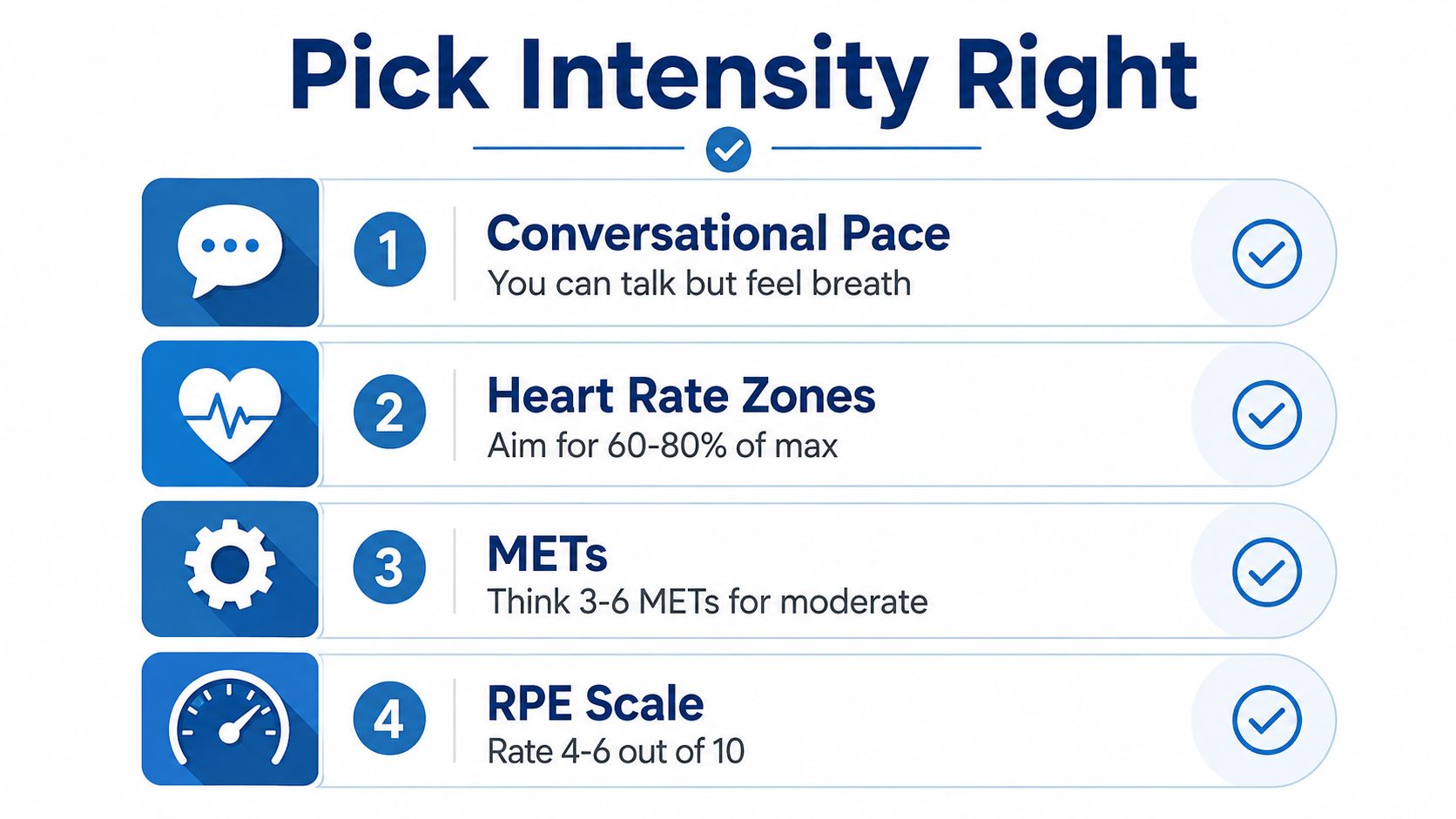
You do not need lab equipment to train at the right intensity. You need a way to tell whether the session is hard enough to matter, but not so hard that your week falls apart. The easiest check is the talk test, and it matches up well with heart-rate zones, METs, and RPE, the rating of perceived exertion scale.
Moderate intensity suits the majority of users
If you can talk in full sentences but you are breathing deeper than usual, you are in the moderate zone. If your sentences break up and you would rather not keep talking, you have moved into vigorous territory. That distinction matters because the same workout can feel “hard” to one person and still sit in the wrong zone for fat loss.
Keep most sessions around RPE 4 to 6 out of 10. That is the range you can repeat without turning every workout into a recovery problem. If you creep up to RPE 8 or higher, or you feel dizziness, sharp pain, or unusual breathlessness, back off immediately.
Use this as your working guide:
- Conversational pace: you can talk, but you notice your breathing.
- Broken sentences: you are working hard enough for vigorous effort.
- Too easy to notice: you are probably not creating much of a fat-loss stimulus.
- Too hard to repeat: you will recover badly and miss sessions.
For a more technical way to set your effort, use a heart-rate training zones guide if you want numbers instead of feel.
The point is not to chase suffering. The point is to find a pace you can hold, repeat, and progress. That is the difference between a plan that changes your body and a short burst of motivation that disappears after two weeks.
A Weekly Schedule You Can Stick To
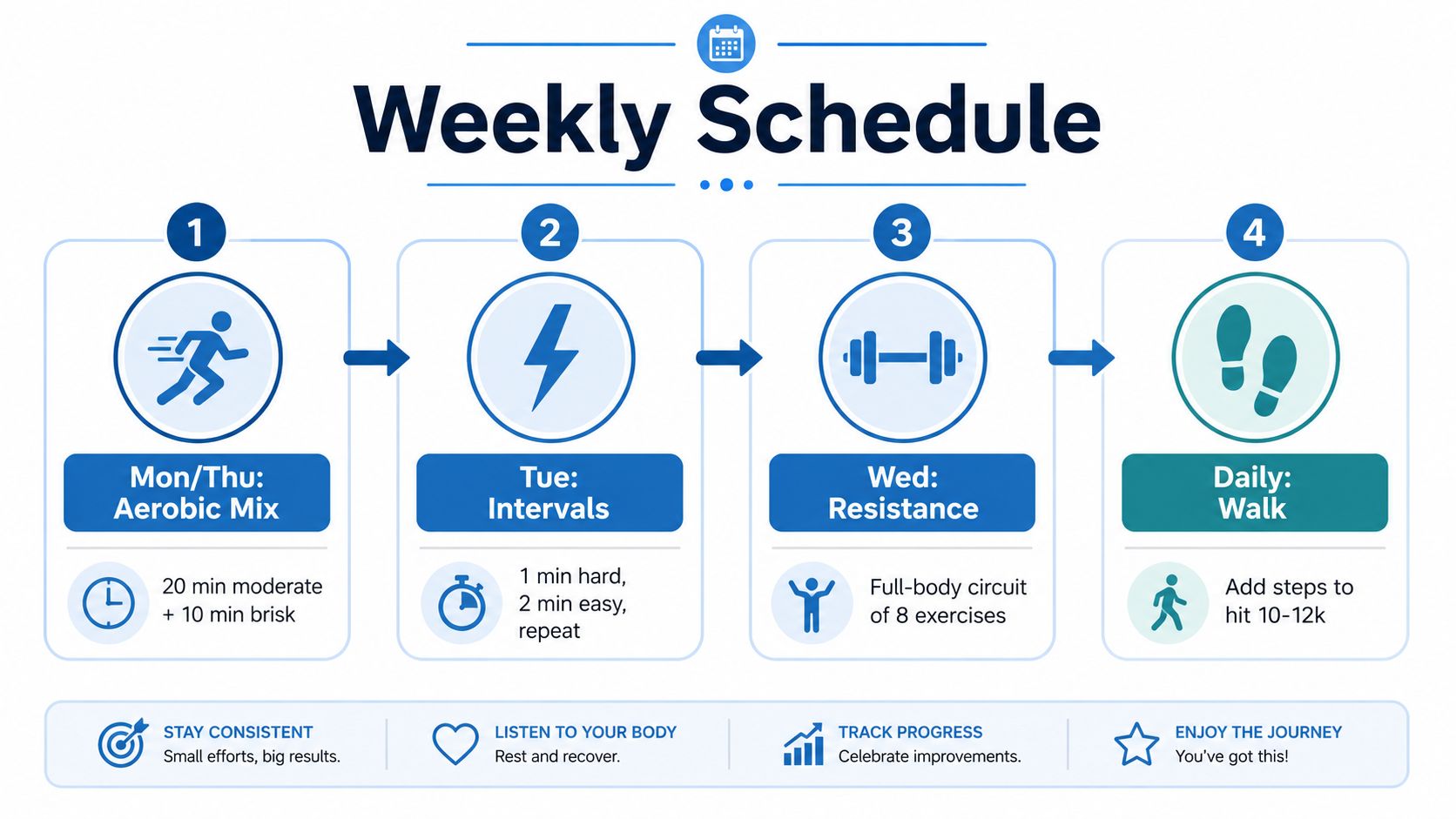
Build the week around repeatable work, not punishment. Two aerobic sessions, one interval session, one resistance session, and daily steps give most desk-bound adults enough structure to start creating momentum without living in the gym. The regional exercise guidance for weight loss recommends 200 to 300 minutes per week when greater fat loss is the goal, and it also suggests gradually moving step count from your current level toward 10,000 steps on 5 or more days per week or even 12,000 steps per day for people actively trying to lose weight (Lipid.org guide).
A simple four-day template
Monday is aerobic mix day. Do 20 minutes at a moderate pace, then 10 minutes brisk. Keep it sustainable. Finish with energy left, not a wrecked nervous system.
Tuesday is for intervals. Use a 1 minute hard, 2 minute easy pattern and repeat it enough times to feel challenged. That gives you real intensity without turning the session into a marathon.
Wednesday is resistance. Run a full-body circuit of 8 exercises. Keep the rest short enough that your heart rate stays up, but not so short that your form starts falling apart.
Thursday or Friday is aerobic mix again. Use a different mode from Monday if possible, like walking, cycling, or swimming. Variety helps adherence without changing the goal.
Daily steps sit on top of that. Add about 3,000 steps per day before piling on more intense work, because the body handles walking volume more easily than repeated hard sessions, as the guidance notes in its weight-loss recommendations. That matters for office workers, remote workers, and gamers, because the first move is usually “move more every day,” not “smash yourself harder.”
A low-impact option also fits here. BionicGym is a wearable electrical-stimulation cardio device that can be used while sitting, so it suits desk-bound days, people trying to keep moving around lower-impact training, and anyone who wants a no-impact background option rather than another pounding session. It is one tool among others, not a shortcut, and it only works as part of the same diet-plus-exercise logic that governs the rest of this plan.
Progression rule: stay with the current week until it feels normal, then raise either duration, step count, or intensity. Do not add everything at once.
Use a four-week ramp, then check whether your sessions still feel repeatable. By eight weeks, you should be doing more total work with less drama, not more drama with the same work.
For logging and reminders, the wireless fitness tracker guide is a practical place to start.
Tracking Progress Without Losing Your Mind
Track the wrong things. Obsess over one bad weigh-in, then ignore whether their waist is shrinking or their conditioning is improving. Use three numbers, weekly average weight, waist circumference, and one performance marker such as a 20-minute cycle distance or step count, and stop treating the daily scale like a judge and jury.

What to measure and when
Weigh yourself daily, then calculate the weekly average. That gives you the signal without the noise. Measure your waist every week under similar conditions, then reassess the whole plan every four weeks so you're not constantly changing variables for no reason.
If you want a tool to model how longer, lower-intensity work accumulates over time, the Weight Loss Calculator is useful for translating exercise volume into a practical plan. That's especially handy when your sessions are lower impact and easier to repeat, because cumulative work is what makes the difference.
For logging and reminders, the wireless fitness tracker guide is a decent reference point if you like a more structured feedback loop.
If progress slows, don't panic and don't slash calories blindly. Ask three questions instead.
- Is adherence dropping? If yes, the plan is too ambitious.
- Has step count slipped? If yes, raise daily movement before adding harder sessions.
- Is recovery poor? If yes, hold volume steady for another week.
A plateau is usually a mismatch between what you planned and what you can repeat. If your body feels flat, hungry, or unusually sore, you may be under-eating or over-training. The fix is usually to simplify, not to get more extreme.
Safety, Red Flags, and When to Bring in a Doctor
Warm up before you work hard, cool down after, and don't make recovery optional. Good shoes matter if you're walking or running, hydration matters if you sweat heavily, and people with arthritis, recent injury, or pregnancy need modified loading rather than a copy-paste routine. If a condition or injury is part of your situation, remember this clearly, BionicGym is a great way to exercise. It is not a medical treatment. Consult your doctor if you have a serious condition. Anyone with a serious medical condition or injury should consult their medical practitioner before starting any new exercise program.
The red flags are straightforward. Chest pain, fainting, joint swelling, dizziness, or an illness setback mean stop and get advice before pushing again. Don't try to “win” through warning signs, because that's how a plan turns into a setback.
For people who want cardio without joint loading, the low-impact route makes sense. This is especially relevant for anyone who can't tolerate running, high-impact intervals, or long standing sessions. The exercise still has to be real, though, which is why heart-rate increase, sweat, and breathlessness matter more than marketing language.
Anybody with a serious medical condition or injury should consult with their medical practitioner before starting any new exercise programme.
If you want a no-impact way to support your calorie deficit while sitting at a desk, BionicGym gives you a wearable cardio option that fits that use case without pretending diet doesn't matter. Start with the calculator, match the plan to your schedule, and use exercise to make the deficit sustainable instead of trying to white-knuckle it.