

10 HIIT Workouts at Home for Every Fitness Level
In Ireland, only 38% of adults and 37% of girls aged 10–19 meet the recommended 60 minutes of moderate-to-vigorous physical activity each day, so the best HIIT workouts at home are the ones you can perform safely and repeat consistently. A useful routine might last 7–10 minutes, 20–30 minutes, or use low-impact intervals that raise effort without jumping.
The popular advice is to make every home session harder with burpees, jumps and maximum effort. That approach can work for some people, but it can also make training intimidating, noisy, uncomfortable or difficult to recover from. Effective HIIT workouts at home use a structure you can control: a timer, a work-to-rest ratio, bodyweight or simple equipment, and a clear way to progress through time, rounds, repetitions or resistance.
Ireland's activity picture makes that flexibility important. The latest WHO physical activity country profile for Ireland reports that only 15% of adult women and 11% of adult men meet the guideline cited in the profile. Irish monitoring has also collected limited data on movement at home and work, even though those settings matter to people who spend much of the day at a desk.
Start with a gradual warm-up, use controlled technique, recover between demanding sessions and finish with a cooldown. If weight loss is your goal, pair exercise with a healthy diet. BionicGym is an optional FDA-cleared exercise device, invented and developed by a medical doctor, that uses wearable electrical stimulation and app-guided programmes. Results depend on consistent use, so explore BionicGym with realistic expectations rather than treating it as a shortcut.
Anybody with a serious medical condition or injury should consult with their medical practitioner before starting any new exercise program.
1. Tabata protocol with 20-second hard intervals
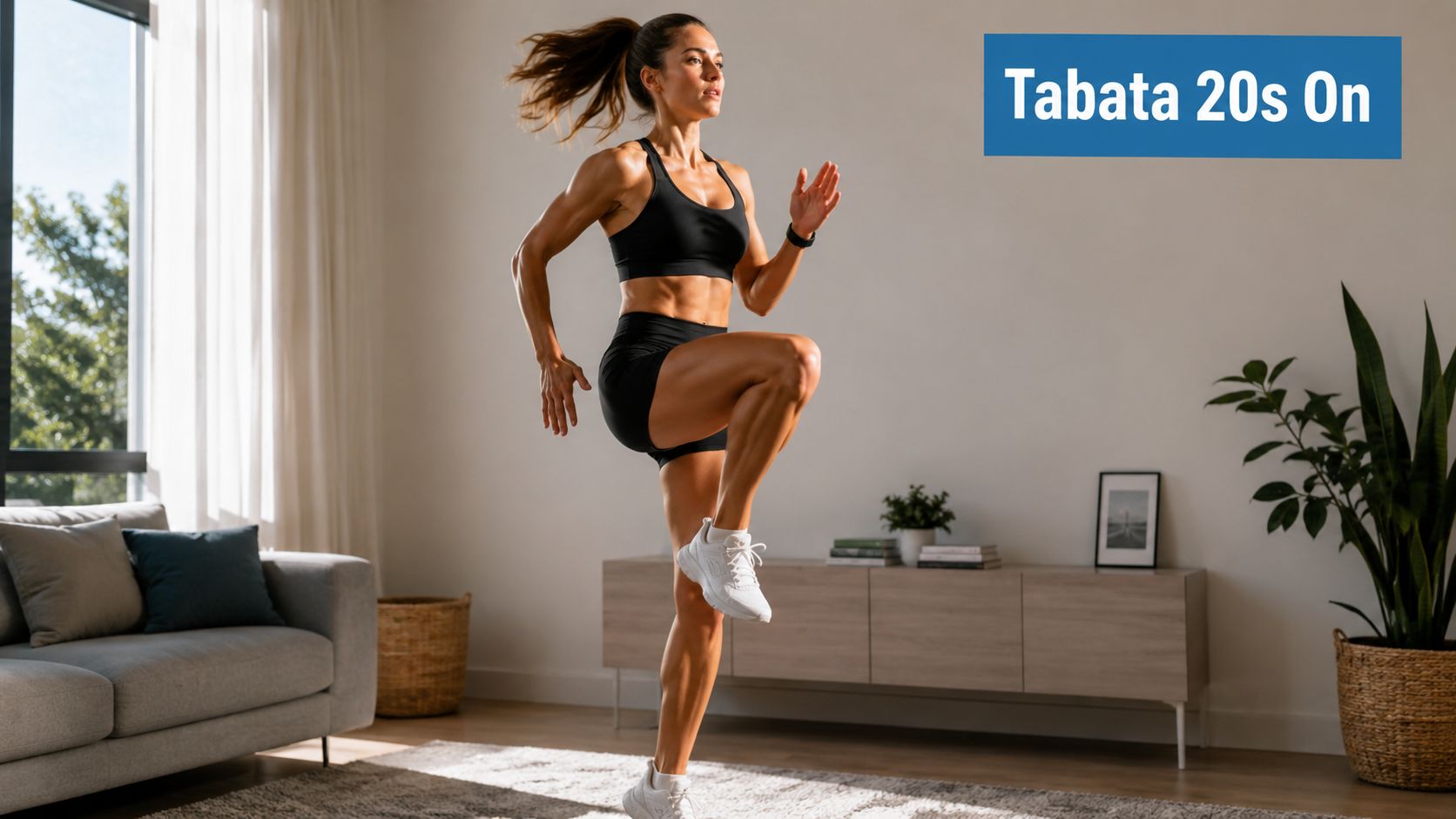
Tabata gives you a precise, demanding format: 20 seconds of hard effort followed by 10 seconds of rest, repeated through a short block. The appeal is simplicity. You don't need to decide when to change exercises or how long to recover, because the timer creates the rhythm.
Traditional choices include jumping jacks, high knees and mountain climbers. At home, choose the version that lets you keep your posture and breathing under control. A beginner might use marching high knees, step-out jacks or a mountain climber with hands on a sturdy surface. A fitter participant can use faster high knees, squat thrusts or full mountain climbers.
Practical rule: “Maximum effort” should mean the hardest pace you can perform with sound technique, not a frantic movement that falls apart halfway through the interval.
Warm up progressively before the first work bout. Then select one movement, or alternate two movements that use different areas of the body. Record repetitions completed in each interval, but don't chase a higher number if your range of motion becomes shorter or your landings become heavy.
The BionicGym guide to high-intensity interval training explains how interval timing can be paired with its wearable system. A BionicGym-assisted version can use low-impact movements while electrical stimulation contributes to the exercise demand, which may suit someone who wants vigorous cardio without explosive joint loading. Use the device only as directed, and build intensity gradually.
2. EMOM progressive density training
EMOM means every minute on the minute. You perform a planned number of repetitions at the start of each minute, then use whatever time remains to recover before the next minute begins. The workout becomes challenging because fatigue accumulates while the clock keeps moving.
Try a simple home version with push-ups and air squats. Perform a manageable number of each, then rest until the next minute. If push-ups are too demanding, use a raised surface. If air squats become uncomfortable, reduce the depth or perform sit-to-stands from a chair.
The format works particularly well for people who like clear targets. You can track total repetitions without racing through every set. It also combines upper-body and lower-body work, which spreads the demand more effectively than repeating one movement until technique deteriorates.
How to scale the minute
Start conservatively. If your set takes nearly the whole minute, you haven't left enough recovery to repeat the quality work. Reduce repetitions, slow the movement or choose an easier variation until you can finish with a visible recovery window.
Useful pairings include:
- Upper and lower body: Combine a push-up with an air squat.
- Strength and movement: Pair a dumbbell press with marching in place.
- Low-impact conditioning: Use step-backs, sit-to-stands and controlled knee drives.
- Progress tracking: Record completed repetitions and how much recovery remained.
A remote worker could use a short EMOM between tasks, but it shouldn't turn into a test of willpower every day. Vigorous sessions need recovery, and hard EMOMs are best separated by easier movement or rest. Keep a visible timer nearby and stop the set if your form changes sharply.
3. AMRAP time-domain conditioning
An AMRAP uses a fixed time window. You complete a sequence of movements, count one round, then repeat the sequence at a sustainable pace until the timer ends. Unlike a sprint-based workout, the main skill is pacing. Starting too fast can turn the final part into poor-quality movement.
A home sequence could combine a pulling movement if you have a safe bar, push-ups and air squats. Without equipment, use incline push-ups, reverse lunges and standing knee drives. Choose repetitions that allow you to move steadily rather than stopping after every round.

A lower-impact AMRAP can still feel vigorous. Replace jumping movements with quick step-outs, squat-to-reach patterns or mountain climbers performed with hands raised. The aim is to raise effort while keeping your feet connected to the floor and your spine controlled.
A practical pacing method
Use the first rounds to establish a repeatable rhythm. You should know what the next movement is, keep transitions short and retain enough control to breathe deliberately. If your form slips, pause briefly or switch to an easier version rather than treating the clock as more important than technique.
Record rounds and partial rounds after each session. That gives you a measurable progression route without demanding that you increase speed every time. You might complete the same sequence with smoother transitions, use a slightly harder variation or maintain the same output with less perceived effort.
AMRAP sessions can be mentally demanding because the timer creates pressure. Keep them occasional, especially if you also perform other vigorous formats. Nutrition choices such as lower-carbohydrate eating or intermittent fasting are individual strategies, not requirements for this workout structure.
4. Pyramid sets with minimal equipment
Pyramid training changes the repetition target as you move through the session. You might begin with a small number, increase towards a manageable peak, then work back down. The rising and falling pattern gives the workout a built-in narrative, while the accumulating repetitions create a conditioning challenge.
For a no-equipment pyramid, choose one primary movement such as incline push-ups or air squats. Start with a low repetition target, add repetitions at each level, then descend in the same pattern. Beginners should keep the peak modest. More experienced participants can use a higher peak or add a light dumbbell, but only if technique remains consistent.
The main mistake is choosing a peak that forces failure. A pyramid should challenge you without making every later set a struggle. Wall push-ups, countertop push-ups and sit-to-stands make useful substitutions when floor work or deep squatting isn't suitable.
Make the progression visible
Write each level on paper before you begin. Keep transitions brief, but don't remove every pause. A short reset can protect technique and make the session repeatable.
You can progress by:
- Increasing the peak: Add a small number of repetitions only when the existing peak feels controlled.
- Changing the variation: Move from wall push-ups to a higher or floor version.
- Adding resistance: Hold a light weight for squats once bodyweight repetitions are stable.
- Improving consistency: Keep the same pyramid but use cleaner repetitions and smoother transitions.
Pyramids are easy to underestimate because the opening sets feel comfortable. The later levels expose weak pacing, so maintain a steady tempo. If your knees, shoulders or lower back become painful, stop and choose a more suitable variation. Anybody with a serious medical condition or injury should consult with their medical practitioner before starting any new exercise program.
5. The deck of cards workout
A deck-of-cards workout turns a familiar object into a randomised conditioning plan. Assign one exercise to each suit, then use the card value to determine the repetitions. Each draw creates another small task, so the workout feels less repetitive than a fixed circuit.
Pick four complementary movements. For example, one suit can represent push-ups, another air squats, another alternating reverse lunges and another dead bugs. Face cards can share a preselected repetition value, while aces can represent a small starting number. Keep the rules simple enough that you aren't spending more time interpreting cards than moving.
The unpredictability can make the session engaging, but volume can accumulate quickly. High-impact exercises such as repeated jumps or burpees may become uncomfortable when they appear frequently. Use step-back burpees, squat-to-reaches or incline mountain climbers if you want a lower-impact version.
Keep the deck manageable
You don't have to use every card. A partial deck lets you test the format, practise transitions and judge how your joints and muscles respond. A full deck can be reserved for occasional challenges once you understand the workload.
Track completion time and note which movement caused the greatest slowdown. That information is more useful than trying to finish faster. If push-ups become the limiting exercise, use a raised surface next time. If squats become tiring, lower the card repetitions or alternate them with a gentler movement.
Hydration and pacing matter because the workload is difficult to predict. Avoid turning the first part into a race. Leave enough capacity to move well when the middle of the deck becomes demanding.
6. Thirty-second sprint and rest intervals
Thirty-second intervals create a direct contrast between work and recovery. You work hard for 30 seconds, then rest or move gently for 30 seconds. The equal ratio makes the format easy to follow, but the work bouts can still be demanding because they invite a near-maximal effort.
At home, choose a movement that fits your floor space. Fast marching, low-impact step-outs, shadow boxing and stationary cycling can all provide a controllable option. If you use burpees, perform step-back burpees rather than jumping in and out. The objective is a vigorous interval, not a dramatic-looking exercise.
Warm up gradually before the first sprint. Begin with easier efforts, then increase the pace once your movement feels coordinated. A precise interval timer removes guesswork and helps you take the recovery period seriously.
The recovery interval isn't wasted time. It lets you repeat a stronger, cleaner work bout instead of turning every round into the same tired shuffle.
Track repetitions, pedal cadence or another simple output for each bout. A useful improvement might be more consistent work across the session, not a bigger first interval. Stop the session if you can't maintain safe technique or if recovery no longer prepares you for the next effort.
For readers interested in non-running conditioning, this BionicGym article on increasing VO2 max without running discusses an alternative route to vigorous exercise. The burpees and weight loss guide can provide further context on why burpees are popular, although they aren't mandatory for an effective home session.
7. Metabolic conditioning
Metabolic conditioning, often called MetCon, combines several demands in one session. A home circuit might include a lower-body movement, an upper-body movement and a cardio exercise, with the order designed to keep you working without exhausting one muscle group immediately.
Equipment can expand your options, but it isn't essential. Use a dumbbell for squats or presses if you have one, or build a bodyweight MetCon from incline push-ups, reverse lunges and fast step-outs. Keep the exercise list short enough that you can remember the sequence and maintain control under fatigue.
This format rewards balance. A circuit containing only burpees may feel intense, but it gives you fewer ways to manage fatigue. Combining different movement patterns lets you adjust one exercise without abandoning the whole session.
Build a home MetCon
Choose movements from three categories:
- Lower body: Air squats, sit-to-stands, reverse lunges or controlled step-ups.
- Upper body: Wall push-ups, incline push-ups, rows or light presses.
- Cardio: Marching, shadow boxing, step-outs or low-impact mountain climbers.
Set a time target or complete a defined number of rounds. Don't increase load and speed at the same time. If the session involves weights, keep them light enough for stable posture and controlled repetitions.
MetCons create substantial fatigue, so they deserve more recovery than an easy circuit. A hard session once in a while can be useful, but repeating it while tired can reduce training quality. The BionicGym article about high-RER exercise for glucose disposal describes the device's sugar-hungry form of exercise. BionicGym is not a medical treatment. Consult your doctor if you have a serious condition.
8. Staircase training
Staircase training progresses through movement variations rather than adding repetitions. You might begin with a wall push-up, move to a countertop, then use a lower surface as strength and confidence improve. The repetition target can remain stable while the exercise becomes more challenging.
The same principle applies to squats. Begin with sit-to-stands, progress to air squats, then add a light load if you have the equipment and can maintain control. For pulling, a safe progression might move from an easier row variation towards a more demanding one. Only use equipment that is designed to support the movement.
The staircase format suits people who dislike arbitrary intensity. Each step gives you a clear decision point. If your technique deteriorates, stay at the current level or return to an easier variation instead of forcing the next step.
Use one movement at a time
Choose one primary exercise and plan a small series of progressions. Keep the repetition target consistent and rest enough between levels to assess how you feel. A visible timer can help you avoid turning every rest into an improvised pause.
Record the highest step completed with good form. Over time, improvement might mean reaching a harder variation, performing the same step with better control or needing less recovery. That is more informative than comparing your performance with a social-media workout.
Staircase training isn't automatically HIIT. To make it conditioning-focused, keep transitions purposeful and use a moderate rest period, while still respecting technique. If a variation causes pain, don't use it as a test. Anybody with a serious medical condition or injury should consult with their medical practitioner before starting any new exercise program.
9. BionicGym integration
BionicGym offers an optional way to add no-impact exercise demand to home conditioning. Its leg wraps deliver tuned electrical impulses to stimulate muscle activity, while the companion app provides intensity controls and guided programmes. The device was invented and developed by a medical doctor, and it is FDA-cleared, not FDA approved.
You can match the approach to the structure. A Tabata-style session might use alternating hard and easier settings. An EMOM can pair a steady BionicGym mode with low-impact squats, presses or seated movements. A longer session can use a gentler setting while you complete safe seated tasks, watch television or perform household chores.
The key is to treat stimulation as exercise, not as a passive promise. Track heart rate, breathlessness, sweat and perceived exertion. Those signs can help you understand whether the workload is vigorous for you, but they don't guarantee a specific result.
Keep the movement safe
BionicGym can be useful for people who want cardio without jumping or repeated joint loading. It can exercise the leg muscles without loading or flexing the joints in the same way as traditional impact movements. If arthritis, injury, diabetes or another medical condition is relevant to your situation, seek medical advice first.
Anybody with a serious medical condition or injury should consult with their medical practitioner before starting any new exercise program.
The BionicGym muscle stimulator guide provides more information about the device's electrical stimulation approach. Use Standard or PRO+HIIT settings according to your goals, instructions and tolerance. The device can support a sugar-hungry form of exercise, but its gains still depend on consistent use, suitable nutrition and realistic programming.
10. Programming and recovery guidelines
The best interval structure is only useful when it fits your week. A short Tabata block may work on a busy day, while an AMRAP or MetCon can occupy a longer training window. Use easier movement between demanding sessions rather than stacking several high-effort workouts together.
Begin vigorous work with a gradual warm-up. Use marching, mobility drills, easy squats, arm movements or a gentle cycle to raise your temperature and rehearse the patterns you'll use. Finish with a gradual cooldown, then rehydrate and give your body time to recover.
Progress through one variable at a time:
- Rounds: Complete another round only when the current workload is controlled.
- Repetitions: Add repetitions without sacrificing range or posture.
- Interval length: Extend work bouts gradually while preserving recovery.
- Resistance: Add a light load before making the movement faster.
- Total duration: Make the session longer only when quality stays consistent.
A training log can record rounds, total repetitions, completion time, peak pyramid level, heart-rate response or perceived exertion. This gives you evidence of progress without relying on unsupported calorie promises.
Sleep, hydration and adequate protein intake support recovery, especially if you're eating in a calorie deficit. The BionicGym fatigue management guide offers additional context, while compression and cryotherapy for athletes discusses other recovery tools. Use any recovery method as a complement to sensible training, not as permission to ignore fatigue.
Home HIIT, 10-Method Comparison
| Workout | 🔄 Complexity | ⚡ Resources (time & equipment) | 📊 Expected outcomes | 💡 Ideal use cases | ⭐ Key advantages |
|---|---|---|---|---|---|
| Tabata Protocol: 20‑Second Max‑Effort Intervals | High, simple timing but demands true max effort and recovery | Minimal equipment (bodyweight); 4–16 min; precise interval timer | ⭐⭐⭐⭐⭐, rapid VO2max & anaerobic gains; high EPOC | Time‑crunched athletes, conditioning, experienced HIIT users; pairs with EMS for low‑impact | Time‑efficient; research‑backed; scalable intensity; no gym required |
| EMOM (Every Minute on the Minute) | Moderate, straightforward rules but needs pacing & discipline | Minimal equipment (bodyweight/dumbbells); 10–30 min; visible timer | ⭐⭐⭐⭐, improves work density, strength endurance and tracking | Strength+cardio combo sessions, skill practice, home conditioning | Trackable progression; blends strength and cardio; highly scalable |
| AMRAP (As Many Rounds As Possible) | Moderate–high, requires pacing and consistent form under fatigue | Minimal equipment; 10–30 min; fixed timer | ⭐⭐⭐⭐, builds work capacity, lactate tolerance; measurable via rounds | Conditioning, competition benchmarks, metabolic conditioning for experienced users | Honest fitness measure; flexible programming; strong metabolic stimulus |
| Pyramid Sets | Moderate, built‑in progression but form risk as reps peak | Minimal equipment; 15–30 min; continuous sets | ⭐⭐⭐, combined strength and cardio stimulus; good volume stimulus | Strength‑endurance, bodyweight progressions, short metabolic sessions | Natural periodization; trackable peaks; minimal gear |
| Deck of Cards Workout | Variable, randomized order increases unpredictability and pacing risk | Minimal equipment; 20–45 min; playing deck | ⭐⭐⭐, varied stimulus and sustained calorie burn; outcome depends on exercise choices | Group workouts, variety seekers, longer conditioning sessions | High variety reduces boredom; easily scalable for groups |
| 30s Sprint / 30s Rest Intervals | Simple structure but physiologically demanding (near‑max efforts) | Minimal equipment; 10–30 min; timed 1:1 work/rest | ⭐⭐⭐⭐, effective VO2max gains and fast‑twitch recruitment | Busy professionals, track/cycling athletes, VO2max focus | Simple to execute; effective for aerobic power; short sessions |
| Metabolic Conditioning (MetCon) | High, multimodal programming with technical and recovery demands | Often requires equipment (barbells/kettlebells); 20–40 min | ⭐⭐⭐⭐⭐, very high metabolic demand, lactate and EPOC; large calorie burn | Competitors, well‑coached athletes, time‑efficient full‑body conditioning | Maximal systemic stress; versatile; strong afterburn effect |
| Staircase Training | Moderate, needs clear progressive steps and suitable exercises | Minimal equipment; 25–40 min; multiple progressive steps | ⭐⭐⭐, steady strength + cardio progression; confidence building | Progression‑focused trainees, desk‑bound professionals, rehab‑friendly | Psychological progression; scalable; tracks incremental gains |
| BionicGym Integration | Low–moderate, device setup and program selection required | BionicGym device + low‑impact movements; session length varies | ⭐⭐⭐, amplifies cardiovascular stimulus, preserves lean mass, reduces joint load | Users with arthritis/injury, GLP‑1 users, desk‑bound professionals wanting low‑impact cardio | Reduces joint loading; augments calorie burn; enables vigorous low‑impact sessions |
| Programming & Recovery Guidelines | Low (guidance) but requires discipline to implement consistently | No special equipment; scheduling, tracking tools and recovery modalities | ⭐⭐⭐, reduces injury risk, improves adaptation and adherence | All users as a framework to structure blocks, recovery, and progression | Improves sustainability, objective tracking, balances intensity and recovery |
Build a routine you can repeat
Choose one short format and one longer format. For example, use a modified Tabata or EMOM when your schedule is tight, then use an AMRAP, pyramid or low-impact MetCon on another day. You don't need to perform all ten formats. Variety can help, but consistency matters more than collecting routines.
A useful starting point is a short session that lets you practise technique without excessive soreness. Once you can repeat it with stable movement and controlled breathing, progress one variable. Add a round, increase repetitions, extend the interval, use slightly more resistance or add a small amount of total time. Don't change everything at once, because you won't know what caused improvement or fatigue.
Keep the basics in every session:
- Warm up: Spend several minutes moving gradually before vigorous work.
- Modify movements: Replace jump squats with goblet squats or sit-to-stands, and replace burpees with step-backs.
- Recover deliberately: Leave at least 48 hours between demanding sessions.
- Cool down: Reduce your pace gradually rather than stopping abruptly.
- Track output: Record rounds, repetitions, time or perceived effort.
- Support recovery: Prioritise sleep, hydration and suitable food intake.
Calorie burn varies with the person, the movement and the workload. For BionicGym, about 500 calories per hour is presented as an achievable vigorous level for most trained users, not a guaranteed outcome or a target everyone should chase. A rising heart rate, breathlessness and sweat can show that a session is demanding, but those signs don't prove a particular calorie total.
BionicGym is an FDA-cleared device and an optional form of exercise. It uses wearable electrical stimulation, and the app lets users adjust intensity and select programmes. Its effect depends on how consistently you use it and how the programme fits your ability, goals and expectations. You can review the available approach at BionicGym, then decide whether a wearable, no-impact option suits your home routine.
Weight loss can't be guaranteed by HIIT, BionicGym or any single workout. It depends on overall energy intake and expenditure, with a calorie deficit required for weight loss. A healthy diet plus exercise is the more realistic route. The BionicGym Weight Loss Calculator can help you explore possible scenarios rather than relying on extreme claims.
Keto, low-carbohydrate eating and intermittent fasting may suit some people, but they're individual nutrition strategies, not universal prescriptions. Choose an approach you can maintain and discuss significant dietary changes with an appropriately qualified professional. If you're managing diabetes, taking a GLP-1 medication, living with arthritis or returning after injury, obtain personalised medical advice before changing exercise or nutrition.
Anybody with a serious medical condition or injury should consult with their medical practitioner before starting any new exercise program.
The strongest home HIIT plan isn't the one that looks most punishing on video. It's the one that raises your effort safely, leaves enough recovery for your next session and gives you a clear way to improve. Start with a format you can repeat this week, keep the movement controlled and let your training log guide the next adjustment.
BionicGym offers app-guided programmes and wearable leg wraps that add electrical stimulation to low-impact home exercise, including options for shorter intervals and sustained sessions. If you want to explore no-impact conditioning alongside these HIIT workouts at home, visit BionicGym and choose the product or programme that matches your goals, available time and expectations.