

Heart Rate During Exercise: Zones, Tracking, and Safety
You glance at your watch halfway through a brisk walk and see a number that seems surprisingly high. A runner may check a wrist display during a fast kilometre, a cyclist may compare a chest strap with a bike computer, and someone on a treadmill may wonder why the screen says 154 beats per minute even though the effort feels manageable. The number can be useful, but only when you understand what it represents and how confidently it was measured.
Heart rate during exercise is best treated as a conversation between your body, your workout, and your monitoring device. It can help you judge intensity, organise training, and notice unusual responses, but it isn't a pass or fail score. Breathing, perceived effort, movement, and recovery still matter.
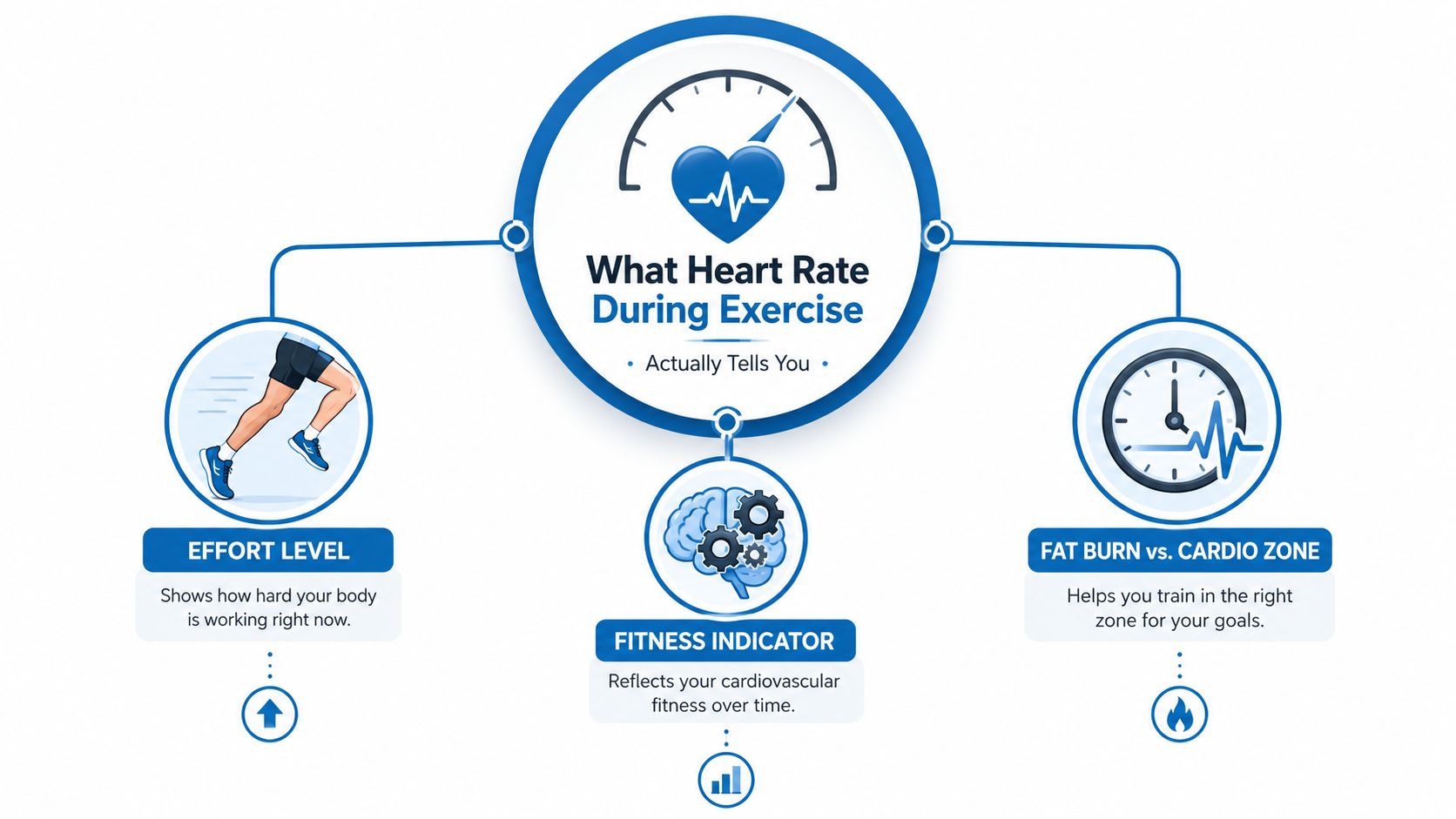
What Heart Rate During Exercise Actually Tells You
Halfway through a brisk walk, your watch shows a higher number than expected. You may feel comfortable speaking, yet the display suggests hard work. That reading is useful, but it needs context.
Heart rate is the number of times your heart beats in a minute. As working muscles need more oxygen and nutrients, the cardiovascular system sends more blood through the body. The heart usually responds by beating faster and, depending on the effort, pumping more blood with each beat.
A simple comparison helps. A car's engine revs higher on a hill because the climb demands more power. Your heart rate follows the same basic pattern. A gentle stroll places a smaller demand on the body, while a hill, sprint, or hard interval requires a stronger cardiovascular response.
The number is a signal, not a verdict
A reading shows cardiovascular demand at that moment. It does not directly measure motivation, muscular fatigue, pain, or how difficult the session feels. Two people can complete the same walk with different heart rates because fitness, heat, hydration, stress, sleep, medication, and movement efficiency vary.
Body position also changes the demand. Standing, sitting, cycling, climbing, and lying down affect circulation differently. Emotional stress can raise heart rate before exercise starts, and a loose or poorly positioned sensor can produce a dramatic reading that does not match your pulse.
Use three checks together:
- Heart rate: Is the number broadly rising or falling as expected?
- Breathing: Is it faster, heavier, or difficult to control?
- Talk test: Can you speak in complete sentences, or only short phrases?
The HSE describes moderate activity as exercise that raises heart rate and breathing while conversation remains possible. During vigorous activity, breathing becomes heavy and conversation is difficult. The HSE's exercise guidance therefore connects intensity with how the body feels, rather than with one fixed beats-per-minute target.
Practical rule: If the number and your breathing disagree, pause before changing the workout. Check the sensor, your effort, and how you feel.
Resting, Moderate, and Vigorous Exercise Ranges
Your watch may show a colour, zone, or label during a workout. Read it like a traffic light, not a legal boundary. Resting is your quiet baseline, moderate exercise is a pace you can sustain, and vigorous exercise demands enough effort to make conversation difficult.
A person walking briskly after poor sleep may see a higher reading than usual, while a fitter person may show a lower one at the same pace. Heat, stress, medication, hydration, and the sensor itself can shift the number. Use heart rate to describe the body's workload, then check it against breathing and the talk test.
Moderate activity usually raises heart rate and breathing while leaving conversation possible. Vigorous activity makes breathing heavy and speaking difficult. The national Irish physical activity guidelines describe vigorous aerobic activity as more than 6 METs and approximately 77% to 93% of maximum heart rate. They advise adults to accumulate 1 hour 15 minutes to 2 hours 30 minutes of vigorous activity per week for substantial benefits.
Training systems do not always draw the same boundaries. The ACSM intensity infographic places moderate intensity at approximately 64% to 75% of maximum heart rate and vigorous exercise at roughly 76% to 95%. A device can therefore place the same session in a slightly different zone without either reading being automatically wrong.
| Activity Level | Heart Rate Range | Percent of HRmax, Approx. | How It Usually Feels |
|---|---|---|---|
| Resting | Individual baseline | Not a training zone | Calm breathing and no exercise demand |
| Moderate | Varies by person | About 64% to 75% of HRmax | Faster breathing, conversation still possible |
| Vigorous | Varies by person | About 76% to 95% of HRmax | Heavy breathing, conversation difficult |
Age affects the likely beats-per-minute value, while the effort cues remain more consistent. Two people can train moderately with different watch readings.
For weekly planning, the Irish HSE activity recommendations advise adults to accumulate at least 2 hours 30 minutes of moderate-intensity activity per week. People who can should aim for 5 hours or more weekly for the best benefits. The guidance also gives children and older adults different expectations, with older adults adding balance and strength work.
Estimating Your Maximum Heart Rate and Target Zones
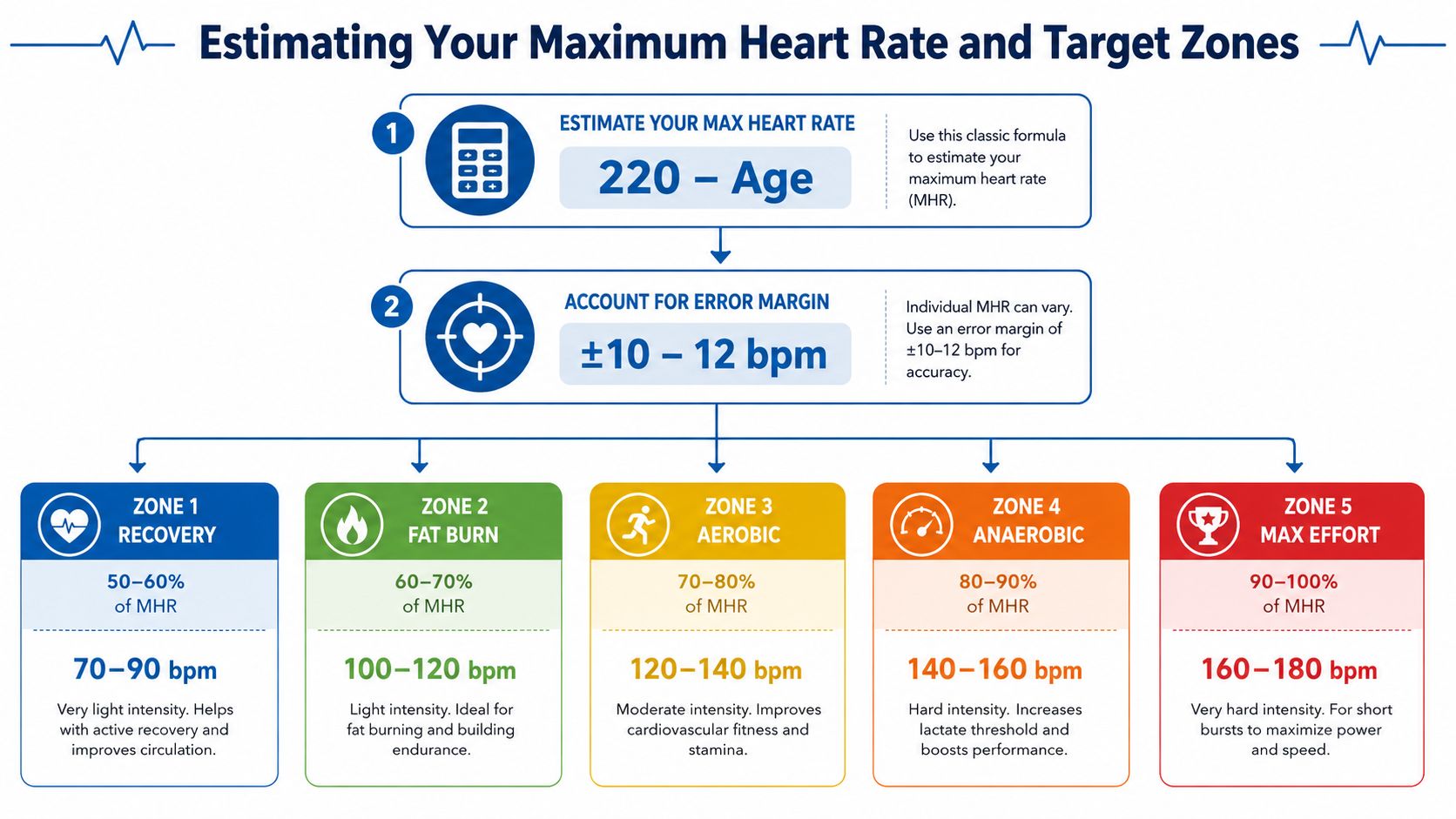
A runner reaches a steep hill and sees a watch display a surprisingly high number. The reading may help describe the effort, but it does not automatically reveal that person's true limit. Maximum heart rate, or HRmax, is an estimate of the fastest rate the heart can reach during maximal effort.
The familiar starting point is:
220 minus your age
Use it as a rough map rather than a boundary. Actual HRmax can sit meaningfully above or below the result because genetics, training history, medication, illness, and daily fatigue all affect the response. The max heart rate calculation guide compares common approaches without presenting any formula as a diagnosis.
Another population-based estimate is:
208 minus 0.7 multiplied by your age
It may suit some people better, yet no age-based equation can fully personalise an exercise target.
Five zones for training decisions
A five-zone model turns a heart-rate reading into a training instruction. The zones work like coloured lanes on a road. Each lane suggests a different type of effort, but the boundaries are approximate rather than universal.
| Zone | Approximate HRmax | Typical use |
|---|---|---|
| Zone 1 | 50% to 60% | Warm-up, recovery, very easy movement |
| Zone 2 | 60% to 70% | Comfortable aerobic work |
| Zone 3 | 70% to 80% | Steady aerobic endurance |
| Zone 4 | 80% to 90% | Threshold work and harder intervals |
| Zone 5 | 90% to 100% | Short, very demanding efforts |
Use the percentages to organise a session, then check how the effort feels. Moderate activity generally allows conversation, while vigorous work makes conversation difficult. The Irish benchmark for vigorous activity sits at approximately 77% to 93% of maximum heart rate, so the upper part of Zone 3 and much of Zone 4 may qualify, depending on the system used.
A more personal method
The Karvonen method uses heart-rate reserve, or HRR:
HRR = HRmax minus resting heart rate
Target heart rate is then estimated as:
Resting heart rate plus HRR multiplied by the desired intensity
For a 40-year-old with a resting heart rate of 65 bpm, the age-based estimate gives an HRmax of 180 bpm. HRR is therefore 115 bpm. At 60% HRR, the estimated target is 134 bpm. At 70% HRR, it is approximately 146 bpm. These figures are calculations, not medical limits, and the HRmax estimate may still be inaccurate.
Perceived effort provides a useful check on the display. If a device reports Zone 2 but comfortable speech is impossible, review the sensor and zone settings. If it shows a lower zone while breathing is laboured, slow down and investigate rather than forcing the session to match the screen.
For practical zone guidance with exercise equipment, see BionicGym's heart rate training zones resource.
Tracking Methods and How Accurate They Really Are
A heart-rate monitor can detect either the heart's electrical activity or the pulse wave created as blood moves through the body. That distinction explains why one device may respond quickly during intervals while another smooths the number or briefly loses it.
| Method | How It Measures | Accuracy During Exercise | Best For |
|---|---|---|---|
| Chest strap | Detects electrical activity across the chest | Generally strong during movement when fitted correctly | Intervals, running, cycling, and detailed training |
| Wrist optical sensor | Uses light to detect blood-volume changes | Convenient, but motion and fit can affect readings | Everyday tracking and broad zone guidance |
| ECG device | Records electrical cardiac signals | Provides more direct rhythm information | Medical assessment and rhythm clarity |
| Fingertip pulse monitor | Detects pulse through the finger | Useful during short, controlled checks | Step tests and spot checks |
Chest straps usually have an advantage during rapid changes because they measure the electrical signal associated with each heartbeat. They still need appropriate contact, and sweat, loose positioning, or skin irritation can make them uncomfortable or unreliable.
Wrist devices use optical sensors. Movement, loose bands, tattoos, skin characteristics, cold hands, and repeated gripping can interfere with the light signal. A watch may work well for walking but lag during high-intensity intervals, especially when the wrist is moving sharply.
Where fingertip checks fit
Finger-based pulse monitoring offers a practical option for short, controlled bouts. Recent Irish research found finger pulse monitoring was reliable and valid during a 3-minute step test in both laboratory and school settings, with no meaningful difference between settings and clinically insignificant absolute mean differences compared with a chest strap. The Irish validation study supports using this approach for suitable short checks, but it doesn't make every inexpensive sensor accurate in every workout.
ECG-based devices are different again. A single-lead wearable can offer useful rhythm information, while medical-grade ECG assessment belongs in a clinical setting. Neither option replaces medical advice when symptoms appear.
For broader context on selecting wearable devices, ThriveXDNA's wearable technology roundup compares how different tools approach fitness tracking. For everyday use, BionicGym's wireless fitness tracker guidance is relevant to people who want heart-rate information while exercising away from traditional gym equipment.
During steady movement, trust a well-fitted wrist sensor as a guide. During hard intervals, unusual readings, or important performance testing, cross-check with a chest strap or stop and take a controlled pulse check.
Using Heart Rate to Guide HIIT and Steady-State Training
Heart rate becomes useful coaching information when you stop asking, “What number should I hit?” and start asking, “What decision does this number support?”
A high-intensity interval session might include a warm-up, hard efforts aimed around Zones 4 and 5, and easier recovery periods. The heart rate often lags behind the work itself. You may finish an interval before the display reaches its highest point because the cardiovascular response continues rising for a short period after the muscles have already slowed.
That lag changes how you interpret the watch:
- Start the interval by effort, not by waiting for the screen to reach a target.
- Look for the trend across the work period and recovery, rather than one peak.
- Allow the number to fall during recovery before beginning another demanding effort.
- Stop the interval if symptoms appear or the response seems abnormal for you.
For steady-state training, choose a pace that settles rather than continually escalates. A brisk walk or easy cycle can sit around Zone 2 for the session, provided your breathing remains controlled and conversation is possible. If heart rate rises gradually while pace stays constant, heat, dehydration, accumulated fatigue, or stress may be increasing the cost of the effort.
Reading your smartwatch without becoming data-drenched
Use the display as a guardrail:
- Lower than expected: Check that the sensor is fitted correctly and ask whether the session feels appropriately easy or moderate.
- Climbing quickly: Reduce pace or resistance if breathing is harder than planned.
- Flat and comfortable: Maintain the effort during a steady session.
- High after stopping: Walk gently until the reading begins to settle, while paying attention to symptoms.
A sustained training habit matters more than forcing every workout into a particular zone. If weight management is your goal, the useful question is how your diet and activity work together over time. Guidance on how to break through a weight loss plateau can complement, but not replace, a sensible exercise plan. BionicGym's high-intensity interval training resource offers another example of how interval structure can be paired with heart-rate awareness.
Practical Scenarios for Desk Workers and Low-Impact Exercisers
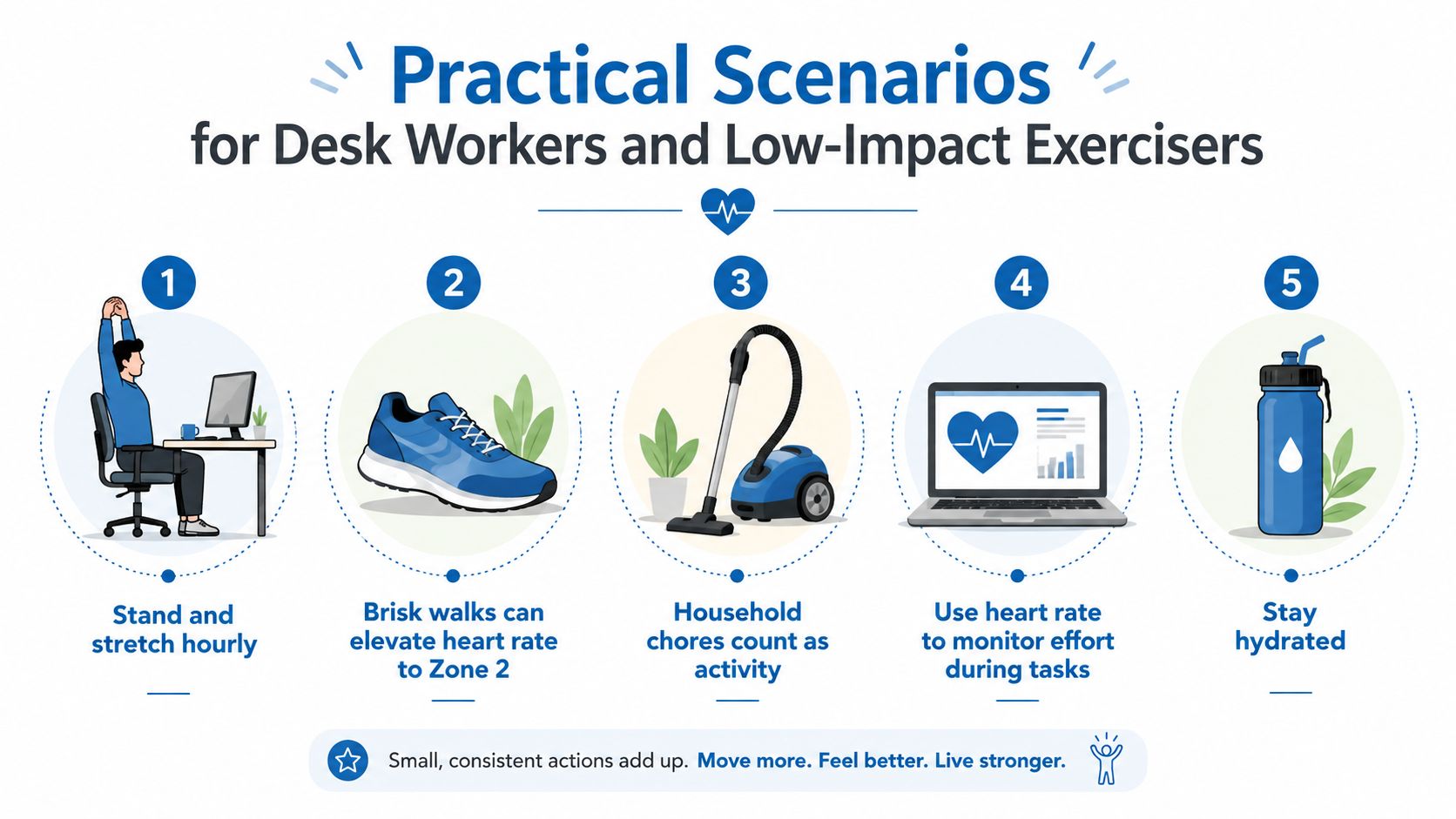
A desk worker may finish a long meeting, stand up, and find that a brisk walk produces a surprisingly high heart rate. That doesn't automatically mean something is wrong. A relatively low activity base can make ordinary movement feel demanding, especially when the person hasn't trained consistently.
The useful response is gradual exposure. Walk between meetings, take brief standing breaks, and use conversation as a guide. Over time, the same route may produce a calmer response and a quicker recovery, although daily readings will still vary with sleep, stress, heat, and workload.
Different activities create different readings
Swimming can produce less reliable wrist readings because water, pressure, and limited wrist movement affect optical sensors. Yoga may involve real muscular effort while heart rate remains modest, particularly during slower practice. Cycling, walking, pool exercise, and an exercise bike can make it easier to observe a continuous cardiovascular response.
Irish arthritis guidance recommends low-impact options such as swimming, pool walking or running, walking, cycling, and exercise bikes to reduce stress on painful joints. It also mentions walking sticks or poles and soft-soled shoes to reduce jarring and load. Arthritis Ireland's osteoarthritis guidance provides practical examples for adapting movement.
Anybody with a serious medical condition or injury should consult with their medical practitioner before starting any new exercise program.
A person managing metabolic health may begin with walking, cycling, low-impact aerobics, or water exercise. HSE Type 2 diabetes care guidance recommends 150 minutes of moderate activity over at least 3 days, avoiding 2 consecutive days without physical activity, and building gradually with low-impact choices. The HSE community nutrition and dietetic guidance supports that gradual approach.
BionicGym is an excellent form of exercise, which is a pillar of treatment for metabolic health. It is not a medical treatment. Consult your doctor if you have a serious condition.
For desk-based movement without traditional weight-bearing cardio, BionicGym's proven cardio resource for desk workers describes how its wearable electrical stimulation system can be used while seated. The intensity still needs to match your experience, and the intended setting must remain safe. Don't use exercise equipment while driving, handling dangerous objects, climbing stairs, or crossing roads.
How Heart Rate Connects to Calories and Aerobic Fitness
A sustained rise in heart rate generally indicates that the cardiovascular system is supporting greater muscular demand. That helps explain why exercise can increase energy use, but heart rate alone can't tell you exactly how many calories you've burned.
Watch estimates usually combine heart rate with movement data and personal information. The estimate becomes more useful when the device has a stable signal, but it remains an estimate. Body size, exercise mode, fitness, sensor error, and intensity all affect the result.
Calories and fuel source also aren't the same question. Lower-to-moderate exercise may use a larger proportion of fat, while harder exercise increases the contribution from carbohydrate. For weight loss, the central issue is total energy balance over time, not whether a watch labels one session “fat burning”. A healthy diet plus exercise remains the sensible route, and a weight loss calculator can help you explore a personal plan without treating the output as a guarantee.
Aerobic fitness is about oxygen use
VO2max describes the highest rate at which your body can use oxygen during exercise. It's widely used as a marker of aerobic capacity because it brings together the lungs, heart, blood circulation, and working muscles.
You don't need to test VO2max in a laboratory to make progress. If a familiar effort gradually produces a lower heart-rate response, or your heart rate settles more quickly after the same session, that may indicate improved efficiency. It isn't proof on its own, because weather, fatigue, medication, and sensor quality can change the reading.
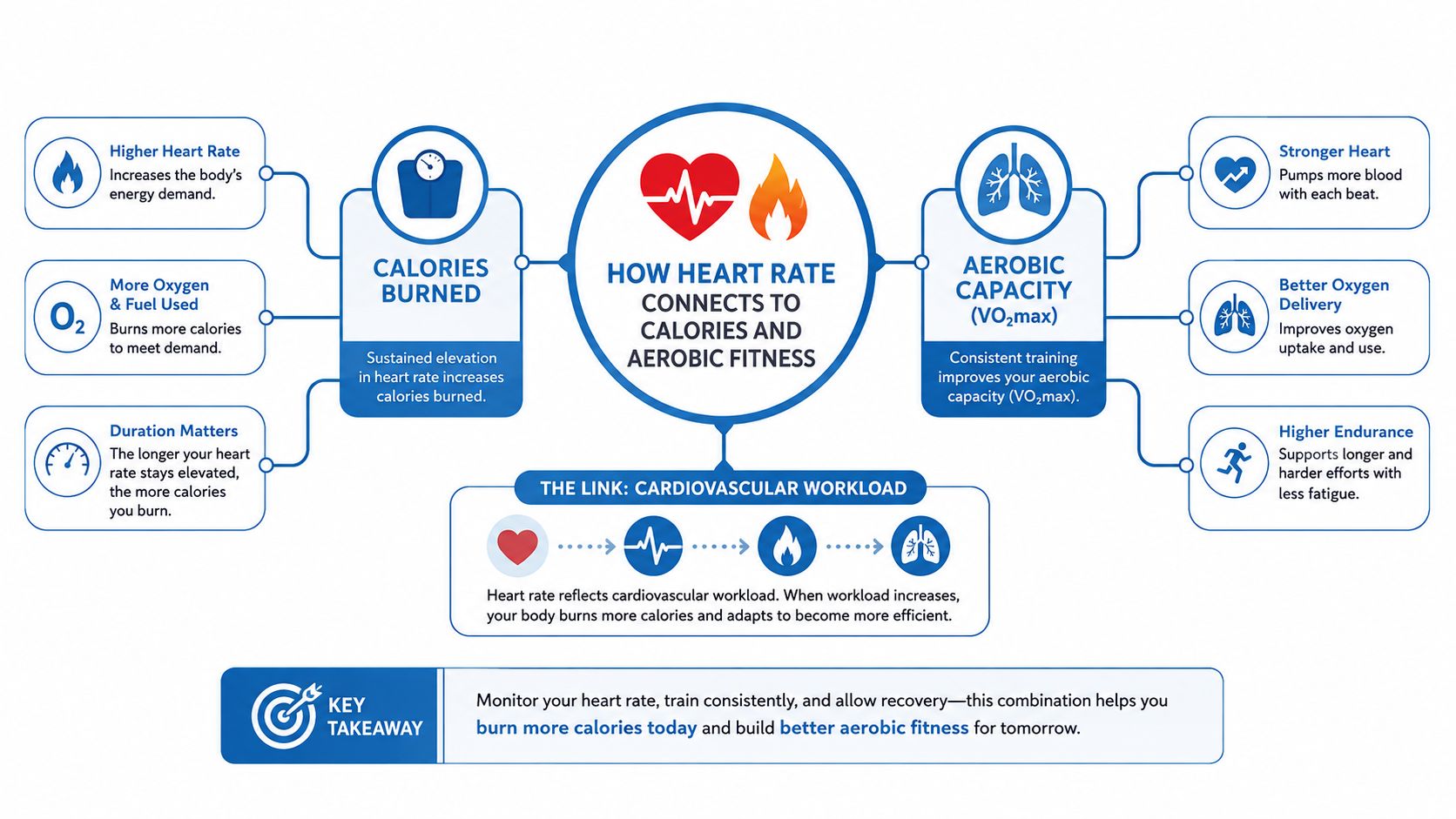
Consistent training can make familiar zones feel easier and help you sustain activity for longer. BionicGym's guide to improving aerobic fitness discusses heart rate and aerobic conditioning in the context of a wearable system that uses electrical impulses to stimulate the leg muscles. Any benefit depends on appropriate use and regular participation, so expectations should remain realistic.
Safety Signals, Red Flags, and When to See a Doctor
Training zones are estimates. They don't know your medical history, medication, current illness, or whether a reading is corrupted by movement. A challenging number can be normal during hard exercise, while a moderate number can still feel unsafe if your body is sending warning signals.
Stop exercising and seek urgent medical help for symptoms such as:
- Chest pain or pressure: Especially if it is new, severe, or accompanied by sweating, nausea, or discomfort elsewhere.
- Unusual breathlessness: Shortness of breath that seems disproportionate to the effort deserves attention.
- Dizziness or fainting: Sit or lie safely and don't resume exercise until you've been assessed.
- Irregular or very rapid palpitations: This is particularly concerning if it continues after stopping.
- An unexpected heart-rate jump: A sudden rise far above your usual response may reflect a sensor error, but don't assume that without checking.
- Poor recovery: If heart rate remains unusually high after exercise and doesn't begin moving towards baseline within 10 minutes, stop and seek medical advice, especially if you feel unwell.
A reading can be wrong because of a loose watch, motion artefact, cold skin, sweat, or poor contact. Check the fit and compare with your breathing and manual pulse, but don't use a suspected device error to dismiss symptoms.
Speak with a doctor before beginning a new programme if you have a known cardiac or metabolic condition, a serious injury, new or worsening symptoms, or a long period of inactivity. The HSE guidance links intensity with breathing and conversation, but it doesn't replace an individual assessment.
Anybody with a serious medical condition or injury should consult with their medical practitioner before starting any new exercise program.
BionicGym is a great way to exercise. It is not a medical treatment. Consult your doctor if you have a serious condition.
This article is for general information and isn't medical advice. A healthcare professional can help you choose an appropriate exercise intensity, monitoring method, and progression plan.
BionicGym is a wearable cardio system that uses app-guided programmes and leg wraps delivering tuned electrical impulses, allowing exercise while seated or completing safe household tasks. If you want to explore a practical way to monitor and build heart rate during exercise, visit BionicGym and review the available options before deciding whether the system fits your routine.