

Electrical Stimulation Machine: How TENS, EMS & NMES Work
You're at your desk, your lower back feels tight, and an advert promises a twenty-minute workout while you remain in a suit. Then a friend mentions a TENS unit that helped her sleep through a sciatica flare-up. Both products involve electrical impulses, but they're not doing the same job.
That distinction matters. TENS, EMS, and NMES are often grouped together, while marketing pages can make every electrical stimulation machine sound like a pain reliever, rehabilitation tool, and cardio trainer at once. The technology has moved from physiotherapy clinics into homes, but the labels haven't become easier to understand.
You're not behind if the category feels confusing. The useful question isn't, “Does electrical stimulation work?” It's, “Work for what outcome?” Pain relief, muscle re-education, and vigorous cardio require different physiological targets and different evidence.
Why You Might Be Reading About Electrical Stimulation Right Now
Electrical stimulation has a long clinical lineage. Irish physiotherapy providers describe electrotherapy as an electrical machine delivering impulses to the body, with TENS presented as a drug-free, low-voltage option for reducing pain. The wider history reaches from early observations involving electric fish to experimental work by Jean Jallabert in 1748, while modern therapeutic stimulation entered mainstream medicine during the twentieth century. Neurosurgeon Clyde Norman Shealy's development of the TENS unit in 1974 is commonly cited as an important milestone. Irish physiotherapy guidance on electrotherapy places that history in the context of routine practice.
The category now covers several very different experiences. A small TENS unit may create a steady tingling beneath adhesive pads. A clinic-grade NMES device may produce a visible quadriceps contraction during rehabilitation. A wearable EMS system may stimulate the legs repeatedly enough to raise breathing, heart rate, and perceived effort.
Those outcomes shouldn't be treated as interchangeable. A product designed to influence sensory nerves isn't automatically suitable for muscle training, and a muscle stimulator isn't automatically a cardio system.
Practical rule: Start with the result you want, not the acronym printed on the box.
Irish clinical guidance describes TENS and electrotherapy as tools used in acute injury and chronic pain settings, while the NHS describes TENS as a safe, easy-to-use, drug-free method that can help relieve short-term and long-term pain, including pain associated with sports injuries. NHS information on TENS The category also remains active in Irish research. A 2025 Trinity College Dublin report described electrical stimulation research exploring how stimulation may “reprogramme” the immune system to help the body heal faster. Trinity College Dublin's report on electrical stimulation
The path to clarity is straightforward. First, identify what the current reaches. Then connect that target to the outcome, the session experience, the safety boundaries, and the evidence. Once you use that sequence, the noisy category becomes much easier to understand.
EMS, TENS, and NMES Explained in Plain English
Think of the body as a communication network. Nerves are the wiring, the brain is the switchboard, and an electrical stimulation machine is a way of sending a controlled signal to a chosen destination.
TENS, or transcutaneous electrical nerve stimulation, mainly targets sensory nerves through electrodes placed on the skin. The resulting signal can influence how pain messages are processed, which makes TENS relevant to temporary pain relief. It isn't designed to create a training contraction across the body.
NMES, or neuromuscular electrical stimulation, targets motor nerves. The current prompts a muscle to contract, so clinicians can use it to support muscle re-education, preserve muscle mass, or assist rehabilitation when voluntary activation is limited. A review of 12 full-text studies, including 11 randomised controlled trials, found that NMES may help preserve muscle mass and joint range of motion. In critically ill patients, a meta-analysis of three randomised controlled trials found improved muscle strength, with a standardised mean difference of 0.93, a 95% confidence interval of 0.51 to 1.35, and P=0.0002, although the review also reported significant heterogeneity and called for stronger evidence. The NMES review and meta-analysis
EMS, or electrical muscle stimulation, is the broadest label. In consumer fitness, it often describes systems intended to stimulate muscle contractions during training, sometimes across several muscle groups. The term can overlap with NMES, which is why the product's stated purpose matters more than the acronym alone.
| Category | Targets | Primary use | Typical sensation |
|---|---|---|---|
| TENS | Sensory nerves | Temporary pain relief | Tingling or buzzing |
| NMES | Motor nerves and selected muscles | Rehabilitation and muscle activation | Rhythmic pulling or contraction |
| EMS | Muscles, often across a wider training area | Fitness or muscle conditioning | Repeated contractions that may become demanding |
A TENS device and a training-focused EMS system may both use adhesive electrodes, but they don't share the same intended outcome. The plain-English explanation of what TENS does is useful because it keeps pain modulation separate from exercise.
The physiology explains the practical difference. TENS primarily changes sensory input. NMES and exercise-oriented EMS make muscle fibres contract, which can alter energy demand, blood flow, and cardiovascular response.
What Electrical Stimulation Actually Does Inside the Muscle
The sequence starts at the motor nerve. An electrical pulse reaches a motor neuron, the neuron signals the muscle fibre, and the fibre contracts. With surface stimulation, recruitment can feel different from voluntary movement because the signal enters through the skin and may activate fibres in a different order.
The contraction generally begins in more superficial fibres before reaching deeper tissue as intensity and recruitment increase. That's why electrode placement, waveform, pulse duration, frequency, and intensity all affect the result. For TENS, clinical guidance commonly describes pulse patterns around 80 to 100 pulses per second, with pulse durations of 100 to 200 microseconds. The current should feel strong but comfortable and should be applied only to healthy, sensate skin. Clinical guidance on TENS mechanisms and safety
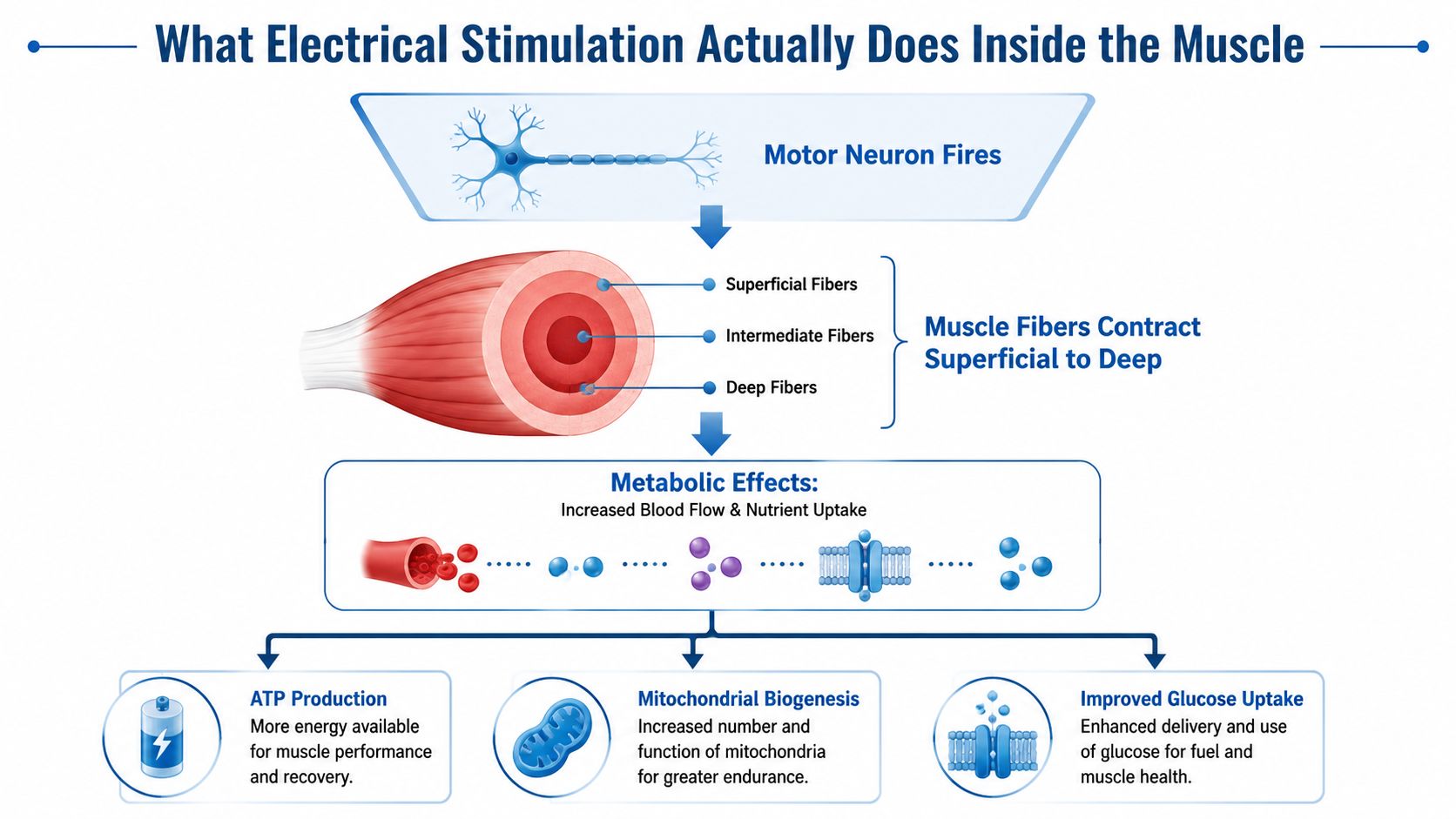
When NMES or EMS creates repeated contractions, the muscle consumes energy. That makes it reasonable to describe this as a sugar-hungry form of exercise, because contracting muscle draws on glucose and other fuels without requiring the joint loading associated with running. The phrase describes the metabolic demand of active muscle. It doesn't guarantee fat loss or imply that every device produces a cardio workout.
Researchers measure this demand through variables such as heart rate, oxygen consumption, lactate, and respiratory exchange ratio, or RER. RER helps indicate which fuel mix the body is using, while oxygen consumption reflects the energy required to sustain the activity. Lactate rises when glycolytic energy production contributes more heavily to the work. These measures can show that stimulation is physiologically active, but they don't automatically establish improved VO2max or conventional exercise equivalence.
One peer-reviewed NMES study measured 351 kilocalories per hour and oxygen consumption of 1.1 litres per minute at 40% stimulation intensity, with energy expenditure remaining high during recovery compared with baseline. The NMES energy-expenditure study That finding supports measurable energy demand, not a universal calorie promise.
A muscle twitch proves activation. It doesn't, by itself, prove vigorous cardio.
That distinction is central to muscle stimulation for aerobic conditioning. A device can work a local muscle group while you sit still, yet still fail to create the whole-body cardiovascular response associated with conventional aerobic training. Judge the machine by its measured physiological outcome, not by the mere presence of a contraction.
Where Each Technology Fits in Everyday Life
A chronic pain patient in a physiotherapy clinic may use TENS with electrodes positioned around, rather than directly on, a painful area. The session might continue while the person rests, with the aim of making a flare more manageable. The likely outcome is modest, temporary pain relief, and the device is a support for comfort, not a diagnosis or a cure.
A person recovering after an ACL injury presents a different problem. The quadriceps may be weak or difficult to activate, so a clinician may use NMES during a supervised rehabilitation programme. The muscle contracts repeatedly while the patient follows prescribed movements. The expected outcome is better activation and a possible strength benefit, not an instant return to sport.
A desk worker seeking low-impact conditioning has another goal. A home EMS system can stimulate the leg muscles during a planned session, with intensity adjusted gradually. If the system produces sufficient muscle work, the person may experience a modest to vigorous cardiovascular stimulus, but that claim needs device-specific evidence rather than a generic EMS label.
| Technology | Typical user | Primary goal | Realistic outcome | Session shape |
|---|---|---|---|---|
| TENS | Person managing a pain flare | Temporary pain relief | Relief may make rest or movement easier | Comfortable stimulation during a flare |
| NMES | Rehabilitation patient | Muscle activation and preservation | Support for strength and range of motion | Clinician-selected contractions paired with rehab |
| EMS | Home fitness user | Muscle conditioning or exercise | Muscle work, with cardio depending on the system | App-guided or programmed intervals |
The overlap can create misleading expectations. TENS pads on a sore calf may alter sensation, but that doesn't make the session a workout. NMES may be used during a long seated period under clinical direction, while a wearable cardio system needs a different intensity and outcome standard. A practical comparison of TENS devices and stimulation boots appears in this guide to TENS machines and boots.
In Ireland, the HSE recommends that adults work towards 2 hours and 30 minutes of moderate-intensity activity each week, beginning with manageable sessions and building towards 30 minutes per day. HSE physical-activity guidance An electrical stimulation machine may supplement that routine, but it shouldn't erase the value of ordinary movement.
How to Choose a Home Electrical Stimulation Machine
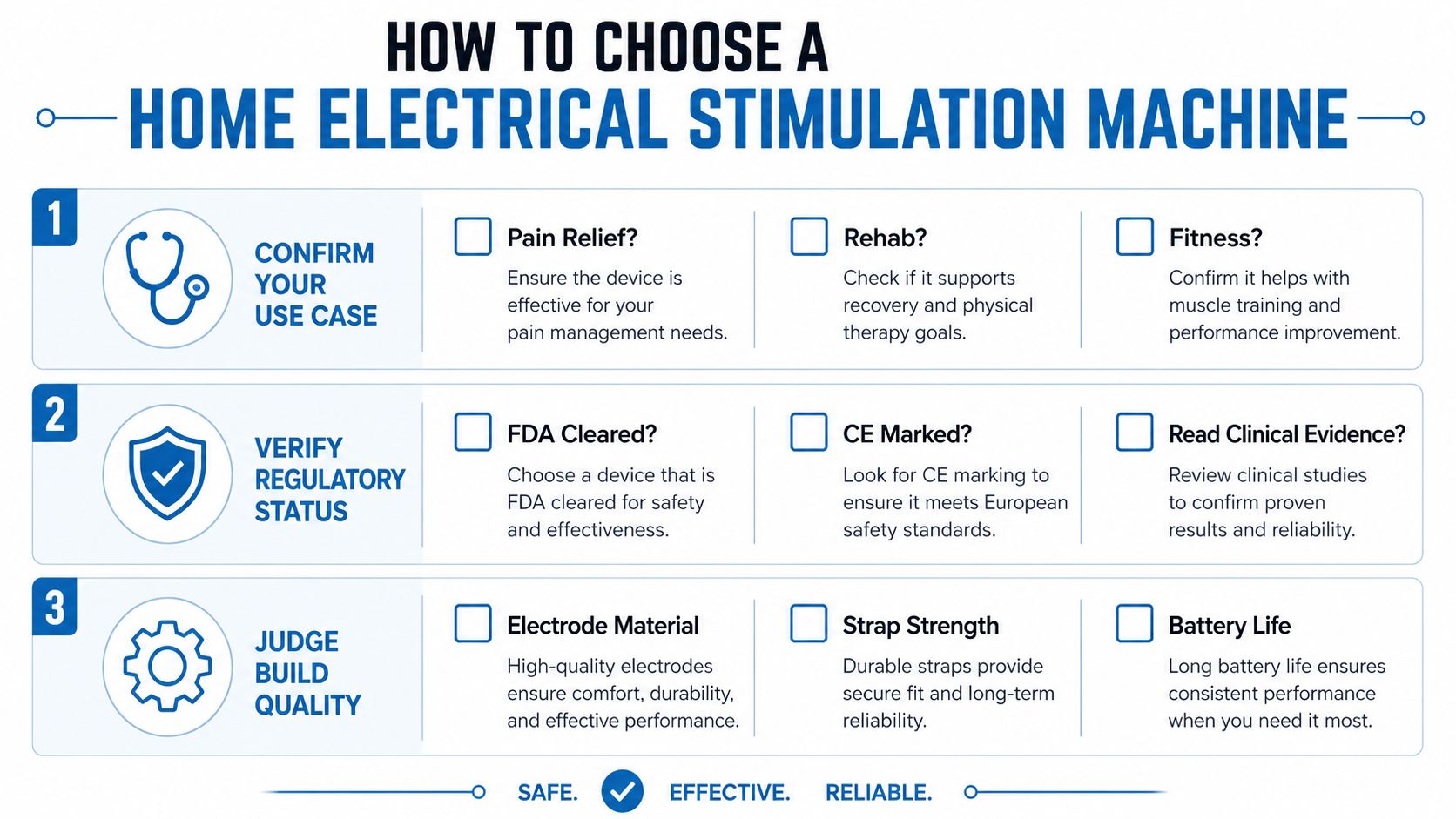
Begin with the use case. Ask yourself whether you want pain relief, rehabilitation support, or a training stimulus. Those are separate buying decisions, even when the products use similar-looking pads, straps, or control units.
For pain, examine electrode placement guidance, comfort controls, and whether a clinician has explained the likely source of the pain. For rehabilitation, the relevant questions include whether the programme matches your weakness, whether a physiotherapist can supervise setup, and whether the device supports the movement you're trying to relearn. For fitness, look for evidence that measures whole-body responses such as oxygen consumption, heart rate, or energy expenditure, rather than only showing a contracting muscle.
Regulatory language needs careful reading. The U.S. FDA says electrical muscle stimulators are regulated devices, and its guidance for powered muscle stimulators describes use under medical supervision as adjunctive therapy for medical diseases and conditions. FDA guidance on electronic muscle stimulators FDA-cleared means a device has been cleared for a specified intended use. It doesn't mean every fitness, weight-loss, or wellness statement made about the product is FDA-cleared, and it isn't the same as saying “FDA approved”.
Examine the parts you'll actually use
A reliable device should make the basic experience predictable. Check whether the leads feel secure, whether the waveform and programme descriptions are clear, and whether the unit works independently or depends entirely on an app. App pairing can help with coaching and tracking, but standalone controls may matter if you want simple sessions.
Also investigate the less glamorous costs:
- Electrode replacement: Find out how pads are replaced and whether the cost fits your routine.
- Warranty terms: Read what the warranty covers, especially for straps, cables, batteries, and controllers.
- First-month usability: Confirm that the supplied electrodes or wraps support regular early sessions.
- Evidence matching: Check whether published evidence addresses the outcome you want, not merely muscle contraction.
Be sceptical of vague improvement percentages, dramatic before-and-after imagery, and celebrity endorsements that aren't accompanied by relevant clinical evidence. BionicGym is one example of a wearable system using leg wraps and app-guided electrical stimulation for exercise, rather than a TENS product intended primarily for pain relief. You can review its EMS muscle stimulator information alongside competing products, then compare the claimed outcome with the evidence provided.
Building a Sensible Session Routine at Home
Your first session should feel almost uneventful. Sit somewhere stable, keep water nearby, select 10 minutes at low intensity, and work with one muscle group or one simple programme. Stop if the skin feels as though it's burning, the muscles cramp, or the sensation becomes painful rather than strong and manageable.
The body adapts to repeated exposure, not to one heroic session. Early sessions should help you learn electrode or wrap placement, recognise a normal contraction, and find an intensity you can repeat. A training log can record the programme, intensity, duration, skin response, and next-day soreness without turning the process into a laboratory project.
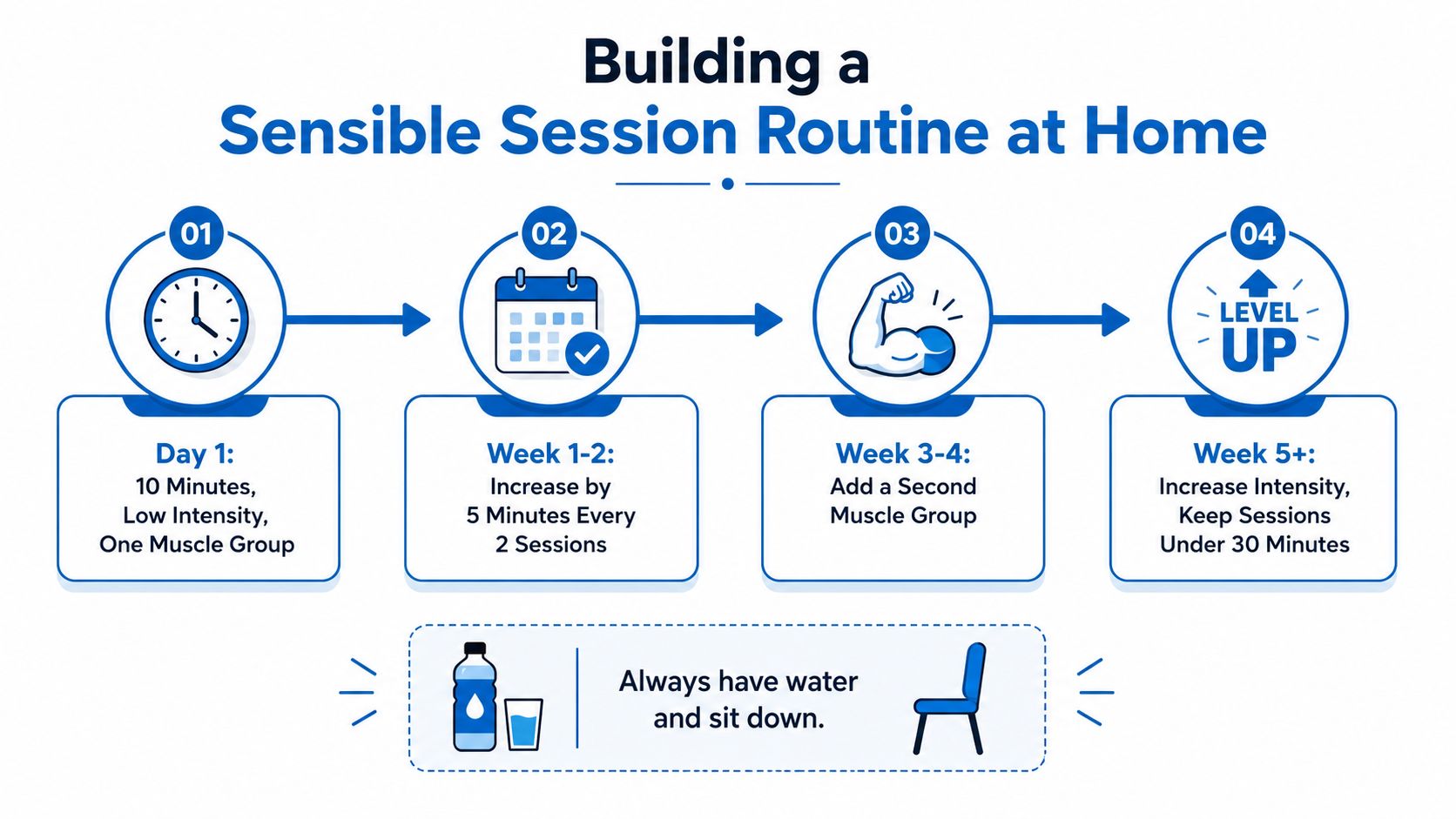
A sensible progression looks like this:
- Weeks one and two: Stay at a familiarisation intensity and prioritise comfort, placement, and repeatability.
- Weeks three and four: Add duration only if the earlier sessions felt controlled and your skin and muscles recovered normally.
- Weeks five to eight: Introduce more demanding intervals when the device and your health profile make that appropriate.
The exact progression depends on the device and purpose. TENS may be used across a pain flare, while NMES dosing should follow the rehabilitation plan. Fitness-oriented EMS may use intervals because repeated contractions create a changing demand, but that still doesn't make every interval programme equivalent to running or cycling.
The HSE's activity guidance supports starting with 10-minute sessions and building towards longer daily activity. HSE advice on activity with a health condition The broader lesson is useful even when the device differs: make the routine easy enough to repeat, then progress deliberately.
Session design matters more than an impressive sticker price. A basic device used consistently for the right purpose can be more useful than a complex machine whose sensation, controls, or safety instructions make regular use unlikely.
Safety, Contraindications, and the Evidence Behind the Claims
A useful claim needs a matching outcome. TENS for temporary pain relief has an established role in pain-management guidance. NMES for muscle activation and preservation during rehabilitation has supportive evidence, although results vary with the person and protocol. Whole-body EMS for cardio or VO2max improvement makes a broader claim. It requires device-specific measurements, not merely proof that a muscle contracts. A machine can create a strong sensation without delivering the cardiovascular effect you want.
Safety begins with the current's path through the body. TENS guidance advises avoiding the neck, eyes, and chest, and using stimulation only on healthy skin with normal sensation. Extra care is needed with pacemakers and epilepsy because current spread may affect cardiac or neurological function. NHS guidance also advises against using TENS in the bath, shower, or while driving, and recommends clinical advice when the cause of pain is unclear. NHS TENS safety advice
Pregnancy, implanted cardiac devices, epilepsy, active malignancy in the stimulation field, and uncontrolled cardiac conditions call for avoidance or individual assessment, depending on the device and intended application. Damaged skin and reduced sensation alter the risk because you may not notice irritation or excessive intensity. Peripheral vascular disease may also require assessment by a clinician.
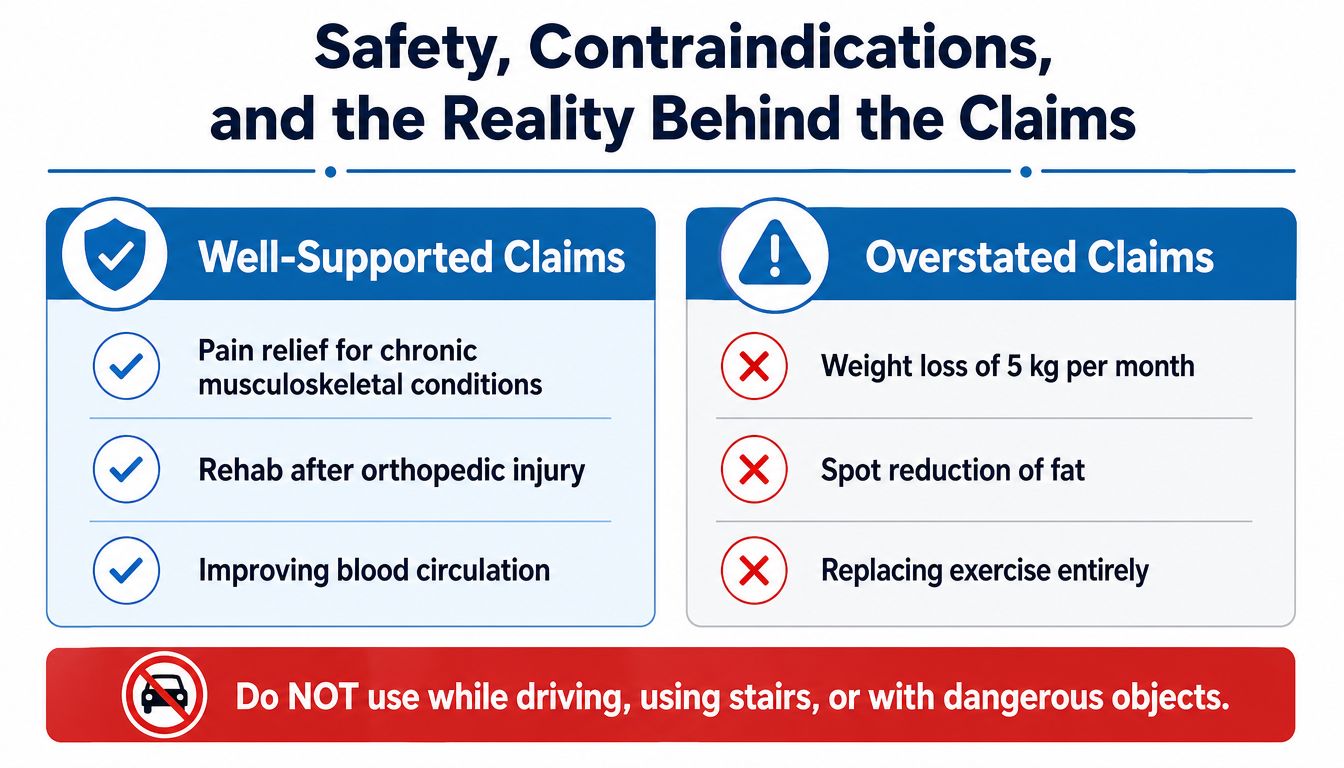
Pain relief and cardio claims should be judged separately. For an example of how TENS is discussed for a specific complaint, see this guide to TENS for back pain. An electrical stimulation machine may increase energy expenditure, but weight loss still depends on overall energy balance, including diet. No responsible claim can guarantee a particular result, promise spot reduction, or present stimulation as a complete replacement for aerobic exercise, strength training, or rehabilitation.
For condition-related use, keep the medical boundary clear:
Anybody with a serious medical condition or injury should consult with their medical practitioner before starting any new exercise program.
BionicGym is a way to exercise. It is not a medical treatment. Consult your doctor if you have a serious condition.
For people managing diabetes, Diabetes Ireland recommends 30 minutes of moderate activity on 5 days a week, with sessions divisible into 10 to 15 minute periods, plus strength, endurance, and balance work on two or more days weekly. It also advises checking blood glucose before, during, and after exercise, and not exercising when glucose is above 14 mmol/L with ketones. Diabetes Ireland physical-activity guidance Exercise can support a care plan, but it does not replace medical advice.
What to Take Away Before You Buy
Use a goal-first filter.
Persistent pain points towards TENS, provided the cause is understood and the safety instructions fit your circumstances. Post-injury weakness, difficulty activating a muscle, or concern about disuse points towards NMES, usually alongside a clinician-designed rehabilitation plan. Limited time, a need for low-impact movement, or interest in a wearable cardio stimulus points towards a whole-body EMS system, but only when the product can support its physiological claims with relevant measurements.
Then check the essentials:
- Regulatory status: Look for FDA-cleared or appropriate regional regulatory language, and read the intended use.
- Evidence fit: Confirm that the evidence addresses pain, rehabilitation, muscle activation, energy expenditure, or cardio, depending on your goal.
- Practical ownership: Check replaceable pads or wraps, lead quality, battery life, warranty coverage, and app support.
- Routine compatibility: Choose controls and session formats you'll realistically use at home, at a desk, or during safe household tasks.
- Medical screening: If you have a serious condition or injury, speak with your medical practitioner first.
Ireland's public-health guidance gives movement a central role. The HSE points adults towards 2 hours and 30 minutes of moderate-intensity activity weekly, while Diabetes Ireland combines aerobic activity with strength, endurance, and balance work. These benchmarks are useful because they keep expectations grounded in an overall movement routine rather than a single gadget.
The decision rule is simple: match the device category to the physiological outcome you're chasing, verify the regulatory claim, and treat electrical stimulation as a supplement to movement and medical care, not a substitute. From there, choose a supervised trial, discuss the options with a clinician, or compare a product's buying criteria before paying.
If you're exploring a wearable electrical stimulation machine for low-impact cardio, review what BionicGym offers and compare its intended exercise use with your own goal. Start with a safe trial session, track how your body responds, and build consistency rather than chasing the strongest setting on day one.