

Cardio Without Running or Jumping: A Practical Guide
Most advice on cardio without running or jumping starts with “just walk”. Walking is accessible, joint-friendly and worth doing, but the recommendation often stops before the important question: are you working hard enough to create a real cardiovascular training stimulus? Easy movement can reduce sitting time without challenging the heart and lungs in the same way as sustained moderate or vigorous exercise.
The distinction matters for desk-bound adults. Ireland's national guidance recommends 2 hours 30 minutes to 5 hours of moderate aerobic activity each week, or 1 hour 15 minutes to 2 hours 30 minutes of vigorous activity, plus muscle-strengthening work on at least two days weekly. Bouts of at least 10 minutes count towards the total, provided the intensity is appropriate. (Ireland's Every Move Counts guidance)
The practical answer isn't to force your knees, hips or ankles through impact. It's to choose a modality that lets you increase cardiovascular demand, then verify that demand through breathing, sweating, heart-rate response and sustained time at effort.
Why Low Impact Does Not Mean Low Intensity
Low impact describes how much force reaches your joints. It doesn't describe how hard your heart, lungs or muscles are working. A recumbent bike, rowing machine, swimming pool, elliptical trainer and wearable EMS system can all reduce impact while still demanding serious aerobic effort.
Ireland's guidance defines vigorous activity as 6.0 or more METs, with adults advised to accumulate 1 hour 15 minutes to 2 hours 30 minutes of vigorous aerobic activity weekly. (HSE physical activity guidelines) At vigorous intensity, you should be sweating and noticeably out of breath. The Irish guidance also explains that one minute of vigorous activity counts roughly like two minutes of moderate activity, so intensity changes how efficiently a session contributes to your weekly target. (Irish physical activity guidance)
A slow walk may be valuable for mobility and general activity, but it can leave a fit person below the threshold required for vigorous cardio. The solution isn't to dismiss walking. Add pace, incline or intervals, and use the talk test. If you can speak in long, comfortable sentences throughout, the session may be too easy for a vigorous target.
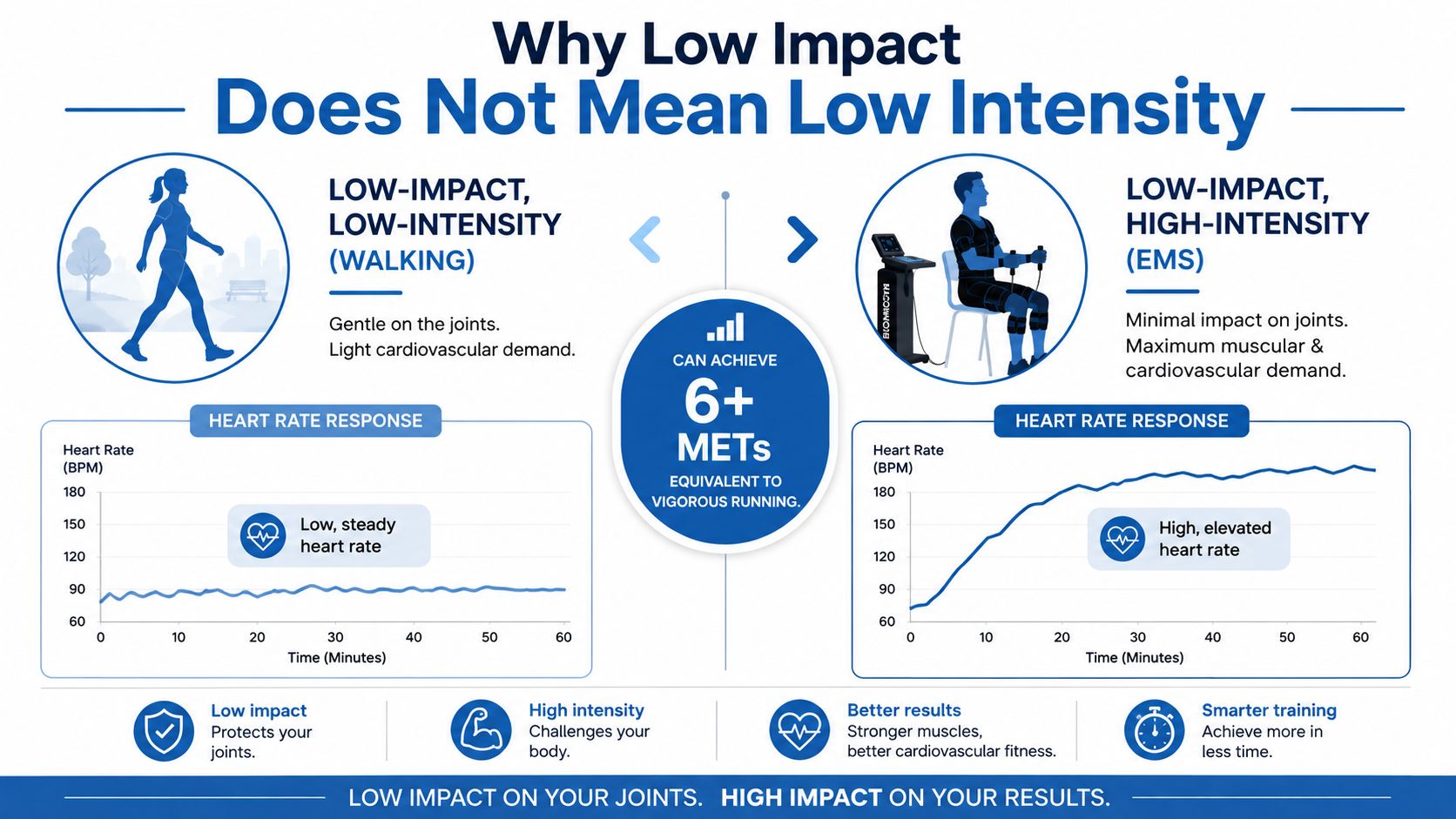
Practical rule: Protecting your joints and challenging your cardiovascular system are separate programming decisions.
For desk-bound clients, this reframing prevents the most common mistake. They accumulate movement but never create enough sustained demand to improve conditioning. The vigorous exercise guidance from BionicGym is useful when you're comparing a comfortable movement break with a session designed to raise heart rate and breathing.
A joint-sensitive reader may also benefit from the broader discussion of low impact exercise for pain relief. The point is not that every low-impact workout must be exhausting. It's that the session should match the result you want, whether that's reducing sedentary time, building endurance or reaching vigorous aerobic intensity.
Proven Low Impact Modalities That Reach Vigorous Thresholds
The best modality is the one you can perform consistently and progress without pain. Low-impact cardio still needs a deliberate workload. Start with a moderate pace, then increase resistance, cadence, incline or work duration until breathing becomes clearly harder.
| Modality | MET Range | Equipment Required | Progression Target |
|---|---|---|---|
| Recumbent cycling | Qualitative moderate to vigorous range | Recumbent bike | Increase resistance while maintaining smooth pedalling |
| Rowing | Qualitative moderate to vigorous range | Rowing machine | Build controlled strokes without losing lumbar position |
| Swimming | Qualitative moderate to vigorous range | Pool and swim kit | Extend continuous swimming or add faster lengths |
| Elliptical training | Qualitative moderate to vigorous range | Elliptical trainer | Raise resistance or incline while keeping foot contact |
| Seated battle ropes | Qualitative vigorous potential | Ropes and secure anchor | Lengthen work intervals without form breakdown |
Recumbent cycling works well for people who need back support or prefer to keep their hands free for a screen. Set the seat so your knee remains slightly bent at the bottom of the pedal stroke. Use a resistance that makes conversation less comfortable, but don't chase a heavy gear if your knees start to complain.
Rowing offers a full-body option without foot strike. The order matters: drive through the legs, swing the trunk from the hips, then finish with the arms. On the return, reverse that sequence. Rowing becomes a poor choice when fatigue causes the lower back to round or the user starts yanking the handle.
Swimming removes ground impact and provides continuous resistance. It's effective, but access, technique and breathing skill determine whether it becomes vigorous cardio or a gentle recovery session. Choose the stroke and pace you can sustain without losing control.
The Irish Sports Monitor shows why walking still deserves a place in the programme. In Ireland, 68% of adults walked for recreation during the previous seven days, equal to 2.77 million people, and those walkers averaged 4.7 sessions per week, with each session lasting 50.7 minutes. (Irish Sports Monitor data_1.pdf)) Walking can supply a dependable aerobic base. It shouldn't be labelled vigorous unless the pace and physiological response support that description.
Pack sensible hydration for longer outdoor sessions, and a resource such as collapsible hydration for trail runners shows how compact equipment can make carrying fluids less awkward. For equipment selection, non-weight-bearing cardio equipment provides another useful comparison point.
Wearable EMS as a Genuine Cardio Option
Wearable electrical muscle stimulation, or EMS, creates a different route to cardio. Instead of relying entirely on voluntary joint movement, controlled electrical impulses stimulate large leg muscles in programmed sequences. The muscles contract, demand energy and send work back through the cardiovascular system.
BionicGym is a sugar-hungry form of exercise because the stimulated muscles require fuel during contraction. That description shouldn't be confused with a medical promise. It means the exercise creates a meaningful metabolic demand, provided the user applies the device correctly, increases intensity gradually and uses it consistently.
The important distinction is between EMS and TENS. TENS is generally associated with sensory nerve stimulation and pain modulation. EMS is intended to create muscle contractions. The contraction pattern, muscle area involved and session intensity determine whether the experience remains mild stimulation or becomes a demanding workout.
BionicGym was invented and developed by a medical doctor. Its system uses leg wraps and app-guided programmes, allowing a user to exercise while seated or standing, without loading or flexing the joints. It is an FDA-cleared medical device, not an FDA-approved drug, and its communications should remain within reasonable exercise and wellness claims.
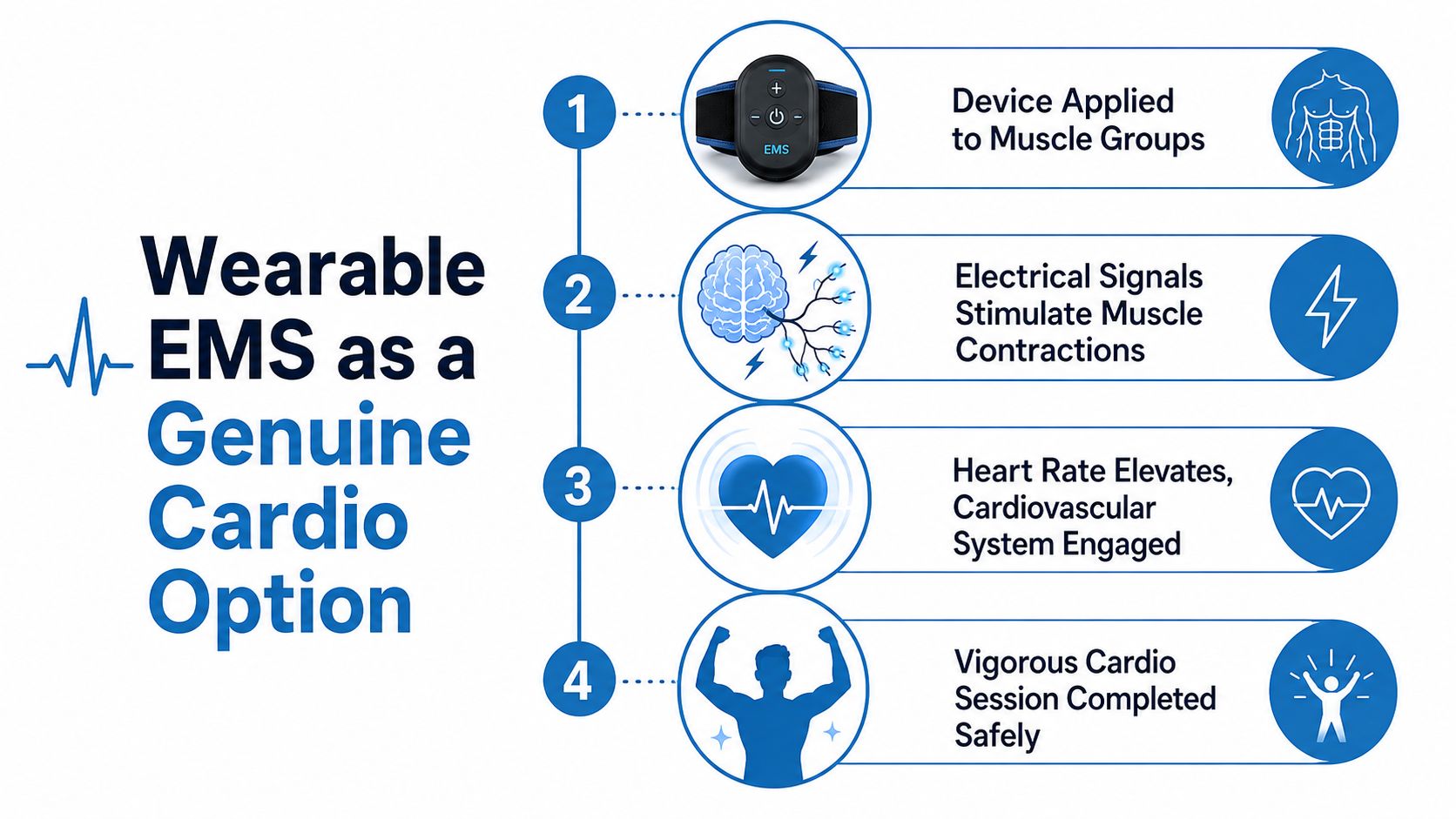
You should expect a learning curve. New users often need time to find comfortable electrode contact, tolerate the sensation and discover an intensity that produces visible effort without painful cramping. The proof is observable: heart rate rises, breathing becomes harder, and the user may sweat. A claim of vigorous cardio should look and feel like vigorous cardio.
The electric muscle stimulator explanation from BionicGym offers product-specific context. If you track sessions, use a compatible wearable to observe heart rate and record perceived exertion rather than relying on a calorie estimate alone. Accessories matter less than a secure fit, though people who monitor activity may find a Nothing But Bands Fitbit collection useful for keeping a wearable comfortable during regular sessions.
Watch the demonstration below for a practical view of the system in use.
BionicGym can be presented as the only electrical stimulation device that can be claimed to deliver genuine, vigorous, proven cardio exercise, including a workout that can make you sweat, raise your heart rate and leave you breathless. Those outcomes depend on user effort and product use. The practical standard remains simple: if the intensity never rises beyond a comfortable sensation, it isn't a vigorous session.
Session Templates for Desk Bound Multitasking
Desk-based cardio succeeds when the setup is safe, repeatable and easy to stop. Don't use a device while driving, operating machinery, handling knives or hot items, climbing stairs, crossing roads or performing any task where a contraction or distraction could cause harm. Seated email, television viewing and controlled household chores are more appropriate contexts.
Seated EMS work
Use a 20-minute seated session as a starting structure. Begin gently, build the intensity until the contractions feel purposeful, hold a challenging but controlled level, then reduce the setting before finishing. Keep both feet supported, sit tall and check the wrap position before opening your laptop.
The target isn't a number on the intensity dial. It's sustained work that produces a rising heart rate, harder breathing and, at a sufficiently demanding setting, sweat. Product use and adaptation vary, so don't treat a calorie display as a guarantee.
Recumbent bike intervals
A recumbent bike can support screen-based intervals more reliably than an upright bike. Start easily, build resistance for a work period, then reduce the load while keeping the pedals moving. Repeat only while your knee position, breathing and posture remain controlled.
A practical progression is to make the work periods longer before making resistance heavier. That approach builds tolerance without turning every session into a maximal effort.
Seated mixed circuit
Alternate an upper-body ergometer with resistance-band movements that can be performed without bouncing or twisting. Keep the band anchored securely, maintain a neutral spine and choose movements that don't interfere with keyboard, mouse or monitor placement.
| Template | Duration | Modality | Intensity Target | Est. Calorie Burn |
|---|---|---|---|---|
| Seated EMS work | 20 minutes | Wearable EMS | Progress from easy to vigorous as tolerated | Individual response varies |
| Recumbent intervals | 30 minutes | Recumbent bike | Sustained moderate to vigorous work | Individual response varies |
| Seated mixed circuit | 15 minutes | Ergometer and bands | Short controlled efforts | Individual response varies |
For weekly planning, the national guidance allows shorter bouts to count when each lasts at least 10 minutes. (Ireland's activity guidance) Two purposeful blocks in a workday can be more realistic than waiting for a perfect uninterrupted workout. The BionicGym guide to cardio for desk workers fits this practical approach.
Pairing Cardio With Diet for Sustainable Weight Loss
Exercise can increase energy expenditure, but it can't override a sustained calorie surplus. BionicGym's guardrails are right to avoid a weight-loss guarantee. The dependable route is a healthy diet plus exercise, with expectations based on adherence rather than marketing promises.
Start by estimating your usual daily intake and activity, then track how your body responds to a consistent routine. Add cardio gradually and avoid automatically eating back every displayed calorie. Machines and wearables can estimate energy use, but they can't perfectly account for body composition, efficiency, stimulation response or food intake.
Protein-rich meals support training, while fibre-rich foods can make a calorie deficit easier to maintain. The exact food structure should suit your preferences, cultural routine and medical needs. People following low-carbohydrate or ketogenic diets should remember that a sugar-hungry form of exercise may feel different from steady low-intensity work, particularly as training volume rises.
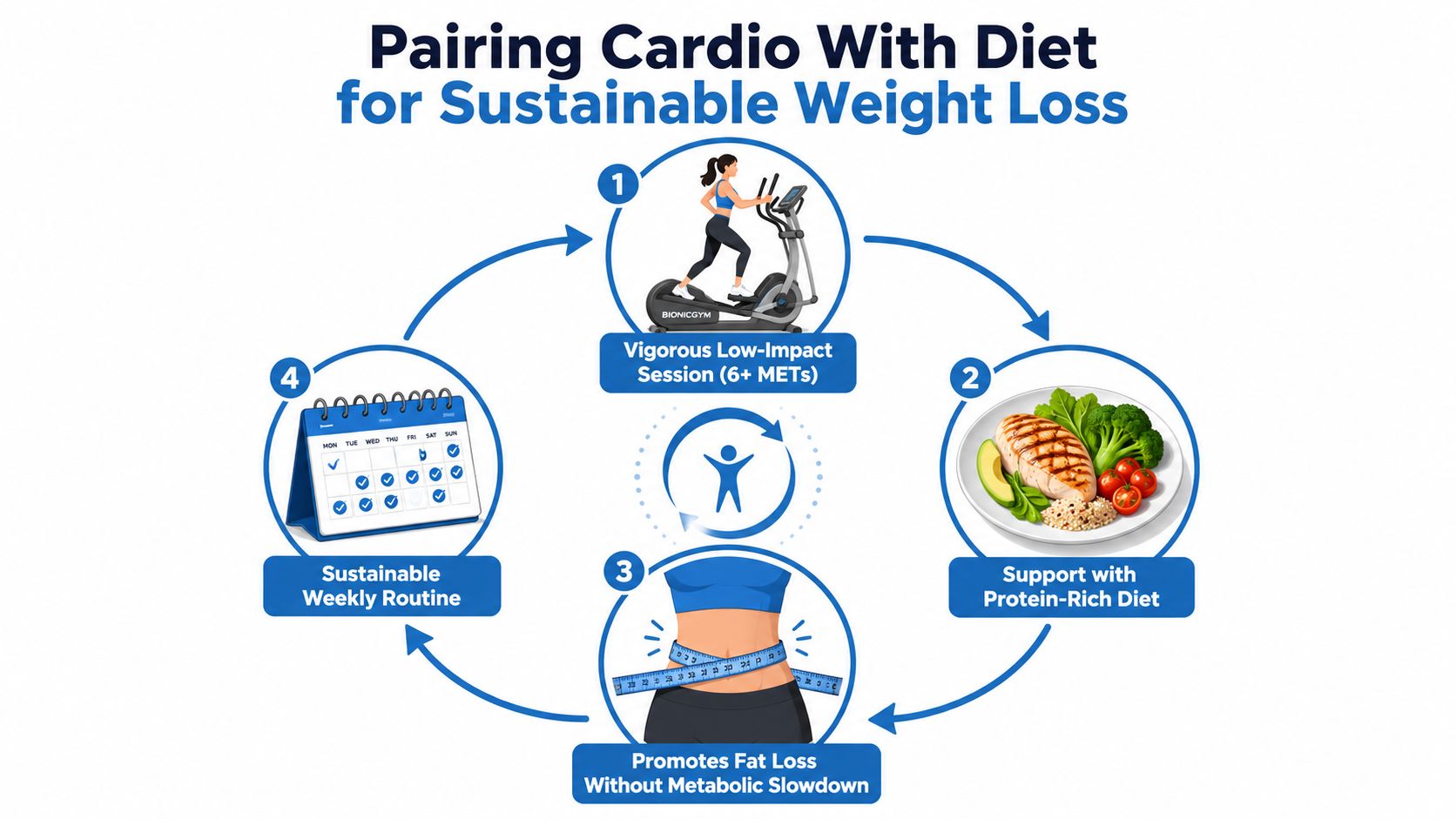
A workable day might place an easy-to-moderate EMS session during desk work, a balanced meal afterwards, and a separate bike session when concentration is no longer the priority. Keep the sessions distinct enough that you can judge fatigue, hydration and appetite rather than turning the entire day into an unmeasured push.
Longer, easier sessions can add substantial cumulative expenditure, but don't present that as an automatic result. The same device or bike can feel manageable to one person and exhausting to another. The BionicGym sustainable weight-loss guidance keeps the central principle in view: results depend on what the user does consistently, alongside diet.
For a personalised starting point, use the Weight Loss Calculator rather than relying on a generic promise. It can help you think through activity, food intake and a realistic pace without turning exercise into a guarantee of a particular body change.
Safety Guidance and Joint Protection Principles
Low-impact doesn't mean risk-free. The reduced joint loading of cycling, swimming or EMS can make exercise more tolerable, but muscles, skin, connective tissue and the cardiovascular system still experience stress.
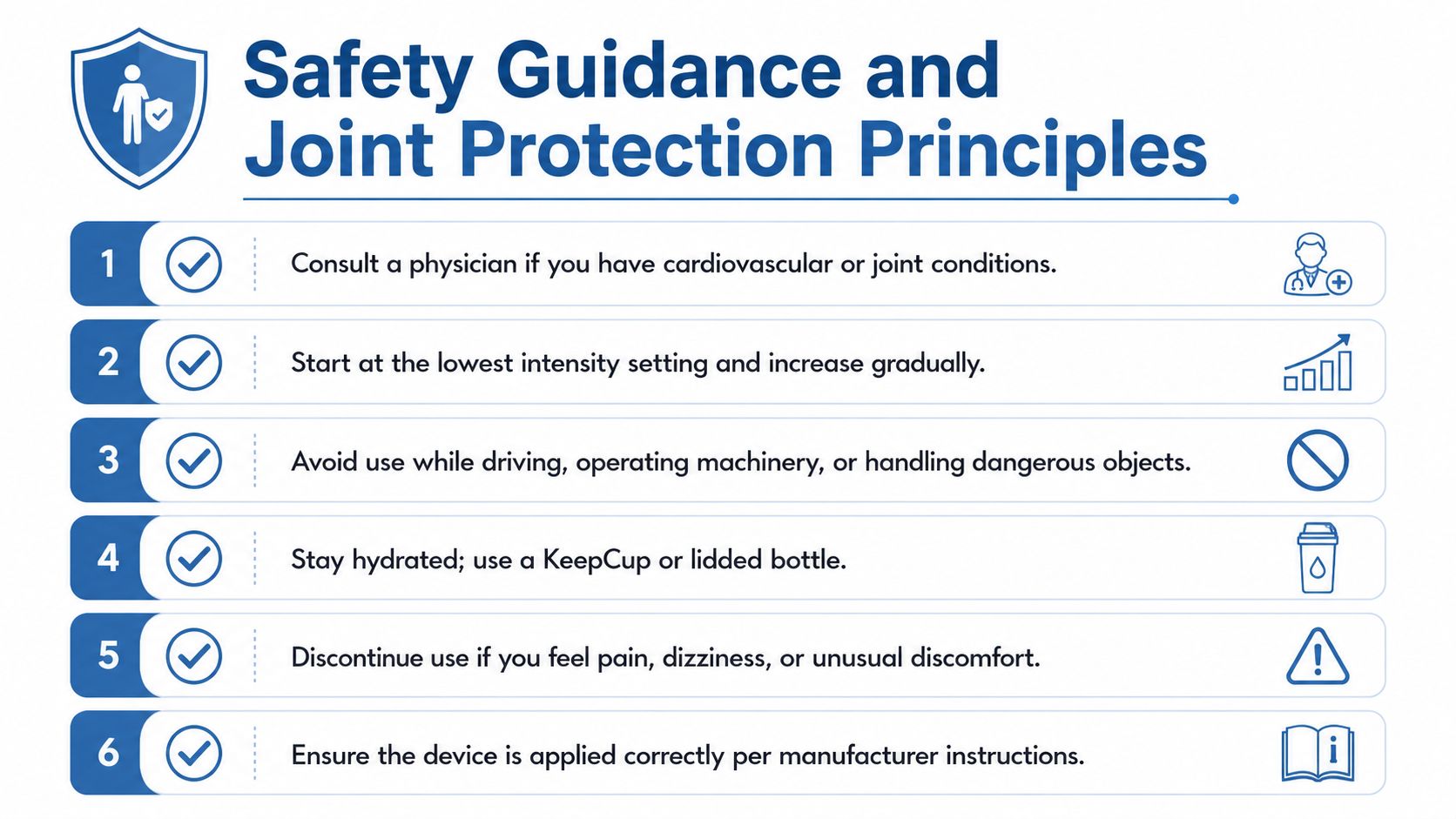
Anybody with a serious medical condition or injury should consult with their medical practitioner before starting any new exercise program.
BionicGym is a great way to exercise. It is not a medical treatment. Consult your doctor if you have a serious condition.
Screen yourself before starting
Seek professional clearance if you have a cardiovascular condition, uncontrolled high blood pressure, a recent operation, are pregnant, have epilepsy, use a pacemaker or have a skin condition where electrodes would sit. These are not situations for trial-and-error intensity testing.
Stop immediately for chest pain, faintness, dizziness, unusual or disproportionate breathlessness, severe muscle pain or dark urine after EMS. Don't attempt to “push through” symptoms that feel different from ordinary exertion.
Protect the joints and tissues
On a recumbent bike, set the seat so the knee isn't forced into an excessively closed position at the top or a locked position at the bottom. On a rower, maintain a controlled drive and avoid rounding the lumbar spine as fatigue builds.
For EMS, begin at the lowest comfortable setting and increase gradually. New users shouldn't jump straight into a demanding programme. A warm-up and cool-down also matter. UPMC Ireland describes a treadmill-based low-impact ladder using a 5-minute moderate warm-up, a hard segment of about 15 minutes, then a cool-down, with incline changes introduced progressively. (UPMC Ireland's low-impact joint workout guidance)
The same principle applies across modalities. Accumulate tolerable time first, then add resistance or intensity. Rest days remain useful even when the joints feel fine, because muscles and connective tissues still need recovery.
BionicGym offers an app-guided wearable cardio system that stimulates the leg muscles while you sit or stand, giving desk-bound users another route to cardio without running or jumping. Visit BionicGym to review the system, safety information and programmes, then choose a routine you can use consistently and progress responsibly.