

Athletic Conditioning Explained from VO2max to Daily Plans
Athletic conditioning looks like hard work from the outside, but the advantage is quieter. The best programmes don't just make people tired, they make the body better at producing, tolerating, and recovering from effort, which is why conditioning has always been more than a sweat session on a machine. That idea has a long pedigree, from the first formal exercise physiology laboratory in the United States at Harvard in 1891 to amateur weightlifting becoming a sanctioned Olympic event in 1896, when strength work moved from spectacle into organised sport science (historical review).
What changed over time is just as important as what stayed the same. As conditioning research expanded, it became a measurable field rather than a coaching hunch, and that shift still shapes how coaches in Ireland and across Europe think about training blocks, repeated testing, and progressive overload (historical review). For women, elite sport also opened up across the 20th century in a way that changed training standards, support systems, and performance expectations (sports medicine review).
What Athletic Conditioning Really Means
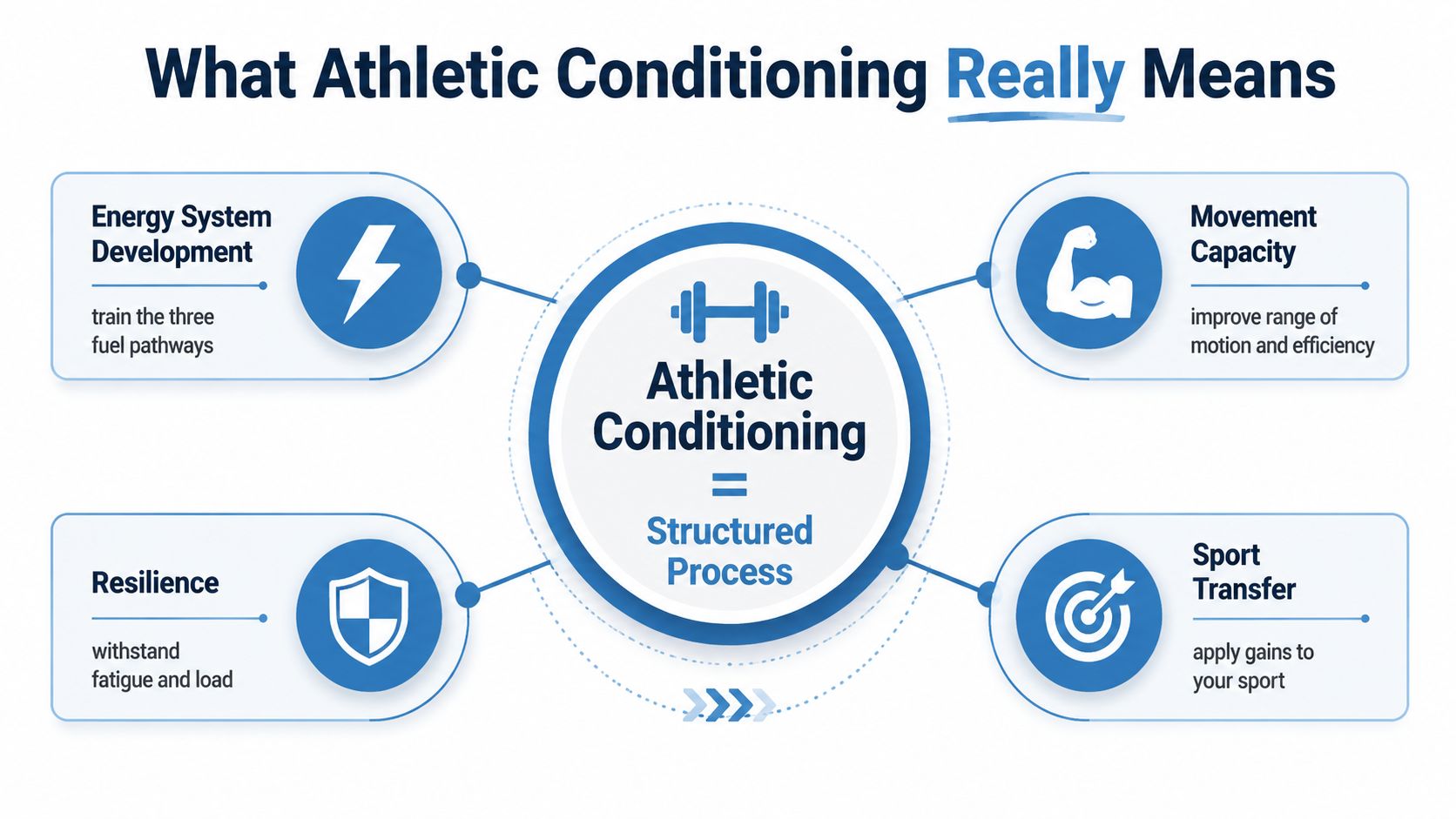
Athletic conditioning is a structured process, not a mood, a vibe, or a punishment session. It's the organised development of the systems that let a person perform, recover, and repeat that performance, whether the goal is a rugby match, a long cycle commute, or just getting through a workday without feeling flattened. If fitness is the dashboard light, conditioning is the engine, gearbox, and tyres working together.
The car analogy that actually helps
Think of the body like a vehicle. The engine is your energy systems, the gearbox is how efficiently you shift between intensities, and the tyres are your movement capacity and resilience, the parts that keep you connected to the ground without wasting energy. A polished-looking car still won't go far if the engine overheats, the gears stick, or the tyres can't grip, and the same is true for an athlete who looks fit but gasses out quickly or breaks down under repeated load.
That's why conditioning is not the same thing as weight loss, and it isn't the same as just “doing cardio”. A person can lose body mass without improving how well they tolerate training, and they can do endless treadmill sessions without building much sport transfer if the work isn't designed well. Good conditioning is the match between the stress you apply and the adaptation you want.
The reason modern programming feels so systematic is that the field grew up that way. In the historical review of strength-training research, 339 published studies were identified between 1894 and 1979, involving 14,575 subjects, with 10,350 undergoing training (historical review). The same review found that 90.3% of those studies were experimental, 55.3% lasted 4 to 8 weeks, and 39.2% used 3 training days per week (historical review). That's the early shape of modern conditioning, fixed blocks, repeated measurement, and a plan that can be adjusted.
Practical rule: if a conditioning plan can't be described in terms of what it changes, how often it changes, and how the athlete responds, it's probably just exercise with better branding.
A good definition helps because it cuts through confusion. Conditioning is a trainable system with inputs, outputs, and trade-offs, and the rest of the article breaks that system into the physiology, the planning, the monitoring, and the low-impact options that make it usable for real people.
The Physiology Behind Better Conditioning
The body doesn't use one fuel lane for every effort. It switches between three broad energy systems, and the art of conditioning is choosing which one to stress, when to stress it, and how much recovery it needs before the next dose. That's why two sessions that feel equally hard can produce very different adaptations.
Three systems, one athlete
The phosphocreatine system handles immediate, explosive work. The glycolytic system covers hard efforts that last beyond that first burst, and the oxidative system is the long-haul pathway that supports sustained aerobic work. For most conditioning goals, the oxidative system matters most because that's where VO2max lives, and VO2max is the gold-standard measure of how much oxygen the body can use during intense exercise (performance monitoring overview).
That matters because conditioning isn't only about how hard a session feels. Two people can do the same workout and produce very different internal responses depending on fatigue, heat, sleep, or fitness status (training load article). The visible workout is the prescription, but the internal load is the actual stimulus.
The same is true for RER, the respiratory exchange ratio, which is one way to see whether a body is leaning more towards carbohydrate or fat use during exercise. Lactate belongs in that same conversation, but not as a villain. It's a signal that the body is working hard and adapting, which is why trained athletes and coaches pay attention to it instead of treating it as useless waste.
A quick way to put this into perspective is to use a calculator that estimates aerobic capacity and then compare that with how you feel in session. A resource like thecalcs vo2 max calculator can help people understand the concept, even though it doesn't replace a proper field or lab test. For a practical training example, a simple progression that improves aerobic output without needing running is outlined in this guide on increasing VO2max without running.
What the signals tell you
- VO2max: tells you the ceiling for aerobic work.
- RER trends: hint at which fuel the body is leaning on during a session.
- Lactate behaviour: shows how hard the body is being pushed and how it's coping.
- Recovery markers: tell you whether the system is adapting or getting buried.
A session can feel brutal and still be poorly targeted. The useful question is not “Was I wrecked?”, it's “What did this stress change?”
That's the physiologic layer that coaches try to influence. Once you understand it, training plans stop looking like random punishment and start looking like controlled experiments.
Designing a Progressive Conditioning Plan
Good conditioning plans usually look boring on paper. They repeat on purpose, and that repetition is what lets the body adapt instead of just surviving the day. The design logic is simple, even if the details get messy.
Build stress, then recover, then adapt
A macro-cycle covers the big picture, often a season or longer. A meso-cycle is a shorter block, often around a month or so in practical use, where the focus narrows. A micro-cycle is the weekly rhythm where the actual stress and recovery are placed with intent. The point isn't to chase novelty, it's to place enough strain on the system that recovery produces change.
That's where progressive overload matters. The body adapts when it gets a challenge it can recover from, and it stalls when the challenge is either too small or so big that recovery never catches up. The classic FITT logic, frequency, intensity, time, and type, is still useful because it forces you to ask whether the plan matches the goal rather than the equipment you happen to own.
Internal load makes that process honest. Coaches don't just look at what was written on the sheet, they look at how the athlete responded.
| Common Internal Load Monitoring Tools | What It Measures | Best Use Case |
|---|---|---|
| sRPE | Session effort relative to duration | Quick daily check after any workout |
| Heart-rate indices | Cardiovascular strain during work | Comparing sessions and spotting drift |
| TRIMP | Training impulse from heart-rate load | Tracking accumulated weekly stress |
| Lactate | Metabolic response to intensity | Calibrating hard intervals or threshold work |
| HRV | Autonomic recovery status | Reading readiness across the week |
| Heart-rate recovery | How fast the system settles after effort | Simple field check for fatigue and adaptation |
The useful link between load and outcome is the athlete's response, not the ego attached to the workout. If a week of planned work leaves the athlete flat, slow, and poorly recovered, the plan was too dense. If it feels easy and changes nothing, the dose was too small.
For people who care about body composition as part of the picture, conditioning still sits beside food intake, not above it. A solid explanation of evidence-based nutrition for fat loss is useful because conditioning and diet have to work together if the goal is a meaningful energy deficit, not just more activity.
A useful way to think about it is this. The best plans don't look heroic on a spreadsheet, they look repeatable, and the adaptation shows up later in the training log, the recovery trend, and the performance output.
Coach's note: if the weekly schedule leaves no room for recovery, it isn't disciplined, it's just crowded.
For a closer look at how stress should be added and then absorbed, this progressive overload guide fits neatly with the logic here.
Sport-Specific and Low-Impact Conditioning Templates
The right conditioning template depends on the task, not the fashion. Endurance athletes, power athletes, and team-sport athletes all need different mixtures of intensity, duration, and recovery, and people with joint limits need a separate track entirely rather than a watered-down version of someone else's plan.
Different goals, different stress
Endurance athletes usually spend more time in aerobic work, including steady blocks and tempo efforts that teach the body to keep output stable. Power athletes need short, intense intervals with enough recovery to preserve quality. Team-sport athletes sit in the middle, they need aerobic base, repeated sprint ability, and the ability to keep decision-making sharp while tired.
A 2023 systematic review in the Journal of Strength & Conditioning Research found that strength-and-conditioning interventions reduced sprint times by 0.03 to 0.41 seconds across studies, with an average improvement of 3 to 4%, and the largest effects often came from resistance training (JSCR review). That doesn't mean every athlete needs the same lift menu, it means the programme has to respect the speed and power demands of the sport.
The low-impact track most people ignore
Cycling, swimming, rowing, and the elliptical are obvious low-impact choices. What often gets missed is that low-impact doesn't mean low-value, it means the joints get a break while the cardiovascular system still works. That's especially important for desk-bound users, injured athletes, or anyone whose body won't tolerate pounding.
A separate option is EMS-based work, where electrical stimulation recruits large muscle groups without the same joint loading you'd get from running or jumping. A practical way to understand high-intensity functional conditioning is through heart-rate response, because even short sessions can push cardiovascular strain very high. In one review, short sessions were reported around 92.7% ± 4% of HRmax, and 15-minute sessions around 91.3% ± 3% of HRmax (BMJ Open Sport & Exercise Medicine review).
A useful comparison is simple:
- Endurance emphasis: long aerobic blocks, steady rhythm, lower impact.
- Power emphasis: short bursts, long rests, quality over fatigue.
- Team-sport emphasis: repeat sprint work, mixed demands, faster recovery.
- Low-impact emphasis: keep the heart working while protecting the joints.
The YouTube example below is a useful visual reference for conditioning drills and how work patterns can be organised in practice.
For a broader look at how low-impact, no-travel conditioning can fit into a week, this low-impact HIIT alternative guide is a relevant companion to the sport-specific templates above.
Measuring Progress Beyond the Scale
The scale is useful, but it's a bad boss. It tells you body mass at a moment in time, not whether your conditioning is improving, your recovery is holding up, or your aerobic system is adapting. For conditioning, the cleaner signals are the ones tied to performance and recovery.
Track response, not just body weight
Heart-rate measures give you a lot more context than the bathroom scale ever will. Resting heart rate, heart-rate recovery, and HRV can show whether the body is coping with repeated sessions or accumulating fatigue. If a person's weekly work is sensible, these markers should usually stabilise or improve over time, even when the scale barely moves.
That's why a simple monitoring stack often works best. Use a chest strap or a reliable optical sensor for heart rate, log a 1 to 10 RPE after sessions, and take a weekly HRV reading at roughly the same time and under similar conditions. Then use the occasional VO2max or RER test in a clinic or lab to calibrate what the numbers mean in real life.
A good resource for the basics of fitness monitoring is this guide to cardiovascular fitness measurement, because the goal isn't to drown in data. The goal is to get enough feedback to adjust the next week intelligently.
A simple week to week read
If resting heart rate is drifting down, HRV is stable, and sessions feel manageable at the same workload, the athlete is probably recovering well. If RPE is rising while the work stays the same, or heart rate stays high longer than usual, that's a sign the current dose may be too dense. You don't need a lab to notice that pattern, you just need to look at the same few signals consistently.
Use the smallest useful dataset. If you can't act on the number, don't track it.
For a product example of how progress metrics are presented in a wearable-friendly format, this performance metrics resource shows why simplicity often beats a wall of charts.
The point of monitoring is programming. If the numbers don't change what you do next week, they're just decoration.
Fitting Conditioning Into a Modern, Multitasking Life
The biggest conditioning gap for many adults isn't effort, it's integration. People already know they should move more, but their day is full of meetings, caregiving, commutes, and screen time, so the question becomes whether legitimate aerobic work can fit into ordinary life without pretending that time magically appears.
Conditioning can happen while life is happening
The answer is yes, provided the dose and safety are right. EMS-based systems like BionicGym use electrical muscle stimulation to contract large lower-body muscle groups while mimicking the body's shivering response, which can raise heart rate, make users sweat, and create a real conditioning stimulus. It is FDA-cleared, not FDA approved, and it's described as a sugar-hungry form of exercise because the work leans heavily on carbohydrate use.
That matters for people who need a practical way to accumulate training minutes without sacrificing their day. Trained users typically burn around 500+ calories per hour, which fits the kind of vigorous work people need when the goal is a meaningful energy expenditure rather than a casual warm-up. Long, low-intensity sessions of 4 to 6 hours can also build very large cumulative calorie burn across a day, which is why consistency matters so much in real life.
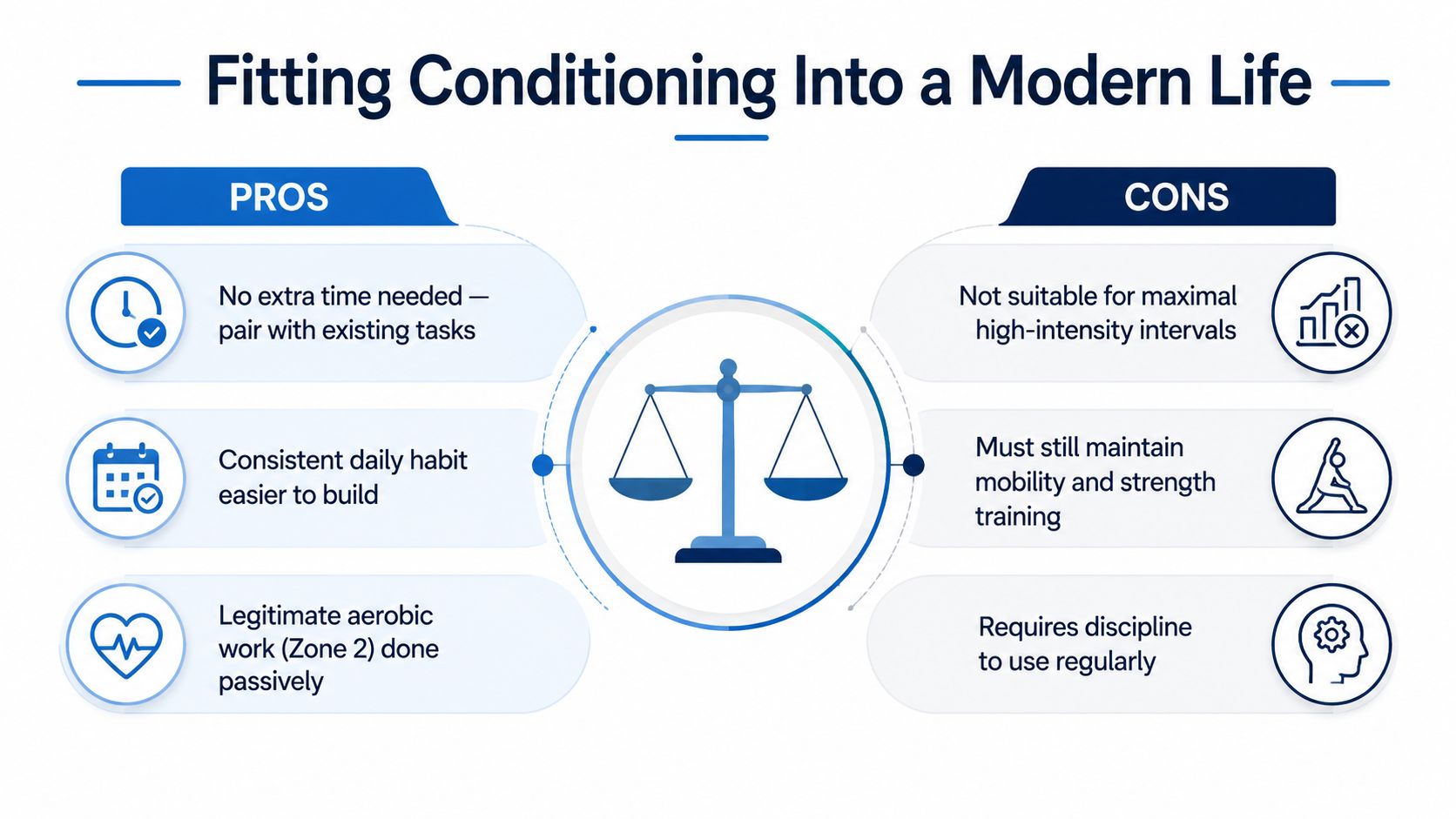
The main advantage is obvious. You can pair conditioning with desk work, TV, light chores, or other seated tasks, which makes it much easier to do something regularly instead of waiting for the perfect training window. The trade-off is also obvious. This doesn't replace every form of athletic preparation, and it still needs to sit beside mobility, strength work, and sensible recovery.
A few safety rules matter here. Do not use any conditioning setup while driving, crossing roads, going up or down stairs, or handling dangerous objects. Do use it in safer settings, such as while watching TV, answering email, or doing light household tasks.
For people who are actively trying to manage body composition, the most honest frame is still diet plus exercise. Conditioning can support the energy balance, but fat loss depends on a calorie deficit, and tools like a calculator help people personalise the plan rather than guess.
Practical use case: if someone spends most of the day seated, a low-friction conditioning option can make consistency realistic without turning exercise into a separate commute.
If you're curious about how BionicGym fits into that kind of routine, the key idea is straightforward, it lets some users do genuine aerobic work while staying at home or staying at the desk, which is a very different problem from traditional gym training.
Safety, Disclaimers and Your Weekly Conditioning Template
Safety comes first because conditioning only works when people can repeat it. BionicGym is FDA-cleared, not FDA approved, and it's an exercise device, not a medical treatment. Anybody with a serious medical condition or injury should consult with their medical practitioner before starting any new exercise program. BionicGym is a great way to exercise. It is not a medical treatment. Consult your doctor if you have a serious condition.
The usage rules are simple. Don't use it while driving, on stairs, crossing roads, or handling dangerous objects. Do use it while sitting at a desk, watching TV, browsing, or doing light chores if that's the safest way to keep the habit alive.
A weekly conditioning template can stay uncomplicated:
- One EMS-based session: a seated conditioning block that fits around work or leisure.
- One traditional cardio block: cycling, rowing, brisk walking, or another modality that suits the joints.
- One strength session: full-body work that keeps muscle and movement capacity in the plan.
- One recovery day: low stress movement, mobility, and better sleep.
If fat loss is the goal, pair that template with a healthy diet and use the Weight Loss Calculator page to estimate what a realistic deficit might look like. That's a better way to plan than hoping exercise alone will do all the work.
The final adjustment should happen at the end of each week. Look at HR trends, RPE, and HRV together, then decide whether the next block needs more volume, the same dose, or more recovery. Conditioning is a long project, not a 30-day challenge, and the people who improve most are usually the ones who keep the plan steady long enough for adaptation to show up.
If you want a conditioning option that fits a desk-bound day without pretending the body isn't working, explore BionicGym. It's built for people who want real aerobic work, measurable effort, and a way to keep training consistent when life gets crowded.